



VESA Announces Open Standards and Logo Program for Display Variable Refresh Rate Performance
 Published2022.05.04 09:59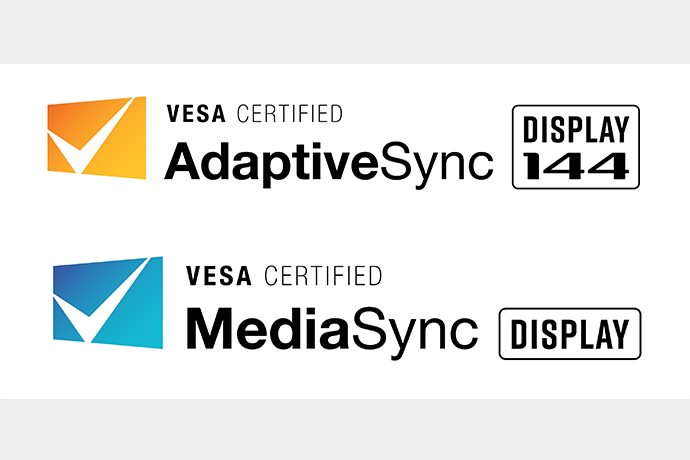
▲VESA’s AdaptiveSync Display and MediaSync Display logo programs (Image-VESA)
Logo attached upon passing DisplayPort compatibility test
While displays used in PCs and laptops support the Adaptive-Sync protocol, no open standard has been established to measure the performance or quality of Adaptive-Sync support. Accordingly, related certification programs and open standards have been established, and improvements in the user experience are expected.
The Video Electronics Standards Association (VESA) announced on the 3rd that it is releasing an open standard for the front of screen (FOS) performance of variable refresh rate (VRR) displays for the first time.
The VESA Adaptive-Sync Display CTS defines more than 50 comprehensive and stringent test criteria, automated test methodologies, and performance requirements for PC monitors and laptop displays that support VESA's Adaptive-Sync protocol.
In addition, the Adaptive-Sync Display CTS includes a product conformity logo program consisting of two grades.
AdaptiveSync Display focuses on much higher refresh rates and low latency for gaming, while MediaSync Display concerns jitter-free media playback and supports all international broadcast video formats.
Through the VESA-certified AdaptiveSync and MediaSync displays logo program, consumers can now easily compare the variable refresh rate performance of AdaptiveSync-supported displays before purchasing a product.
Only after passing both the Adaptive-Sync Display CTS and VESA DisplayPort™ compliance tests can the VESA Certified Adaptive-Sync Display or MediaSync Display logo be affixed.
■ Participation of the entire display ecosystem>
VESA’s Adaptive-Sync Display CTS and Logo program, developed after more than two years of effort, was made possible through the participation of over 20 VESA member companies that make up the display ecosystem. Companies in displays, graphics cards, CPUs, panels, display drivers, and various components all participated in creating the standards and programs.
In 2014, VESA added the Adaptive-Sync protocol to the VESA DisplayPort video interface standard, enabling the display of smoother images and reduced eye strain in games and video playback.
It displayed content at a wide range of frame rates, lowering power consumption and increasing efficiency. Since then, VESA's Adaptive-Sync technology has been widely adopted across the display industry, and currently, almost all GPU chipset companies support this technology.
While many PC and laptop displays today support the Adaptive-Sync protocol, there has not yet been an open standard to measure the performance or quality of a display's Adaptive-Sync support.
VESA’s AdaptiveSync Display and MediaSync Display logo programs are significant in that they meet precisely these needs. Through testing based on the Adaptive-Sync Display CTS, clear criteria are provided to evaluate the visual performance of variable refresh rate operation.
Jang Seok-ho, Senior Vice President of IT Development at LG Electronics, stated, “With the announcement of the VESA Adaptive-Sync display standard, we can expect greater innovation in the gaming monitor sector within the rapidly growing gaming market,” adding, “We consider it very meaningful that the LG UltraGear brand has participated in this certification program from its inception.”
■ Comprehensive evaluation of Adaptive-Sync performance
The VESA Adaptive-Sync Display CTS can perform over 50 automated display performance tests for key variables, including refresh rate, flicker, gray-to-gray response time (including overshoot and undershoot limits for achieving high quality), video frame drop, and video frame rate jitter.
All display products must be tested in factory default or factory mode configurations in accordance with the VESA Adaptive-Sync Display CTS, and the test is performed at room temperature to inspect the display under actual usage conditions.
To obtain VESA AdaptiveSync Display or MediaSync Display logo certification, you must also pass testing and certification for VESA's DisplayPort standard. Almost all desktop and laptop GPU products released in the last two years support VESA's Adaptive-Sync protocol.
VESA recommended that consumers check with their GPU vendors to see if their GPUs and software drivers support Adaptive-Sync behavior by default for VESA-certified Adaptive-Sync displays and MediaSync displays.
■ Logo program certifying optimal FOS performance
The VESA-certified AdaptiveSync Display logo indicates performance by including the maximum video frame rate achievable when AdaptiveSync operation is tested at the display product's factory default settings and native resolution. For example, it is displayed in the form of 'AdaptiveSync Display 144' or “AdaptiveSync Display 240”.
On the other hand, the VESA-certified MediaSync display logo does not display these figures. This is because the certification logo focuses on whether there is no display jitter, rather than on high frame rates. Display companies wishing to participate in the VESA-certified AdaptiveSync or MediaSync display logo program can send their products to any VESA authorized testing center (ATC) for testing.
Roland Wooster, Chairman of the VESA Display Performance Metrics Task Group, explained, “The Adaptive-Sync Display CTS is the result of what VESA has built since announcing the Adaptive-Sync protocol eight years ago, providing an open standard that spans the entire industry regardless of brand. Through the LOGO program, it enables consumers to verify whether the display they purchase for gaming or media playback meets specified FOS performance requirements when used with a suitable GPU.”
He stated, “To develop this test standard and logo program, VESA raised the standards for performance conditions and test methodologies to be stricter than existing standards and logo programs,” adding, “We will continue to develop and improve the Adaptive-Sync Display CTS to develop new displays, meet market demands, provide better visual quality to consumers, and offer a better user experience.”
More information about the Adaptive-Sync CTS and the VESA-certified AdaptiveSync logo program can be found at https://www.adaptivesync.org/ .

Comments
Related news
VESA Announces eDP Standard Version 1.5
VESA (Video Electronics Standards Association) has announced a new version of the eDP standard with added features and protocols including enhanced Adaptive Sync support, which is expected to enable improved power optimization for display devices.
2021.11.05by 강정규 기자
Supports VESA and DisplayPort UHBR certifications
VESA® (Video Electronics Standards Association) has announced a certification program for various video source, display, and cable products that support DisplayPort UHBR (ultra-high bit rate), the faster data link rate defined in the DisplayPort standard version 2.0, and is moving forward to ensure the highest level of display connectivity and operational performance.
2022.03.07by 강정규 기자
.jpg)
ST, AMOLED Power Management IC New Release... Improved Battery Life and User Convenience
As the miniaturization trend of electronic devices continues and expectations for required functions progressively increase, implementing maximum display performance with minimal power consumption to enhance device battery life is expected to serve as a core focus of power management semiconductors.
2022.04.12by 명세환 기자
ESP32 Development Environment Selection and GPS Application Implementation
The ESP32 is a microcontroller that integrates Wi-Fi, Bluetooth, 12-bit ADC, capacitive touch, PWM, DAC, and UART in a single SoC. However, the abundance of features does not by itself solve the designer's problems. The real challenges lie in selecting the appropriate development environment, determining which pins can be used and which must be avoided, and converting raw data from modules into usable information. This document addresses ESP32 peripheral constraints (ADC2 and Wi-Fi coexistence limitation, UART1 occupancy, ADC non-linear regions), the trade-offs between Arduino IDE and ESP-IDF, and the process from connecting NEO-6M/NEO-M8N GPS modules to UART2, parsing NMEA sentences, and visualizing routes in Google Earth, all organized based on documented references.
2026.10.12by 편집부
MIPI CSI-2, DSI-2, C-PHY, D-PHY Test Solution Technical White Paper
The MIPI interface adopts a burst mode that transitions between low-power (LP) and high-speed (HS) states for low-power consumption, and in return, strict timing rules are imposed on state transitions. Additionally, the high-speed section operates as a packet-based protocol with headers, ECC, and CRC, so verification engineers must handle waveforms and protocols simultaneously. Traditional configurations combining general-purpose oscilloscopes and AWGs reveal limitations in setup complexity, measurement uncertainty, and lack of reproducibility when faced with these requirements. This white paper, based on webinar materials, organizes the structure of this problem and describes how the SV5C-DPTXCPTX generator for receiver testing and SV5C-DPRXCPRX analyzer for transmitter testing integrate state transition testing, stressed eye testing, and protocol analysis into a single bench, along with their application boundaries.
2026.10.12by 편집부











