


[MBC Architecture Expo] Lee Jong-sun, CEO of Metalcraft, says, "Even downtown landscapes are undergoing digital transformation."
 Published2022.05.17 14:09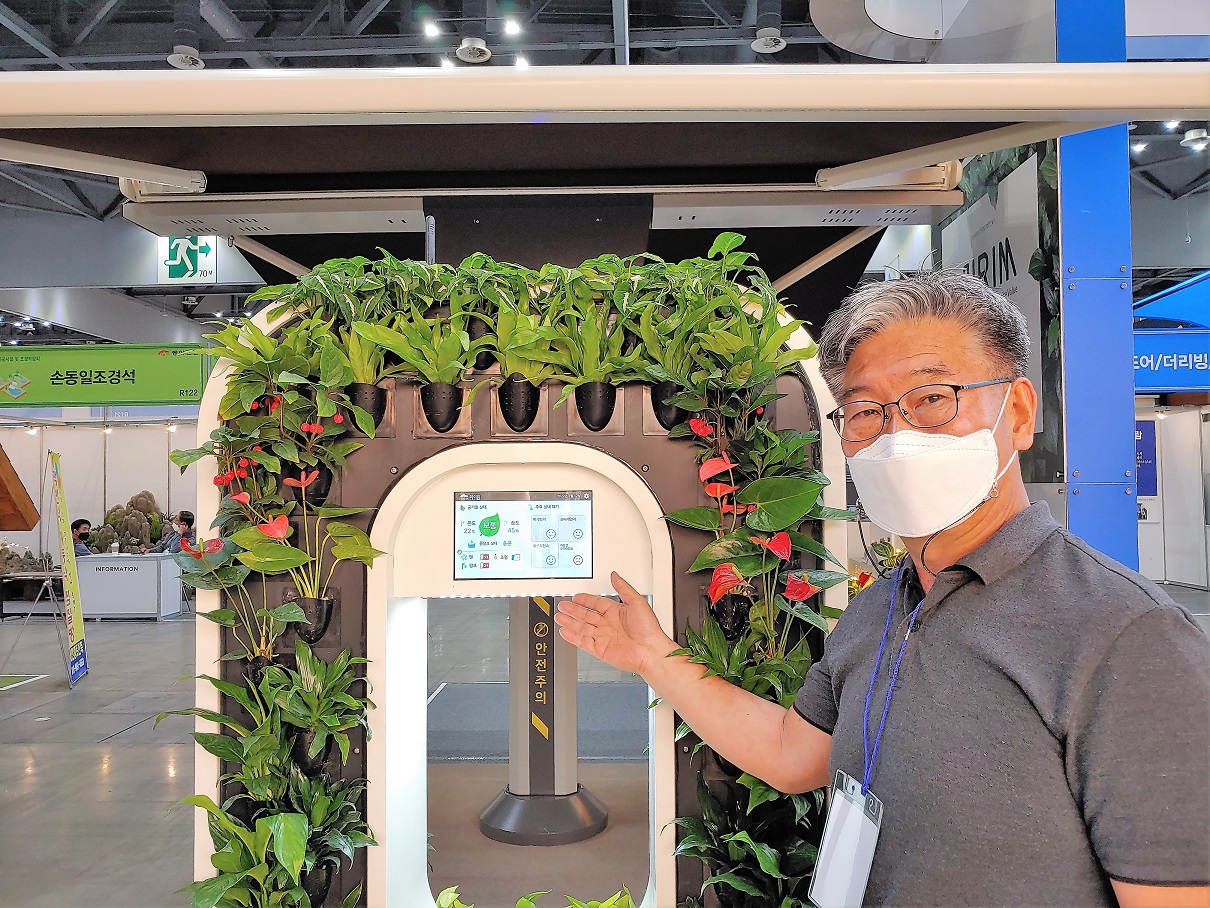
▲Metalcraft CEO Lee Jong-sun introducing a plant-based air purifier.
Domestic market size exceeds KRW 320 billion, with exports also expected.
Sensors and communication play a crucial role in smart IoT and AIoT. Today, objects that provide convenience in our daily lives are equipped with various sensors, which perform specific actions under specific conditions through sensing. IoT products, with their added communication capabilities that enable integrated control and application utilization, have become indispensable necessities in our daily lives.
At the MBC Architecture Expo held at KINTEX in Ilsan on the 12th, various construction and interior related materials and products were introduced, and ICT, IoT, and eco-friendliness were also attracting attention in today's architectural trends.
We met with Lee Jong-sun, CEO of Metalcraft, who participated in the exhibition that day and showcased IoT and ICT products, and heard his story.
■Please introduce your company.
Two companies participated in the exhibition: Metalcraft, which manufactures smart sunshades, and Biocraft, which manufactures plant-based air purifiers. They have developed large parasol sunshades for 20 years, distributing them at crosswalks and crossings nationwide. Now, they are introducing a digitalized version of their smart sunshade. In addition, we brought ‘Irim’, which analyzes indoor air quality and provides individual air purification solutions, to this exhibition.
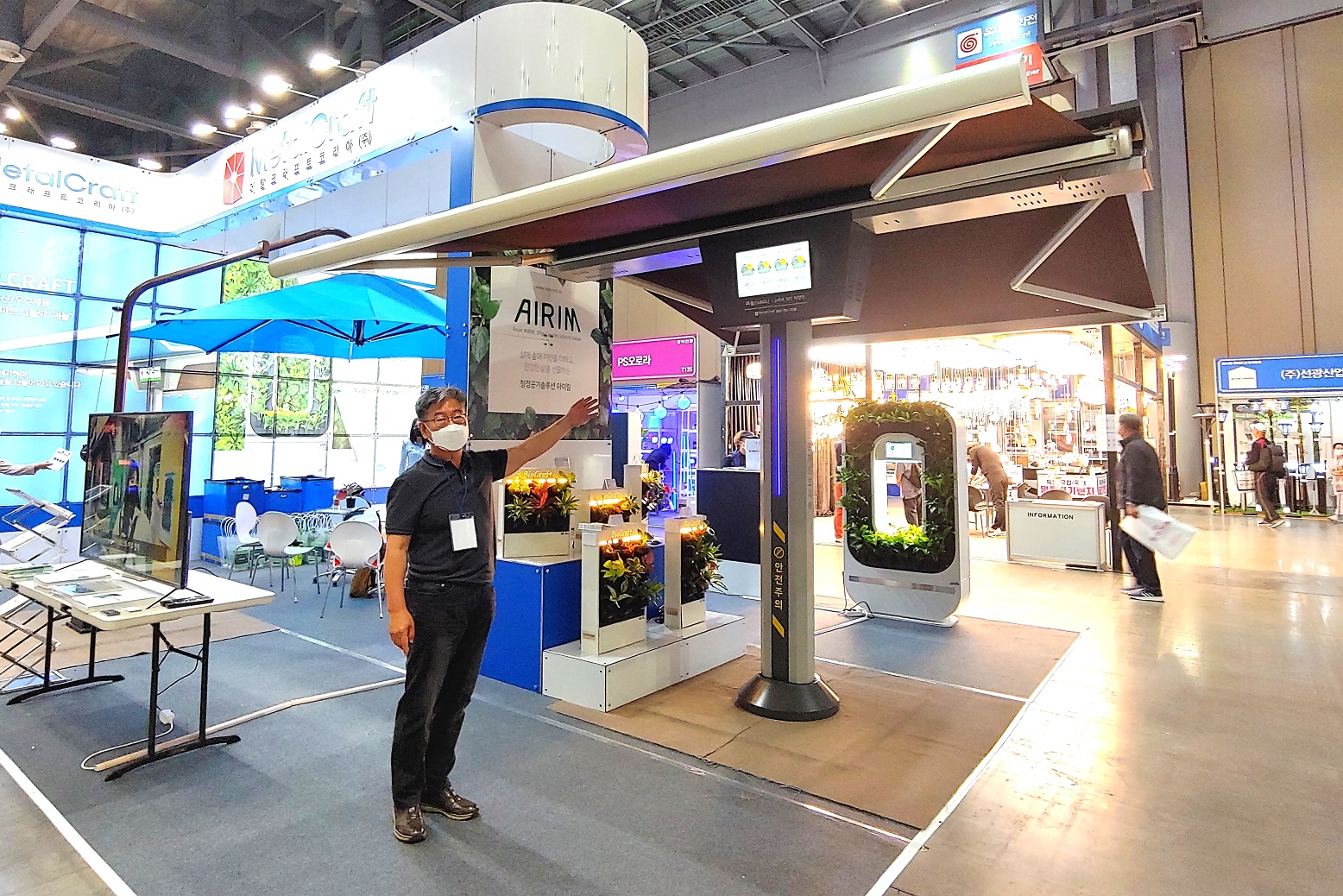
▲Metalcraft Smart Shade 'Sunol'
■How does a smart shade differ from a conventional shade?
Existing shades are difficult to maintain, requiring manual opening and closing of individual shades. Metalcraft, therefore, has been developing a digital transformation product through research and development for the past three years. The smart shade can be used with an app and features an automatic opening and closing system utilizing a combination of temperature and light sensors. Remote control and monitoring are possible from the comfort of your office, and a vibration sensor automatically retracts the shade when wind speeds exceed 7 m/s.
Additionally, it features a display function, allowing it to be used for public information and announcements. A recent example, which received favorable reviews, involved installing a smart sunshade in front of an elementary school to provide convenience to parents waiting for their children. In addition to providing shade, the system also allows for voice guidance, such as school dismissal notifications sent by teachers. Future application development is expected to further enhance its utility.
What functions are focused on in air purification solutions?
We focus on managing fine dust, ultrafine dust, carbon dioxide, and volatile organic compounds. We measure air quality using sensors, and we focus on carbon dioxide management in particular. Among the 50 or so air-purifying plants known through NASA research published in 1989, shade plants were selected to purify carbon dioxide and volatile organic compounds such as formaldehyde and toluene that cause sick house syndrome.
Biocraft is building a remote control service to provide remote solutions and on-site services, and is also continuing its research into building an AI system that optimizes indoor air quality through big data analysis by accumulating data on individual indoor air quality.
■What are your thoughts on the related outlook?
Assuming smart sunshades are installed in 390,000 villages nationwide, sales could reach 2.6 trillion won. According to data from the Ministry of the Interior and Safety, there are approximately 32,000 crosswalks in Korea, creating a market worth approximately 320 billion won.
The appearance of urban areas will also change significantly in the future. Full-scale shipments are expected to begin this year. As digital transformation progresses, we anticipate that urban landscapes will also become digitized, and all of our products are also geared toward digitalization.
■What are your future plans?
While we have experience exporting overseas through distribution channels, we've recently been receiving direct contact from buyers from the Middle East, Australia, and other countries. We look forward to pioneering new export avenues. Furthermore, we plan to invest in facilities, including automated processing lines, through the government's smart factory initiative.
We've focused our R&D efforts on all our products to date, building our capabilities. We're confident in our products. We will continue to strive to expand the company's scale and sales.

Comments
Related news
[Small and Medium Venture Competition] Opening the Era of Autonomous Driving with ‘Safety’ as the Top Priority - Sonnet
Sonet, which was the first small and medium-sized enterprise to obtain autonomous driving temporary operation permission, has begun autonomous driving paid transportation services in the Daegu Metropolitan City Technopolis area (7.2 km section).
2022.02.02by 성유창 기자
ST Ushers in the Era of Online Life with Intelligent Sensors
Signal processing and artificial intelligence (AI) algorithms integrated into MEMS (Micro-Electro-Mechanical Systems) sensors have led to the release of processing units that can significantly reduce space and power consumption while supporting local decision-making. These developments are drawing attention as they are expected to implement a convergence of technology enabling electronic decision-making with the physical world.
2022.02.21by 배종인 기자
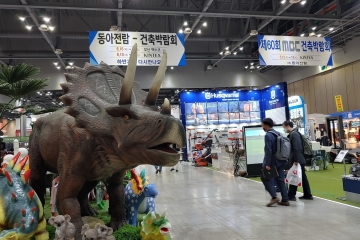
[MBC Architecture Expo] Future Living Environments Transformed by Cutting-Edge IT Technology
With the growth of the semiconductor industry, various cutting-edge technologies such as IoT, AI, and displays are being widely adopted, and the architecture and interior design industries are actively launching products incorporating these technologies. The scope is expanding from the use of temperature and humidity, carbon dioxide, and motion recognition sensors to products equipped with AI functionality and eco-friendly products utilizing solar panels.
2022.05.12by 명세환 기자
ESP32 Development Environment Selection and GPS Application Implementation
The ESP32 is a microcontroller that integrates Wi-Fi, Bluetooth, 12-bit ADC, capacitive touch, PWM, DAC, and UART in a single SoC. However, the abundance of features does not by itself solve the designer's problems. The real challenges lie in selecting the appropriate development environment, determining which pins can be used and which must be avoided, and converting raw data from modules into usable information. This document addresses ESP32 peripheral constraints (ADC2 and Wi-Fi coexistence limitation, UART1 occupancy, ADC non-linear regions), the trade-offs between Arduino IDE and ESP-IDF, and the process from connecting NEO-6M/NEO-M8N GPS modules to UART2, parsing NMEA sentences, and visualizing routes in Google Earth, all organized based on documented references.
2026.10.12by 편집부
MIPI CSI-2, DSI-2, C-PHY, D-PHY Test Solution Technical White Paper
The MIPI interface adopts a burst mode that transitions between low-power (LP) and high-speed (HS) states for low-power consumption, and in return, strict timing rules are imposed on state transitions. Additionally, the high-speed section operates as a packet-based protocol with headers, ECC, and CRC, so verification engineers must handle waveforms and protocols simultaneously. Traditional configurations combining general-purpose oscilloscopes and AWGs reveal limitations in setup complexity, measurement uncertainty, and lack of reproducibility when faced with these requirements. This white paper, based on webinar materials, organizes the structure of this problem and describes how the SV5C-DPTXCPTX generator for receiver testing and SV5C-DPRXCPRX analyzer for transmitter testing integrate state transition testing, stressed eye testing, and protocol analysis into a single bench, along with their application boundaries.
2026.10.12by 편집부











