



[Show Me the Thing's THING Winner Interview] Peace Electric: "MAKE Contest, the Carrot for Spreading Making Culture"
 Published2022.06.02 11:30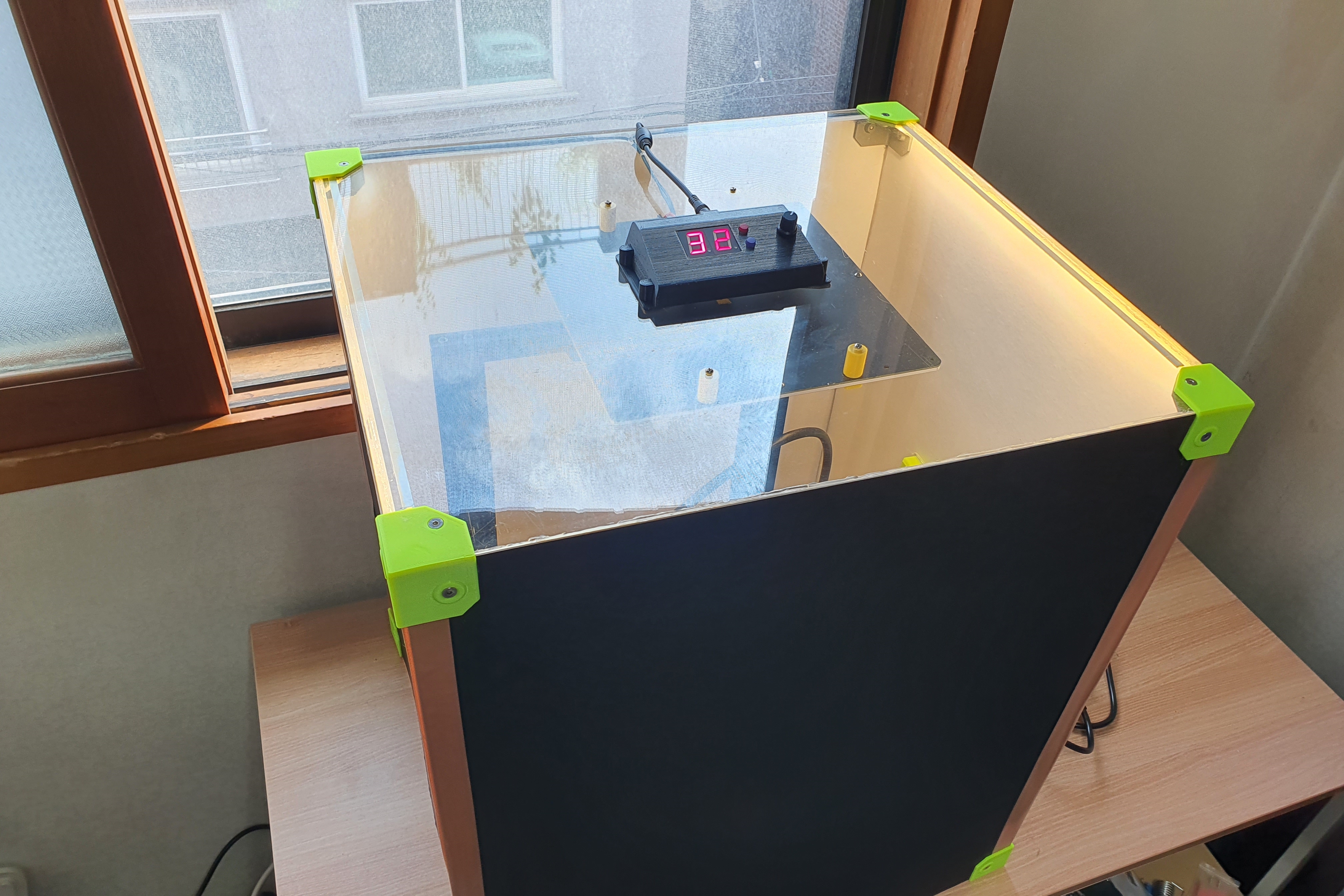
[Editor's Note] The first Make Contest, "Show me the Things," hosted by e4ds has concluded. Themed "Show me your temperature," the previous contest was enriched by a variety of entries utilizing temperature and humidity sensors. We interviewed Peace Electric, one of the three winners of the prestigious "Things" award. In this contest, which aims to make our everyday lives smarter, he was selected as the "Things" winner for his "Automatic Temperature Control 3D Printer Chamber."
■Please introduce yourself.
I'm an ordinary engineer working at an AI robotics company. While developing for work, I also enjoy various crafting projects as a hobby. I have a lot of ideas I want to try, but I'm not good at putting them into practice.
However, thanks to the great contest held by E4DS, I had fun participating in this contest as it gave me an opportunity to realize an idea I had always had.
■How do you feel about winning the first MAKE contest?
Honestly, I didn't have any expectations because I prepared it in such a short time. It received unexpectedly positive reviews and won an award. Although it was a simple, early-stage project, it was well-received for its practicality, and I'm very happy to have received such a well-deserved award. It was a small attempt, but it was a contest that made it worthwhile, and it has further fueled my motivation to continue making projects in the future. I'm grateful for this.
■Why did you participate in this contest?
I kept encountering shrinkage issues with my 3D printer output. I was thinking about needing a 3D printer chamber when I stumbled upon an announcement from E4DS, a popular webinar host, that they were holding a MAKE contest. The topic was "temperature and humidity." This led me to create a 3D printer chamber that would directly address temperature.
■Please explain your winning work.
This device is built on the Arduino platform, a popular platform for fast prototyping. It features an analog temperature sensor that measures the internal temperature of the 3D printer chamber and a heating bed that heats the internal air. It has a 2-digit FND display that shows the current temperature and set temperature, and a switch to control the set temperature.
The main function is to actively control the heating bed MOSFET via PWM so that the internal chamber temperature tracks the user-set temperature. Simply put, this can be thought of as controlling the internal temperature to the user's desired level. Additionally, it has a volume control function to adjust the lighting brightness so that the interior can be seen even at night.
■What prompted you to come up with this idea?
I wanted to solve the problem of shrinkage, a chronic problem with 3D printers. Furthermore, many commercially available or self-built chambers didn't have the ability to actively control temperature, so I decided to try making one myself.
■Were there any difficulties during the development process?
Because the chamber had to be larger than the 3D printer, it was larger than expected and difficult to build. To save money and make it lighter, I used hardboard for the chamber walls. However, this proved more difficult than building it with wood panels or other materials.
Additionally, heating the heating bed required more power than expected, so I had to purchase an additional power adapter with a higher rated current. The difficulty encountered during manufacturing was that MOSFETs generate a lot of heat due to high current, so additional heat dissipation measures had to be taken.
■Is there anything you would like to improve on in your work?
Currently, the chamber is made with a cover structure, but if we make the next model in the future, I think it would be more convenient to use if we made it with a door structure.
■What did you gain from this contest and what are your plans for the future?
I hope that making culture will spread further. I believe the MAKE Contest hosted by E4DS will help spread this culture and provide a much-needed boost for makers and engineers. It's truly wonderful to be able to realize your ideas, be evaluated, and even receive rewards. If there are any future events like this, I will participate without hesitation.
thank you
This contest announcement and review can be viewed again via the e4ds EEWebinar.
The second "Show Me the Things" contest, hosted by e4ds Make, is currently underway. The contest, which focuses on healthcare, currently features Quest 2, "Prepare Hardware and Components," which runs until the 12th.
Meanwhile, the 2022 e4ds Semiconductor Trend Day will be held at COEX on the 10th, hosted by Channel 5 Korea. In addition to sessions covering the latest trends in GaN, SiC, and automotive semiconductors, a special offline session titled “Next-Generation Memory Development Direction and Material Trends - 3D Stacked DRAM Technology” by Professor Hwang Cheol-seong of Seoul National University is also planned.
More details can be found on the e4ds news homepage .

Comments
Related news
.jpg)
e4ds Make Selects 3 Honorable 'Masterpieces'
국내외 반도체·전자산업 전문매체 e4ds의 브랜드 e4ds 메이크(make)에서 지난 27일 제1회 'Show me the 띵s(Things)' 콘테스트의 수상작을 발표했다.
2022.04.28by 명세환 기자
.jpg)
Sharing 2022 Semiconductor New Technology and New Material Trends
As the semiconductor industry experiences remarkable growth, intense competition in cutting-edge technology is intensifying in next-generation processes. Amid active semiconductor investment and research in response to the digital transformation era encompassing autonomous vehicles, metaverse, and smart manufacturing, a venue has been established to provide insights into new processes and materials.
2022.05.20by 명세환 기자
.jpg)
Semiconductor Trend Day shares the latest semiconductor industry outlook.
Supply chain issues, technological competition, and digital transformation are rapidly changing the trends surrounding the semiconductor industry, making it more important than ever to quickly acquire relevant information and extract insights.
2022.05.31by 명세환 기자

Intel Unveils Next-Generation 'Core Ultra Series 3' and vPro Platform for Enterprise PCs
Intel has officially unveiled the "Intel Core Ultra Series 3" for next-generation enterprise PCs and the latest vPro platform, addressing a wide range of demands from enterprise notebooks to high-performance workstations.
2026.03.26by 배종인 기자

ROHM Launches ESD Protection Diode Compatible with High-Speed Interfaces of 10Gbps or Higher
Semiconductor specialist ROHM has developed the 'RESDxVx series' of ESD (electrostatic discharge) protection diodes capable of responding to next-generation high-speed data communication environments exceeding 10Gbps, simultaneously enhancing both signal quality maintenance required in high-speed interfaces and IC protection performance.
2026.03.26by 배종인 기자











