


Microchip Eliminates Magnets for EV Motor Position Monitoring
 Published2022.06.16 11:27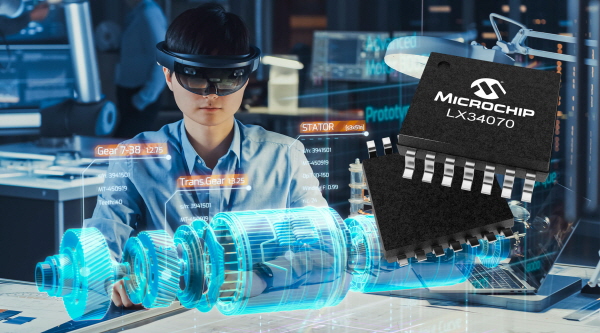
Microchip Technology (Asia General Manager and Korea Representative Byung-Don Han) is leading the global trend toward moving away from expensive, low-accuracy magnet-based solutions for position monitoring of electric vehicle (EV) motors through inductive sensors.
Microchip Technology Inc. (NASDAQ: MCHP) today announced the expansion of its industry-leading family of inductive position sensors into the electric vehicle motor control market with the LX34070 integrated circuit (IC) designed specifically for electric vehicle motor control applications.
The product offers differential output, fast sampling rates, and features that help achieve functional safety certification for ISO 26262 compliance up to Automotive Safety Integrity Level C (ASIL-C).
Today, developers of motor control systems are rapidly replacing Hall-effect position sensors and older magnetic resolver solutions with inductive sensors.
Inductive sensors enable integration onto simple, compact printed circuit boards (PCBs) by eliminating expensive magnets and other heavy transformer-based structures.
“The LX34070 inductive position sensor enables designers to develop lighter, smaller and more reliable motor control solutions that meet stringent safety requirements, reduce total system cost and operate smoothly and accurately in the noisy environments of automotive DC motors, high currents and solenoids,” said Fanie Duvenhage, vice president of Microchip’s Mixed-Signal and Linear Analog Business Unit.Can be pronounced. Developers can further simplify electric vehicle motor control designs by pairing the LX34070 with Microchip’s other functional safety-certified devices, including Microchip’s 8-bit AVR® and PIC® microcontrollers (MCUs), 32-bit MCUs, and dsPIC® digital signal controllers,” he explained.
■ LX34070 offers a variety of benefits at a much lower cost
The LX34070 inductive position sensor solution offers several benefits at a significantly lower cost than magnetic resolvers and linear voltage differential transducers (LVDTs).
The LX34070 device uses PCB traces rather than transformer-based magnetic windings or coil structures, making it negligible in size and mass compared to other devices that weigh up to 500 grams.
Additionally, the LX34070 is more accurate because it does not rely on magnet strength, and is more robust because it actively rejects stray magnetic fields.
These and other features provide developers with greater flexibility when deciding where to deploy the thin, lightweight PCB-based LX34070 solution in electric vehicle motor control designs.
PCB-based inductive position sensors use a primary coil to generate an AC magnetic field that is connected to two secondary coils.
A small metal target object disturbs the magnetic field, causing the two secondary coils to receive different voltages, the ratio of which is used to calculate absolute position.
Meanwhile, e4ds news will hold the 2022 e4ds Industrial Motor Control Technology Conference at the main auditorium of the Korea Conference Center (Gangnam Station) on July 22.
This conference will explain the operating principles of transformers, generators, and electric motors, which are the core of motor control, and will share key development points and help developers understand by implementing actual models using MATLAB Simulink.
More information about the conference can be found on the e4ds conference page ( https://www.e4ds.com/seminar_introduce.asp?idx=132 ).

Comments
Related news

"Support for simplifying inverter design to improve motor efficiency"
To improve energy efficiency, electronic device manufacturers are equipping their products with devices made from high-efficiency materials such as SiC and GaN, or adopting new circuit architectures such as inverters that enable flexible response depending on the situation. We asked Kim Chang-ho, General Manager at Infineon Korea, about the solutions and support measures that Infineon provides to accelerate inverter design.
2021.06.18by 이수민 기자
TI Announces 70W BLDC Motor Driver: No Drive Software Required
The transition from AC induction motors to BLDC motors is happening rapidly. Now, the development of next-generation devices hinges on faster motor response speeds and shortened design cycles. On the 9th, Texas Instruments announced two 70W BLDC motor driver products using trapezoidal control and field-oriented control (FOC) that do not require motor driving software.
2021.09.09by 이수민 기자
TI Launches First 3D Hall-Effect Position Sensor
Texas Instruments (TI) has introduced for the first time a 3D Hall effect position sensor that delivers faster real-time control speed and industry-leading accuracy, enabling precise real-time control in factory automation and motor drive applications.
2021.10.13by 배종인 기자

Intel Unveils Next-Generation 'Core Ultra Series 3' and vPro Platform for Enterprise PCs
Intel has officially unveiled the "Intel Core Ultra Series 3" for next-generation enterprise PCs and the latest vPro platform, addressing a wide range of demands from enterprise notebooks to high-performance workstations.
2026.03.26by 배종인 기자

ROHM Launches ESD Protection Diode Compatible with High-Speed Interfaces of 10Gbps or Higher
Semiconductor specialist ROHM has developed the 'RESDxVx series' of ESD (electrostatic discharge) protection diodes capable of responding to next-generation high-speed data communication environments exceeding 10Gbps, simultaneously enhancing both signal quality maintenance required in high-speed interfaces and IC protection performance.
2026.03.26by 배종인 기자











