



[Interview] Mark Ng, General Manager of Electric Vehicles and Powertrains at Texas Instruments (TI): "Industrial motor control components require efficiency, precision, and miniaturization."
 Published2022.07.20 12:17
Embedded devices must minimize latency and maximize power efficiency.
Sitara MCU Family Meets Motor and Digital Power Control Needs
TI Launches Dedicated Controller 20 Years Ago, 200ns Gate Driver
[Editor's Note] Industrial motors are widely used in various equipment and devices, including robots. Recently, they have also been incorporated into various ultra-small smart IoT devices, such as smartphones, and mobility devices, such as electric vehicles, establishing themselves as essential components in our lives. Using and controlling these industrial motors requires comprehensive knowledge beyond electrical and electronic engineering, encompassing mechanical engineering. In particular, the value of industrial motors is increasing as they are used in mobility devices, such as electric vehicles, and serve as the primary power source for human life. This necessitates precise and predictable technologies capable of predicting the direction of motion, including failures. We sat down with Mark Ng, general manager of the Electric Vehicle and Powertrain Division at Texas Instruments, a global expert in the industrial motor field, to discuss how to precisely control industrial motors and the latest trends in industrial motors.
 ■ Please introduce Texas Instruments.
Texas Instruments (TI) is a global semiconductor company that designs, manufactures, tests, and sells analog ICs and embedded processors for a wide range of applications, including industrial, automotive, personal electronics, communications equipment, and enterprise.
TI aims to create a better world by enabling more affordable electronic products through semiconductors.
To achieve this, we are continuously innovating to develop smaller, more efficient, more reliable, and more cost-effective technologies. We call this process "Engineering Progress."
This is what TI has been doing for decades and is still doing today.
Since the establishment of TI Korea in 1988, it has contributed to the development of the Korean semiconductor and electronics market for several decades.
■ Recently, the need for real-time motor control has increased as the demand for motors with higher power efficiency, automation performance, and lower noise has increased. In this trend, I would like to know about TI's motor control technology and main products.
Vehicle manufacturers are working to reduce CO2 emissions and are making continued progress.
At TI, we're reducing vehicle CO2 emissions through vehicle electrification. It's clear that a fundamental shift in passenger vehicle technology is needed.
While automakers around the world must focus on global emissions regulations, they must also continue to make their vehicles affordable enough to encourage consumers to switch to hybrid or fully electric vehicles.
No one wants to spend more money on an electric car than on an internal combustion engine car.
Additionally, consumers expect driving range and charging frequency comparable to internal combustion engine vehicles. Finding solutions for cost and driving range while prioritizing safety and reliability is crucial.
TI is developing products to address these challenges. Let's look at some key powertrain areas and give some examples.
TI's battery management technology enables additional charging capabilities in battery packs through industry-leading battery monitoring accuracy.
It allows for cheaper and safer battery cell chemistries, such as Lithium Iron Phosphate (LFP), which delivers up to 25% longer driving range while reducing system costs.
For onboard chargers and DC/DC converters, TI's real-time digital control solutions, bias supply devices, and isolated gate drivers shorten charging times and increase the efficiency of electric vehicles.
TI's technology enables advanced control topologies for bandgap switching technologies such as SiC or GaN.
Traction inverter systems play a critical role in achieving optimal performance. Because these systems require high computational power, it's crucial that the control function seamlessly works with dynamic output current control to maintain ideal motor torque and improve overall system efficiency. TI's real-time controller supports higher performance in these situations.
As emissions decrease and driving range increases, drivers will continue to seek vehicles that offer improved safety and reliability.
As safety requirements become more stringent, the industry must rethink how existing vehicle systems are designed to enhance the driving experience with advanced safety features.
TI helps customers reach ASIL-D, the highest level of functional safety, with a variety of functional safety-compliant devices.
■ Motors, which were mainly used as auxiliary power sources in the past, are beginning to appear as main power sources. In particular, motors in electric vehicles play a crucial role not only in driving the vehicle but also in protecting the lives of passengers. Therefore, not only is motor control more precise, but the durability of the control system is also becoming increasingly important. I'd like to learn about TI's efforts in this regard. Also, if there are any TI product lines specifically for electric vehicle motors, please tell us about them.
The automotive industry is seeing a lot of innovation to lower the price of electric vehicles.
First, silicone is being used to replace expensive and heavy machine parts. An example is that mechanical relays are being replaced today by load isolation switches.
Bulky and heavy inductive EMI coils are being replaced by dynamic noise cancellation technologies, and the mechanical wire harnesses in battery packs are being replaced by wireless communication technologies.
The industry is looking for ways to replace materials with cheaper alternatives, particularly to reduce its overall reliance on rare earths.
Many battery manufacturers are switching to lithium iron phosphate (LFP) battery cell chemistry, which is cheaper than traditional chemistries that require cobalt and rare earths.
It also reduces the use of expensive motors with heavy magnets that require significant amounts of rare earth elements.
Another industry trend we've identified through working with leading OEMs is powertrain integration.
Powertrain integration can be achieved at the system level by combining applications such as onboard chargers, high-voltage DC/DC inverters, power distribution units (PDUs), and battery management systems.
Integration can also be applied to machines, controls, power switches or power modules, depending on the customer's design goals.
Powertrain integration allows vehicle manufacturers to reduce costs by using fewer electronic components at the system level, combining magnets and cooling systems, depending on the application, instead of two or three separate mechanical enclosures or boxes for the DC/DC converter, onboard charger, and inverter.
■ Nowadays, industrial motor control can be achieved more easily and quickly than in the past thanks to simulators and other tools. In particular, TI is helping developers further reduce design time by using sensorless motor control that does not require motor drive software. Could you please share your outlook on future motor control technology trends and TI's development plans?
Real-time control is not a new technology. TI introduced a dedicated controller about 20 years ago. A real-time control system is a closed-loop control system that collects, processes, and updates data. This "control" is crucial in advanced motor control applications, such as power conversion and powertrain applications.
Almost every subsystem in an electric vehicle relies on real-time control. A variety of exciting innovations are increasing automotive efficiency and improving the driving experience, while lowering other barriers to entry, such as range and charging times.
Demands for efficiency, precision and size in products that rotate motors or convert power are increasing.
To maximize and optimize real-time control, embedded devices used in the system must be designed to minimize latency and maximize power and cost efficiency.
TI's C2000™ and ARM™-based microcontrollers (MCUs) offer higher levels of analog integration that enable current loops of <1·s, known as fast current loops.
TI's new high-performance ARM™-based AM2634-Q1 MCU is the latest addition to the Sitara MCU family and can help enhance processing power in electric vehicles.
The Sitara AM2634-Q1 MCU is the first device in the Sitara MCU portfolio to combine a real-time control subsystem derived from C2000™ MCUs with the Sitara multi-core Arm® architecture to meet the dynamic performance requirements of motor and digital power control applications.
The AM263 MCU family combines real-time control capabilities with over 3,000 DMIPS (Drystone Million-per-second) computing performance, enabling smaller and lighter motor and mechanical enclosures, reduced system costs, increased driving range, and more affordable electric vehicles.
The AM263 MCU family leverages and extends the benefits of C2000 real-time MCUs to provide even more options for electric vehicle powertrain applications.
Increase processing power and detection Advances in real-time control that extend operational performance and enable higher precision and efficiency, while also enabling higher levels of system integration to make vehicles more affordable.
Motors, once auxiliary power sources, are now emerging as primary power sources. In electric vehicles, motors play a crucial role not only during driving but also in driver safety. This trend makes precise motor control and control system durability more important than ever. How is TI adapting to this trend, and which electric vehicle motor products would you like to highlight?
Almost all automakers have presented roadmaps to transition to electric vehicles by 2030, and this is our future.
TI has the industry's leading portfolio of integrated gate drivers with the fastest short-circuit protection at 200 nanoseconds and advanced built-in diagnostics.
For electric vehicle motor drives, TI's reinforced rated capacitive isolation technology provides industry-leading electric field analysis capabilities that simplify the transition to 800-V technology.
In high-voltage environments such as electric vehicles, functional safety is essential to prevent damage to people and vehicle systems.
Functional safety design takes a lot of time. To help automakers accelerate development time to ASIL D, the highest level of functional safety under the ISO 26262 standard, TI is providing documentation and analytics that automakers can leverage in their work.
The aforementioned ARM™-based MCU AM2634-Q1 integrates functional safety functions including ASIL (Automotive Safety Integrity Level) D, the highest level of automotive safety integrity rating, the full version of EVITA (E-Safety Vehicle Intrusion Protected Applications) hardware security module, AUTOSAR (Automotive Open System Architecture), an automotive standard software platform, and communication peripherals into a single chip, reducing BOM.
TI's gate driver portfolio includes devices in every functional safety category, from simple to complex. Each category provides resources to help designers streamline the certification process.
For example, TI has developed the UCC5870-Q1, the first TI functional safety compliant gate driver, targeting applications such as traction inverters. While using this product does not automatically achieve an ASIL rating, TI provides documentation to assist in ISO 26262 system design to help achieve an ASIL D rating.
■ Please give a final word to e4ds news readers.
We would like to express our gratitude to the e4ds staff for their dedication to rapidly delivering high-quality content and providing diverse information and insights based on their high level of expertise, contributing to the development of the domestic IT industry.
In this age of innovation, we look forward to continuing to provide our readers with a variety of information, including cutting-edge technologies and the latest trends in the IT industry.
Meanwhile, the " 2022 e4ds Industrial Motor Control Technology Conference, " featuring TI, will be held in the main auditorium of the Korea Conference Center on July 22nd. This conference promises to be an opportunity to learn about the fundamentals and advanced technologies of industrial motor control, as well as to see real-world examples of TI's industrial motor control solutions in real time. Applications can be made at the e4ds conference .
※ Resume
Mark Ng leads a team of systems engineers dedicated to automotive hybrid and electric powertrain applications, focusing on three key areas of electrification: traction inverters, battery management systems (BMS), onboard chargers, and DC/DC converters.
The team collaborates with vehicle manufacturers and Tier 1 component manufacturers worldwide to design complete system solutions. Mark also advises on promotional decisions and new product development.
Prior to his current role, he served as Business Development Manager for the Analog Power Products Business, Infrastructure Power Products Manager for the High Performance Isolation Business Unit, and Product Marketing Manager for the Isolated DC/DC Telecom Division in Hong Kong.
Prior to his time in Hong Kong, he worked as an analog FAE (Technical Support Engineer) in Sunnyvale, California, supporting North American sales and marketing. He also held positions as an Applications Engineer and Senior Applications Engineer at Xilinx.
Mark received his bachelor's and master's degrees in electrical engineering from Santa Clara University.

Comments
Related news
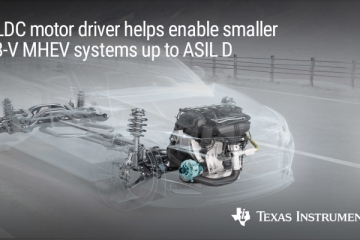
TI Unveils 3-Phase BLDC Motor Drive Controlling 48V Motors
TI has launched the DRV3255-Q1 Grade 0 BLDC motor driver for 48V high-power motor control systems including traction inverters and starter generators in mild hybrid electric vehicles (MHEV). Designed according to a TÜV SÜD certified functional safety development process, the DRV3255-Q1 meets ISO 26262 ASIL D functional safety requirements. Additionally, it delivers maximum motor power of 30kW and reduces motor system size by up to 30%.
2021.02.24by 명세환 기자
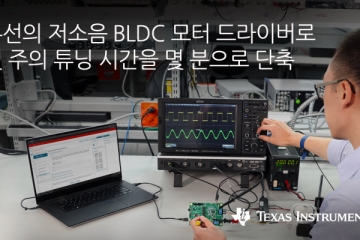
TI Announces 70W BLDC Motor Driver: No Drive Software Required
The transition from AC induction motors to BLDC motors is happening rapidly. Now, the development of next-generation devices hinges on faster motor response speeds and shortened design cycles. On the 9th, Texas Instruments announced two 70W BLDC motor driver products using trapezoidal control and field-oriented control (FOC) that do not require motor driving software.
2021.09.09by 이수민 기자
TI Launches First 3D Hall-Effect Position Sensor
Texas Instruments (TI) has introduced for the first time a 3D Hall effect position sensor that delivers faster real-time control speed and industry-leading accuracy, enabling precise real-time control in factory automation and motor drive applications.
2021.10.13by 배종인 기자
.jpg)
Presenting intelligent motor control technology for field developers
The '2022 e4ds Industrial Motor Control Technology Conference,' hosted by Channel 5 Korea and organized by e4ds news, will be held on July 22nd at the Grand Hall of Korea Conference Center (Gangnam Station).
2022.06.21by 배종인 기자
[Interview] Jong-su Lim, CEO of Sujin, “High reliability of motor control and Simulink-based modeling”
[Editor's Note] Motor control technology is one of the essential technologies used across various industries including △smart factories △electric vehicles △drones △robotics. Although it is being utilized in many aspects of industrial applications and product development, the current situation is that development is being conducted by following previously developed materials and content, which results in considerable time being required to resolve problems when they occur. The industrial motor control technology conference hosted by e4ds has created an opportunity to enhance developers' understanding and technical expertise by presenting core theories for motor control and demonstrations of technologies applied in the field such as MATLAB and Simulink. In this regard, we had an opportunity to meet with Lim Jong-soo, CEO of Su-jin, who was invited as a speaker.
2022.06.23by 명세환 기자











