


Samsung Electronics Launches Second-Generation Smart SSD, Leading the Way in Computational Storage
 Published2022.07.21 11:00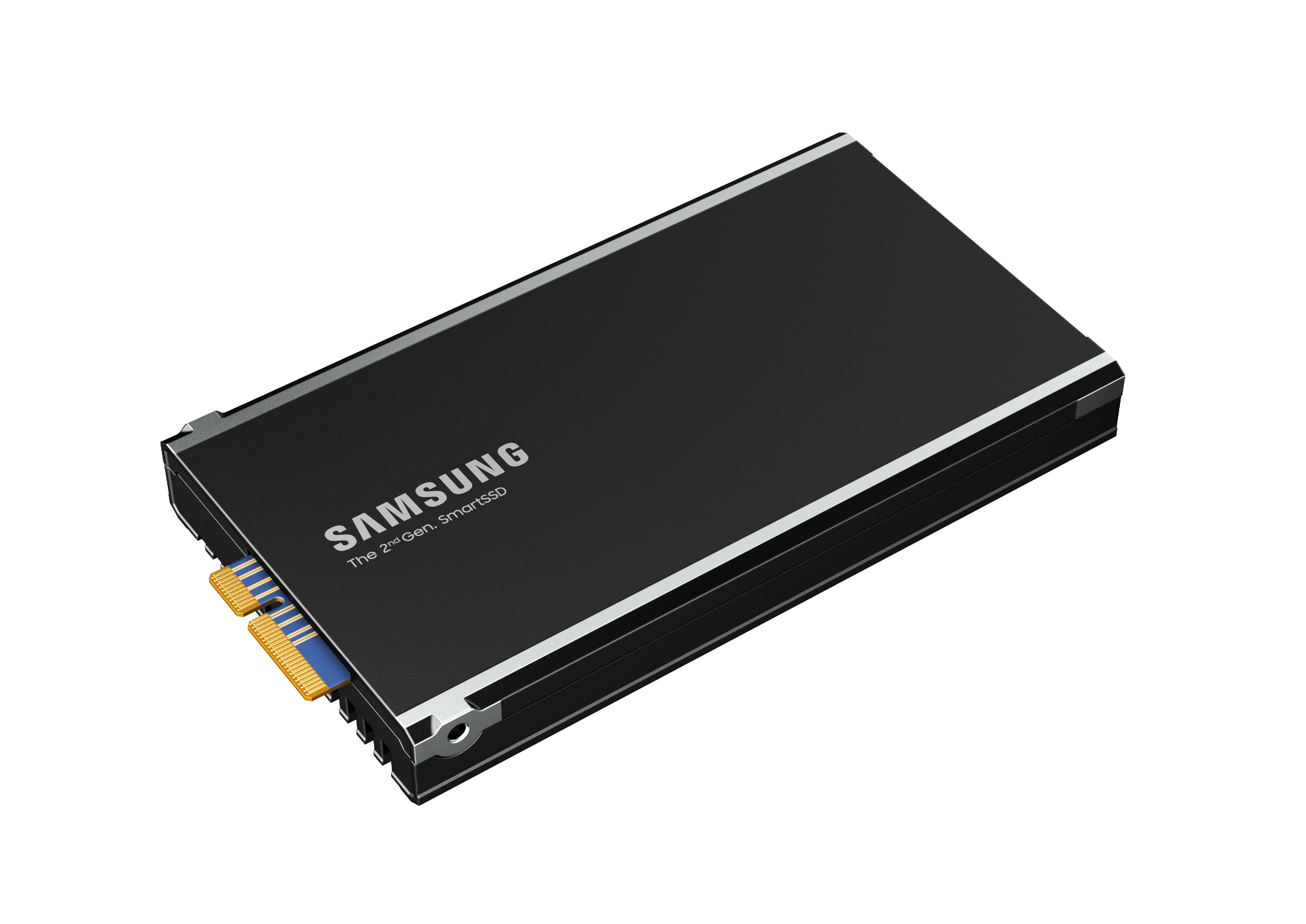
▲Samsung Electronics' 2nd generation Smart SSD (Image - Samsung Electronics)
Storage is no longer limited to storing data. In this era of data explosion, the efficiency of storing and managing ever-increasing amounts of data with minimal resources is becoming increasingly important. With the advent of computational storage, the role of storage, previously focused on data storage, has expanded to encompass computing.
Samsung Electronics announced on the 21st that it has developed a "2nd-generation Smart SSD" with enhanced internal computing capabilities. Smart SSDs are a type of computational storage that incorporates a processor for computation, enabling data processing within the storage.
Samsung Electronics emphasized that the second-generation Smart SSD has more than double the computing performance compared to previous products, and that the software developed by users has the ability to process data by utilizing the Arm cores and IP built into the Smart SSD. When applying the second-generation smart SSD to a system, it was explained that compared to a system equipped with a general SSD, the time for some database operation processing is reduced by up to 50%, energy consumption is reduced by up to 70%, and CPU usage is reduced by up to 97%.
Computational storage is attracting attention as a next-generation storage device that can provide more efficient services in fields such as Metaverse, Artificial Intelligence (AI), Big Data, Deep Learning, Machine Learning, and 5G/6G that require processing of massive amounts of data.
Unlike existing SSDs that only store data, Samsung Electronics' Smart SSD has a computational function built into the SSD, so that when processing specific data, the computational function is performed directly within the SSD, minimizing data movement between the CPU, GPU, and RAM. Samsung Electronics stated that this resulted in improved system performance and energy efficiency.
“Samsung Electronics has confirmed the growth potential of computational storage through the successful launch of the first-generation Smart SSD,” said Choi Jin-hyeok, Vice President of Solution Development at Samsung Electronics’ Memory Business. “We will further expand our next-generation storage product line by actively responding to diverse customer and market needs, such as databases and video transcoding, with the second-generation Smart SSD, which has further enhanced computational performance.”
“Samsung’s second-generation Smart SSD, powered by AMD’s Xilinx Versal™ Adaptive SoC, offloads some of the computational work previously performed by the CPU to the storage, reducing power consumption during data movement and increasing CPU efficiency,” said Sina Soltani, vice president and general manager of AMD’s Data Center Communications Group. “Samsung’s Smart SSD will contribute to expanding customer markets with its superior performance and high power efficiency in the data-centric market.”
Samsung Electronics is expected to actively pursue computational storage standardization in the future by collaborating with international storage standards organizations such as SNIA and the NVM Express Working Group. The computational storage market is expected to expand as technology is verified across various applications.
Meanwhile, the first-generation smart SSD jointly developed by Samsung Electronics and AMD in 2020 is being supplied to global IT companies, including video communication platform companies, and won the 'CES Innovations Honoree' in 2021.

Comments
Related news
Samsung Electronics Launches Professional Portable SSD 'T7 Shield'
Physical shock protection solutions that safeguard data from impacts occurring in daily use and prevent data loss are always critical.
2022.04.28by 명세환 기자
Samsung Electronics and Red Hat Collaborate on Next-Generation Memory Software
With the explosive increase in data usage due to the development of advanced industries such as AI·ML and metaverse, the paradigm of memory/storage utilization in data centers is undergoing significant transformation. Accordingly, companies possessing both hardware and software capabilities are pursuing mutual collaboration for advancement.
2022.05.25by 명세환 기자
Samsung Electronics Develops 24Gbps GDDR6 DRAM
Despite recent market cooling concerns about an approaching DRAM downcycle, fierce competition in advanced solution technologies is underway in the graphics DRAM market, driven by expansion in the data center and server market. As the high-performance graphics DRAM market is expected to grow at double-digit rates annually, new graphics DRAM products have emerged that enhance high-speed data processing with low power consumption.
2022.07.15by 명세환 기자

Intel Unveils Next-Generation 'Core Ultra Series 3' and vPro Platform for Enterprise PCs
Intel has officially unveiled the "Intel Core Ultra Series 3" for next-generation enterprise PCs and the latest vPro platform, addressing a wide range of demands from enterprise notebooks to high-performance workstations.
2026.03.26by 배종인 기자

ROHM Launches ESD Protection Diode Compatible with High-Speed Interfaces of 10Gbps or Higher
Semiconductor specialist ROHM has developed the 'RESDxVx series' of ESD (electrostatic discharge) protection diodes capable of responding to next-generation high-speed data communication environments exceeding 10Gbps, simultaneously enhancing both signal quality maintenance required in high-speed interfaces and IC protection performance.
2026.03.26by 배종인 기자











