


Semiconductor 'Superpower', Mobilizing National Capabilities
 Published2022.07.21 14:50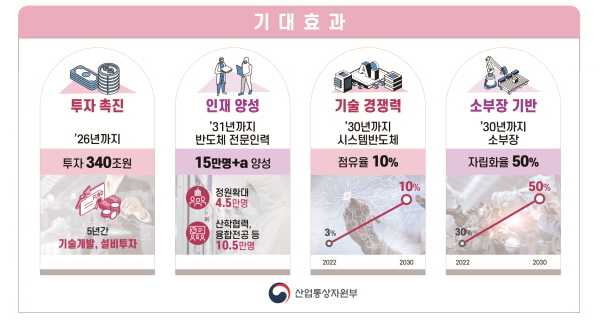
▲Expected Effects of Semiconductor Superpower Achievement Strategy
10% Market Share in System Semiconductors by 2030
50% Self-Sufficiency Rate in Materials, Parts & Equipment (MPE), Market-Leading Type
Industry, academia, and research institutions are mobilizing all private and public capabilities, including investing 340 trillion won to achieve South Korea's semiconductor superpower status.
On the 21st, the government announced the 'Semiconductor Superpower Achievement Strategy' jointly by relevant ministries.
According to this, the government will promote investment through infrastructure support for companies and expedited licensing, expansion of corporate investment tax incentives, and deregulation in areas such as labor and safety, undertaking technology development and equipment investment of 340 trillion won by 2026.
Additionally, regarding human resources, the government plans to cultivate more than 150,000 semiconductor specialized personnel by 2031 through workforce development via universities and graduate schools, establishment of four major industry-academia cooperation infrastructures, and strengthened recruitment and management of excellent talent.
Regarding technology, the government plans to secure technological competitiveness by achieving a 10% market share in system semiconductors by 2030 through developing three major next-generation semiconductor technologies, supporting the growth of promising fabless companies, and strengthening the system semiconductor ecosystem capabilities.
Regarding materials, parts & equipment (MPE), the goal is to achieve a 50% MPE self-sufficiency rate by 2030 through converting to market-leading type technology development, establishing growth bases for MPE companies, and expanding support for promising technology commercialization.
■ Promoting Corporate Investment Through Infrastructure Support and Regulatory/Licensing Exemptions
First, regarding corporate investment support, government funds will be provided for essential infrastructure construction costs such as electricity and water supply at national core semiconductor industrial complexes, floor area ratio exemptions will be applied to increase from the current 350% to a maximum of 1.4 times higher at 490%, and the allowable capacity for new and expanded facility installations in limited sites will be expanded.
Regarding licensing and permits, expedited processing of industrial complex development-related permits will be mandated unless there are major and obvious reasons.
In particular, by expanding tax credits, the large enterprise tax credit rate will be unified with mid-sized enterprises and increased by 2% from the current 6-10% to 8-12%.
Additionally, exceptions to statutory working hours will be recognized, and regulations on chemical substances and safety will also be relaxed.
In particular, deregulation under the High-Pressure Gas Safety Management Act will also be pursued to enable rapid installation of essential equipment for advanced manufacturing processes domestically.
Furthermore, the scope of deferral allowances will be expanded so that semiconductor small and medium enterprises acquired by large enterprises can be exempted from becoming subsidiaries for 7 years, allowing deferral for small and medium enterprises with R&D spending of 3% or more, making it applicable to more than 70% of domestic semiconductor small and medium enterprises.
■ Expanding Semiconductor Workforce Development Through University and Graduate School Innovation
Regarding semiconductor personnel, regulations will be relaxed to allow enrollment increases when only the 'faculty securing rate' is met, and for national universities, the full-time faculty standard will be relaxed to 70% or higher.
Additionally, 100% online operation of bachelor's degree programs will be allowed, and semiconductor specialized universities and graduate schools will be newly designated with support for personnel expenses and equipment.
For non-major students to enter the semiconductor industry, a semiconductor brain track will be operated, where undergraduate students can complete double major and minor courses over two years. Operation at 30 institutions is scheduled to begin from 2022.
For industry-led workforce development, a semiconductor academy will be established where the semiconductor association establishes and operates curricula, and the government and companies plan to jointly invest 350 billion won over 10 years in R&D for cultivating master's and doctoral level talent.
A Korean-style IMEC will be established to provide mass production-level educational environments with company-donated equipment, and 10 contract degree programs for materials, parts & equipment will be pursued.
■ Concentrated Development of Power Semiconductors, Automotive Semiconductors, and AI Semiconductors
To advance power semiconductor technology, a preliminary study of 450 billion won scale will be pursued for developing 18 core technologies across major fields such as circuit design, processes, and materials.
Additionally, for automotive semiconductor technology development, a preliminary study of 500 billion won scale will be pursued for developing 16 high-value items across 4 major fields including processors, sensors, power semiconductors, and mixed-signal chips.
AI semiconductors will receive 1.25 trillion won in support, with performance verification through demonstration being pursued by applying them to domestic key industries including data centers, future vehicles, biotechnology, home appliances, machinery and robotics.
In addition, 30 promising fabless companies with potential will be selected as star fabless companies to support their growth, and new planning of large-scale R&D preliminary study projects specializing in advanced post-processes will be undertaken.
■ Materials, Parts & Equipment Converting to Market-Leading Type Technology Development
The proportion of forward-looking technology development for securing the future among MPE R&D will be expanded to 20% or higher in 2023, and core strategic MPE technologies such as advanced packaging and EUV photomask technology will be significantly expanded.
At the Third Pangyo, R&D facility investments by semiconductor MPE and fabless companies will be prioritized to establish a semiconductor-specialized R&D cluster, and a dedicated space for semiconductor companies will be created at the Global Business Center within the Second Pangyo.
Additionally, a 300 billion won-scale semiconductor ecosystem fund for concentrated investment in semiconductor MPE companies and M&A will be jointly established by the private and public sectors, and consideration of secondary interest rate deductions will be pursued for demonstration and mass production equipment investment of core strategic MPE items.
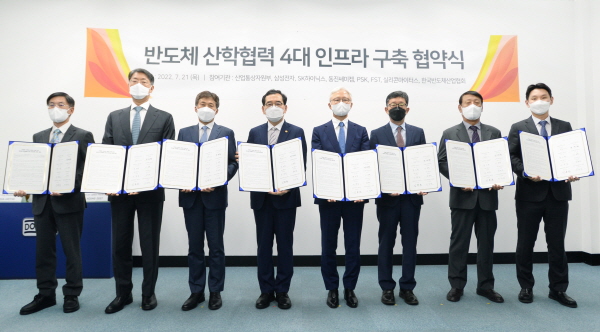
▲Participants pose for a commemorative photo at the industry-academia cooperation four major infrastructure establishment agreement ceremony.
■ MOU Signed for Four Major Semiconductor Industry-Academia Cooperation Infrastructure
In relation to this, the Ministry of Industry, Trade and Energy, Samsung Electronics, SK Hynix, Dongchin Semichem, PSK, FTS, Silicon Mitus, and the Semiconductor Association signed an MOU on the four major semiconductor industry-academia cooperation infrastructure to establish an industry-academia cooperation workforce development ecosystem.
Lee Chang-yang, Minister of Industry, Trade and Energy, stated: "Just as the industrial field continues to evolve, this policy announcement is by no means the conclusion of the semiconductor industry development strategy. Going forward, we will practice the 'Semiconductor Superpower Achievement Strategy' by maintaining close communication with the industry and continuously supplementing related measures." He added: "In particular, we will group promising new industries that will drive future semiconductor demand such as batteries, displays, future mobility, robotics, and biotechnology as 'Semiconductor Plus Industries,' and will sequentially establish competitiveness strengthening measures for Semiconductor Plus Industries to ensure virtuous cycle co-growth with the semiconductor industry."

Comments
Related news
The new government's semiconductor investment and talent development efforts
China's semiconductor rise, U.S. President Biden holding a semiconductor wafer, and TSMC with the world's largest foundry market share—these three have a common point. That is, they all fall within the category of comprehensive government support for semiconductor industry development.
2022.04.28by 명세환 기자
Samsung to invest 450 trillion won in semiconductors and new growth IT over 5 years
Samsung's global standing has been elevated further following U.S. President Biden's visit to Samsung Foundry, and attention is focused on the company's vision for future growth. Samsung has announced that it aims to expand job creation to one million people through achieving status as a semiconductor superpower and fostering new growth engines for the future, bringing expectations for domestic economic stimulus.
2022.05.24by 명세환 기자

50% cash support for foreign investment in high technology and supply chains
As economic security, including supply chain stability, has emerged as a key pillar of national competitiveness, the EU and the United States are competitively rolling out cash support measures for semiconductors and other core industries. Government authorities have also announced strengthened cash incentive programs to attract foreign investment in national strategic technology sectors, reinforcing efforts to attract foreign companies.
2022.07.19by 명세환 기자
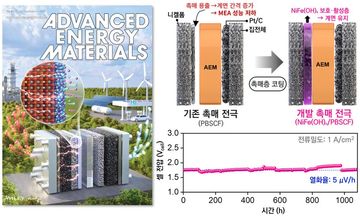
Materials Research Institute Develops Ultra-thin Coating Water Electrolysis Catalyst Technology
The Korea Institute of Materials Science has simultaneously resolved the performance and durability trade-off problem in water electrolysis catalysts by applying ultra-thin surface coating technology. Achieving 1.9 times higher performance compared to conventional catalysts while demonstrating 1,000-hour long-term stability, the institute has developed technology scalable to industrial water electrolysis systems through a simple process.
2026.10.07by 배종인 기자
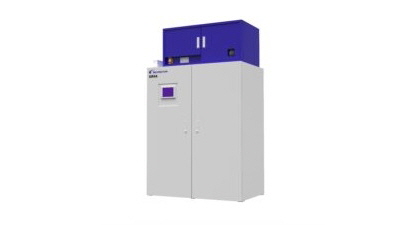
Gigaphoton Develops Neon Gas Recycling System for ArF Excimer Lasers...Achieves 50% Recycling Rate
Gigaphoton announced that it has developed a gas recycling system for ArF excimer lasers and achieved a 50% neon gas recycling rate.
2026.10.02by 배종인 기자











