



Global Semiconductor Market Enters Downcycle
 Published2022.07.29 14:00
Sectors to Watch: Growth Expected in Data Centers, Cloud Infrastructure, and Automotive Semiconductors
The slump in consumer product consumption is becoming more pronounced due to the impact of global inflation. It appears that the semiconductor industry has entered a down cycle, as semiconductor sales growth rates have been revised downward and related companies have pointed out weak demand for consumer products during their second-quarter conference calls.
According to the 2022 global semiconductor sales forecast released by market research firm Gartner, the growth rate of global semiconductor sales in 2022 is expected to be only 7.4%. This represents a significant drop from the 26.3% growth rate in 2021 and signals a semiconductor downcycle as it was revised downward from the 13.6% growth forecast announced last quarter.
Overall, as economic conditions are expected to worsen throughout the year, Gartner has lowered its forecast for global semiconductor revenue in 2022 to $639.2 billion, down $36.7 billion from the estimate released in the previous quarter. In particular, growth is expected to slow further as demand and prices for memory semiconductors stabilize in consumer-related sectors such as PCs and smartphones.
In addition, while PC shipments recorded growth in 2020 and 2021, they are projected to decline by 13.1% in 2022. Consequently, Gartner predicted that revenue from PC semiconductors would also decrease by 5.4% in 2022. In addition, the growth rate of smartphone semiconductor sales in 2022 is expected to be only 3.1%, which is a significant drop from the 24.5% growth rate in 2021.
During the second-quarter conference call, Samsung Electronics Vice President Suh Byung-hoon explained, "While we forecast that server demand for memory will continue, mobile and PC demand will remain weak." He added, "To meet future demand growth, investments have been executed in the Pyeongtaek Phase 3 infrastructure and expansions in Hwaseong, Pyeongtaek, and Xi'an." In particular, it appears that investments focused on process transitions, proceeding primarily to expand production capacity for advanced foundry processes of 5nm and below.
Richard Gordon, Vice President of Practice at Gartner, stated, “While semiconductor shortages are easing, the global semiconductor market is entering a bear market,” adding, “As the weakness persists through 2023, semiconductor revenue is projected to decline by 2.5% year-over-year in 2023.” He continued, “Weakness has already been confirmed in the semiconductor end market, particularly in sectors closely linked to consumer spending. Consumer disposable income is under pressure due to rising energy and fuel costs, along with inflation, taxes, and interest rates.” "This affects spending on electronic products such as PCs and smartphones," he explained.
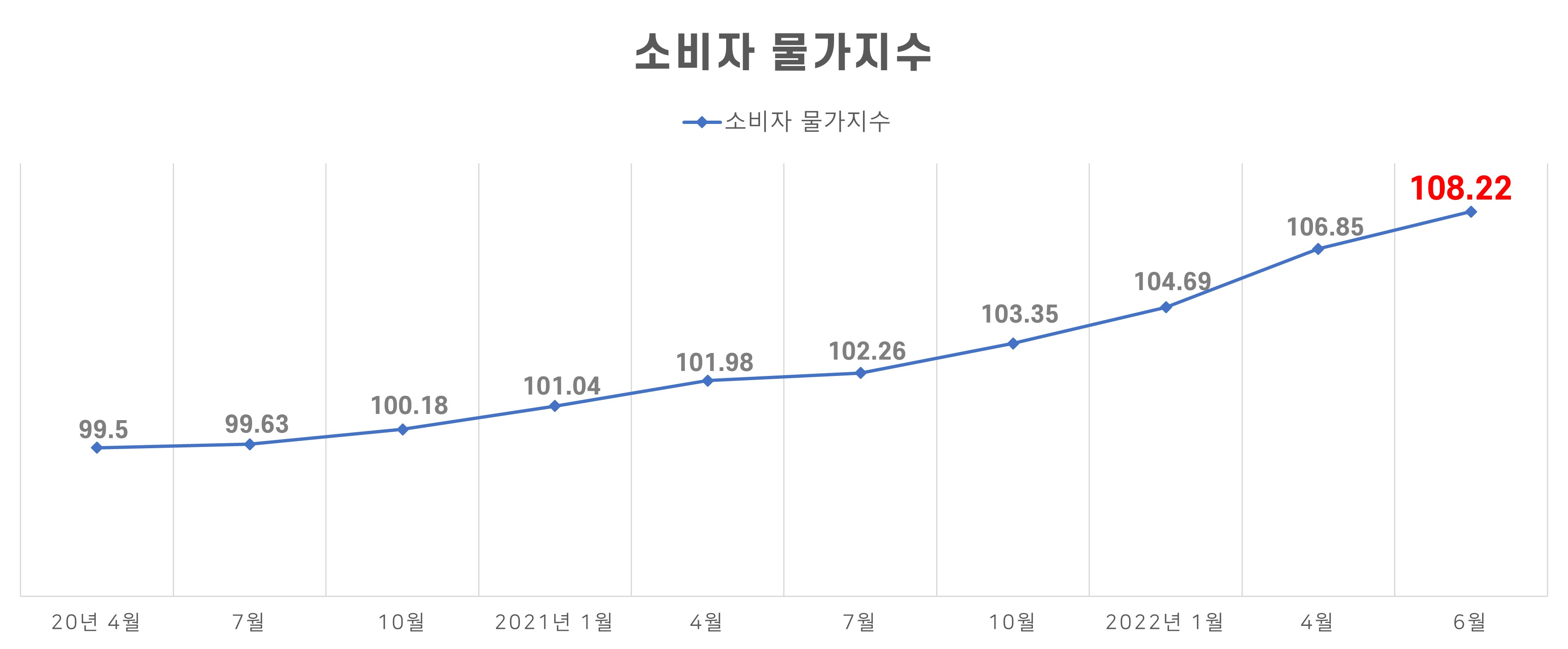
▲ Trends in Domestic Consumer Price Index (Source: Statistics Korea / Graphic: e4ds)
With weakening consumer sentiment linked to the global economic downturn significantly impacting demand for IT products, the domestic consumer price index has steadily risen from 99.5 around April 2020, during the early stages of the COVID-19 pandemic, reaching 108.22 in the most recently released June figures. As consumer price inflation reaches record highs not only in Korea but also globally—including Australia, the UK, and the US—it is projected that a slump in demand for electronic devices resulting from weakened consumer sentiment will be unavoidable.
Vice President Gordon, noting that the semiconductor market is entering a downcycle, stated, “While the consumer market is expected to slow down, semiconductor sales in the data center market are projected to maintain robust growth for a longer period, driven by continued investment in cloud infrastructure, and are expected to record a growth rate of 20% in 2022.” He added, “Furthermore, as the number of semiconductors per vehicle increases due to the transition to electric and autonomous vehicles, the automotive electronics sector is expected to continue double-digit growth over the next three years.”
The recent shortage of microcontrollers (MCUs) is a good example of the robust demand for automotive semiconductors, and the demand in the server market is also expected to maintain a sufficient upward trend in the future, driven by the surge in data usage and technological advancements such as 5G, the Internet of Things, and edge cloud.

Comments
Related news
Gartner, “Device ‘Cold Wave’”
Since the global spread of the COVID-19 pandemic, the IT product sector has experienced a consumption boom. Coupled with the development of IT technologies such as high-quality content like 4K and 8K, as well as AI, autonomous driving, connected cars, and cloud services, last year recorded unprecedented growth in related IT spending. This year is experiencing a more subdued boom compared to last year, and the device sector is facing headwinds, causing heightened tension regarding changes in the global market and domestic industry trends.
2022.07.25by 명세환 기자
.jpg)
Samsung Electronics, 2Q sales of 77.2036 trillion won… Highest ever in 2nd quarter
Samsung Electronics achieved record-high operating results for the second quarter in 2022, driven by strong response to server demand in the semiconductor division and expanded supply of system semiconductors.
2022.07.28by 배종인 기자

New Record for 2Q Silicon Wafer Shipments
In the second quarter of 2022, global silicon wafer shipments reached a record high due to sustained demand for semiconductors.
2022.07.29by 배종인 기자

Intel Unveils Next-Generation 'Core Ultra Series 3' and vPro Platform for Enterprise PCs
Intel has officially unveiled the "Intel Core Ultra Series 3" for next-generation enterprise PCs and the latest vPro platform, addressing a wide range of demands from enterprise notebooks to high-performance workstations.
2026.03.26by 배종인 기자

ROHM Launches ESD Protection Diode Compatible with High-Speed Interfaces of 10Gbps or Higher
Semiconductor specialist ROHM has developed the 'RESDxVx series' of ESD (electrostatic discharge) protection diodes capable of responding to next-generation high-speed data communication environments exceeding 10Gbps, simultaneously enhancing both signal quality maintenance required in high-speed interfaces and IC protection performance.
2026.03.26by 배종인 기자











