


Samsung Electronics Accelerates Development of Future Wearable Technology
 Published2022.08.01 14:08
.jpg)
▲Samsung Electronics Researcher Shin Bong-soo and Ajou University Research Team (From left: Kim Baek-gyeom, Kim Dong-jin, and Professor Ko Je-seong) (Photo: Samsung Electronics)
Realistic wearable technology is expected to surpass smartphones as the future of next-generation electronic devices and become a core technology of the metaverse. Accordingly, ultra-lightweight, multi-functional actuators for wearable implementation have emerged as a key technology for next-generation immersive interaction.
Samsung Electronics announced on the 1st that a research paper on an ultra-light and ultra-thin artificial muscle actuator jointly developed by Samsung Electronics and Ajou University was recently published in the world-renowned academic journal 'Nature Communications'.
This study presents a vision for expanding the application of artificial muscle actuators, which have been mainly used in the field of robotics, to the field of small wearables.
The actuator is a system that can move an object by applying pressure or measure the pressure of an artificial muscle. The research team has achieved results that prove the possibility of implementing future technology that can be applied to wearable devices such as AR glasses and haptic gloves by researching and developing a multi-functional artificial muscle actuator based on shape memory alloy.
In the field of virtual environments, research is being conducted on actuators and sensors to enhance immersion. Actuators and sensors applied to AR/VR wearable devices must be small and lightweight for wearability, while also implementing complex visual and tactile functions.
To overcome the limitations of existing electromagnetic motor-based actuators, the research team designed an ultra-light (0.22 g) and ultra-thin (less than 5 mm) multi-functional actuator that combines shape-memory alloy-based artificial muscles and flexible elements, and tested its actual effectiveness in wearable devices.
By applying the technology to AR glasses, the research team claimed to have confirmed a reduction in visual fatigue experienced by users. The actuator directly adjusts the distance between the display and the AR glasses' optical system based on the object's focal length, mitigating convergence mismatch, a phenomenon that causes visual fatigue.
This convergence mismatch phenomenon is similar to the dizziness experienced when watching a 3D movie. It occurs when there is a mismatch between the accommodative distance for focusing on the screen and the convergence distance for focusing on 3D objects, which increases eye fatigue.
Furthermore, by applying the artificial muscle actuator to a tactile transmission glove, the research team confirmed that it could provide a tactile sensation similar to pressing with an actual hand. The actuator has the advantage of measuring pressure without a separate sensor, allowing a tactile transmission glove using it to be thin yet capable of recognizing Braille and other symbols. Converting the recognized Braille into electrical signals and transmitting them could potentially be utilized in future telehaptics technology.
As core hardware technologies for next-generation realistic interaction are gradually developing, Seongjeon Electronics announced that it plans to continue researching innovative technologies through industry-academia cooperation.

Comments
Related news

Samsung Electronics to hold 'Samsung Security Technology Forum' in August
With the dawn of the 5G and 6G era, device paradigms are shifting toward connected cars, edge AI, and AIoT, while the importance of device security is receiving unprecedented attention. Accordingly, IT companies including Samsung are maturing security technologies through forums for identifying and discussing security technology agendas.
2022.07.25by 명세환 기자
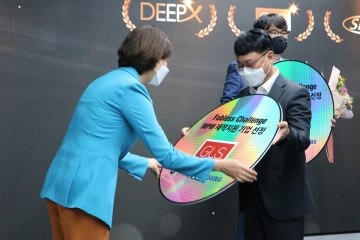
Samsung Electronics and the Ministry of SMEs and Startups (MSS) are partnering to develop the system semiconductor ecosystem, hosting the Fabless Challenge.
Samsung Electronics and the Ministry of SMEs and Startups have joined forces to build a domestic system semiconductor ecosystem aimed at revitalizing the domestic fabless ecosystem.
2022.07.27by 명세환 기자
.jpg)
Samsung Electronics, 2Q sales of 77.2036 trillion won… Highest ever in 2nd quarter
Samsung Electronics achieved record-high operating results for the second quarter in 2022, driven by strong response to server demand in the semiconductor division and expanded supply of system semiconductors.
2022.07.28by 배종인 기자
ESP32 Development Environment Selection and GPS Application Implementation
The ESP32 is a microcontroller that integrates Wi-Fi, Bluetooth, 12-bit ADC, capacitive touch, PWM, DAC, and UART in a single SoC. However, the abundance of features does not by itself solve the designer's problems. The real challenges lie in selecting the appropriate development environment, determining which pins can be used and which must be avoided, and converting raw data from modules into usable information. This document addresses ESP32 peripheral constraints (ADC2 and Wi-Fi coexistence limitation, UART1 occupancy, ADC non-linear regions), the trade-offs between Arduino IDE and ESP-IDF, and the process from connecting NEO-6M/NEO-M8N GPS modules to UART2, parsing NMEA sentences, and visualizing routes in Google Earth, all organized based on documented references.
2026.10.12by 편집부
MIPI CSI-2, DSI-2, C-PHY, D-PHY Test Solution Technical White Paper
The MIPI interface adopts a burst mode that transitions between low-power (LP) and high-speed (HS) states for low-power consumption, and in return, strict timing rules are imposed on state transitions. Additionally, the high-speed section operates as a packet-based protocol with headers, ECC, and CRC, so verification engineers must handle waveforms and protocols simultaneously. Traditional configurations combining general-purpose oscilloscopes and AWGs reveal limitations in setup complexity, measurement uncertainty, and lack of reproducibility when faced with these requirements. This white paper, based on webinar materials, organizes the structure of this problem and describes how the SV5C-DPTXCPTX generator for receiver testing and SV5C-DPRXCPRX analyzer for transmitter testing integrate state transition testing, stressed eye testing, and protocol analysis into a single bench, along with their application boundaries.
2026.10.12by 편집부











