


Intel Unveils Virtualized Wireless Access Network Capabilities
 Published2022.08.05 10:47
Mobile operators have begun adopting virtualized wireless access networks and open ecosystems. As interoperability Open RAN collaborations gain momentum, Intel is also participating in experiments with innovative O-RAN-based technologies.
Intel participated in Global PlugFest Spring 2022 on the 5th and unveiled virtualized wireless access network capabilities together with industry partners.
As the wireless communications industry pursues technologies beyond traditional Radio Access Networks (RAN) utilizing dedicated hardware, an increasing number of mobile operators are adopting virtualized Radio Access Networks (vRAN) and open ecosystems based on general-purpose hardware. This is because it enables flexibility, scalability, and operational efficiency, thereby unlocking the potential of 5G networks and achieving greater innovation as they evolve into 6G networks.
As this trend continues, movements toward interoperable OpenRAN collaboration are also accelerating. Industry integration was recently showcased at the O-RAN Alliance virtual demo and Global Plugfest Spring 2022, which featured over 50 companies and organizations across three continents. The event demonstrated the integration of multi-vendor network functions and compliance with O-RAN standards.
As a Plugfest participant and a member of the O-RAN Alliance, Intel experimented with O-RAN-based innovative technologies together with various industry partners. Partners shared new use cases that can generate revenue and reduce operating costs based on intelligent RAN architecture innovations compatible with open RAN.
Intel confirmed energy savings through the results of major technology innovation experiments. Intel, which claims that up to 12% energy savings are possible, successfully demonstrated the reduction in operational energy consumption of open RAN infrastructure in infrastructure installed at the University of Utah Mobile Network Lab in collaboration with Vodafone, Wind River, Keysight Technology, and Radisys. Measured using actual traffic scenarios, the results confirmed power savings of 9% and 12% in scenarios with high and low mobile traffic, respectively.
Furthermore, RAN slice assurance technology enables the provision of 5G services that guarantee Service Level Agreements (SLAs), which ensure performance and quality levels. Network slicing plays a crucial role in helping service providers deliver innovative new services and maximize return on network investment. Accordingly, Intel emphasized that the delivery of services and business models is possible by leveraging 3rd Gen Intel® Xeon® processors.
Intel and VMware experimented with dynamic RAN slice resource allocation for SLA assurance on an open cloud platform supported by the VMware Telco Cloud Platform (TCP). Through this, they demonstrated the ability to support multiple cells and virtual distributed units (vDUs). The experiment was conducted using VMware xApps hosted on the VMware Real-time RAN Intelligent Controller (RIC). The RIC uses O-RAN standard interfaces to dynamically allocate cell resources, supporting the fulfillment of end-user SLAs. The operator can provide differentiated services based on slicing through SLA guarantees in the local mobile network.
Intel demonstrated AI and machine learning-based Network Slice Radio Resource Management (NSRRM) xAPP SLA assurance on an O-RAN intelligent controller integrated with an open and virtualized RAN based on Intel® FlexRAN™ reference software, which includes an AI/machine learning-based scheduler. This presented the possibility of providing telecommunications operators with revenue-generating business models using optimal radio resources.
Christina Rodriguez, General Manager and Vice President of Wireless Access Networking at Intel, said, “Industry-wide opportunities like Plugfest demonstrate the value of collaboration toward open ecosystems and software-defined networks. Intel is committed to driving technological innovation and intelligence across RAN environments, including CloudRAN and OpenRAN networks, and to supporting operators in achieving all the business and efficiency benefits of RAN virtualization.”

Comments
Related news
ADI Announces RF Platform for 5G O-RAN Equipment Optimization
ADI announced RadioBus, a wireless platform based on ASIC for O-RAN compatible 5G wireless devices. The platform integrates functions required for O-RAN compatible 5G wireless devices, including baseband ASIC, software-defined transceiver, signal processing, and power supply. Additionally, it has been designed to enable significant improvements in performance and form factor.
2021.03.26by 이수민 기자

Keysight-NTT Docomo Sign MOU for O-RAN Standard Success
Keysight has signed an MOU with Japanese telecom carrier NTT DoCoMo to enhance the O-RAN ecosystem.
2022.04.01by 김예지 기자
Lattice Unveils Security Control FPGA and ORAN Solutions, "Responding to Complex and Changing Trends"
As system control architectures become increasingly complex, modern CPU and SoC designs lack sufficient 3.3V I/O support, creating a need for solutions to address this issue. Simplified system design and integration have become essential requirements, and an opportunity has been arranged to introduce Lattice's solutions for resolving these challenges.
2022.06.03by 명세환 기자
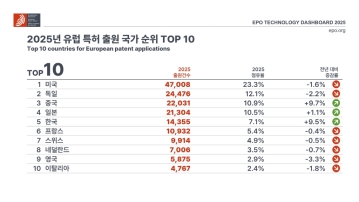
European Patent Applications Surpass 200,000 for the First Time… South Korea Maintains 5th Place, Led by Batteries and Telecommunications
According to the European Patent Office (EPO)'s 'Technology Dashboard 2025', European patent applications last year reached 201,974, surpassing 200,000 for the first time. Korean companies and inventors filed 14,355 applications, representing a 9.5% increase from the previous year and maintaining 5th place by country. Battery, digital communication, and semiconductor technologies led the growth, with Samsung ranking as the top EPO applicant for the second consecutive year and LG reaching 3rd place. The presence of major domestic cities such as Seoul, Suwon, and Yongin was also confirmed. It was also revealed that Korea's European patent strategy is expanding beyond individual technologies to span the entire industry.
2026.03.24by 명세환 기자

SK Telecom First Applies AI-Based Network Operations at Gwanghwamun K-Pop Concert
SK Telecom announced that it applied an AI-based network operation system for the first time at a large-scale K-pop concert held in the Gwanghwamun area of Seoul on March 21st, managing communication quality throughout the event. Mobile data usage during the three hours before and after the concert reached 12.15TB, approximately doubling compared to the same time slot the previous weekend. SK Telecom monitored traffic using the AI system 'A-One' in five-minute and 50-meter units to respond to potential overload situations, while also operating temporary communication facilities and on-site personnel in parallel. This case is interpreted as confirmation of the practical applicability of AI-based autonomous network operation in an environment where demand from dense events and foreign users increases simultaneously.
2026.03.23by 명세환 기자











