



Intel Meets Intelligent Visual Cloud Requirements with Flex GPU
 Published2022.08.29 13:51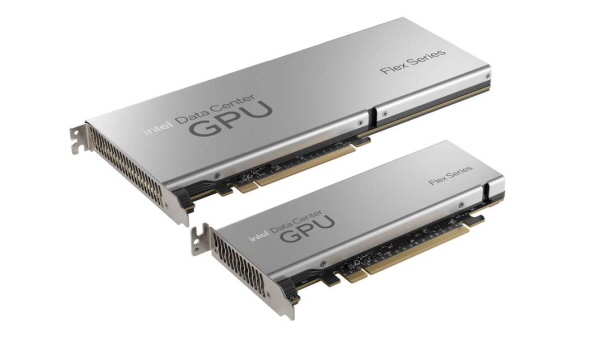
Supports 68 simultaneous cloud game streams
Intel has unveiled a GPU for data centers capable of up to five times higher media transcode processing performance and supporting up to 68 simultaneous cloud game streams.
Intel announced on the 25th that it would unveil the Intel® Data Center GPU Flex Series, known by the codename 'Artik Sound-M'.
The newly announced GPU products help free users from the constraints of isolated and proprietary environments, and help data centers reduce the need for separate individual solutions.
Intel provides a single GPU solution built to flexibly handle a wide range of workloads without affecting performance or quality.
In addition, it supports Total Cost of Ownership (TCO) reduction and optimization for various cloud workloads, including media delivery, cloud gaming, AI, the metaverse, and other new visual cloud use cases.
Jeff McVeigh, General Manager and Vice President of Intel’s Supercomputing Group, said, “The current graphics landscape is facing an exponential increase in pixels due to consumers, applications, and resolution. “Current data center infrastructure must handle significant workloads such as computing, encoding, decoding, moving, storing, and displaying visual information,” he said. “The Intel Flex Series GPUs are groundbreaking products that specifically address today’s computing requirements while providing the flexibility and scalability to deliver immersive experiences in the future.”
Intel Flex Series GPUs are products that meet the requirements for quality, density, and latency. As the industry's first data center GPU to feature a hardware-based AV1 encoder, Flex Series GPUs provide 5x1 higher media transcoding performance and 2x2 higher decoding performance with only half the power consumption of competitor GPUs.
In addition, it reduces TCO based on a bandwidth improvement of over 30%3 and provides extensive support for popular media tools, APIs, frameworks, and the latest codecs.
Intel Flex Series GPUs are designed based on Intel's Xe-HPG architecture and are supported by an extensive ecosystem of hardware vendors and software developers. They also enable developers to flexibly scale various AI inference workloads, such as media analysis, smart cities, and medical imaging, between CPUs and GPUs without being restricted by software copyrights.
Currently, media processing, media delivery, AI visual reasoning, cloud gaming, and desktop virtualization are surging within data centers. As a result, the data center GPU market for visual clouds is expected to grow to $15 billion by 2026. This leads to a phenomenon where the industry becomes dependent on copyrighted software, such as CUDA, for GPU programming.
The Intel Flex Series GPU solution stack overcomes these limitations while providing significant advantages in flexibility, scalability, and power consumption compared to other solutions. It enables solution providers to reduce TCO by supporting more subscribers with a smaller number of servers.
The software stack runs on oneAPI, which presents a productive path for accelerated computing, and enables developers to be free from the economic and technical issues caused by software copyright. It offers an open alternative to dependence on proprietary languages by supporting the maximization of hardware performance through safe and proven tools that complement existing languages and parallel models. This allows users to develop open, portable code that fully utilizes various combinations of Intel CPUs and GPUs.

Comments
Related news

Intel Issues $1.2 Billion Green Bonds... Strengthening Sustainability Efforts
IT companies are actively investing to contribute to the global environment. Intel is expected to issue green bonds to support environmental improvement goals as part of sustainable management, including greenhouse gas reduction and renewable energy usage.
2022.08.04by 명세환 기자
.jpg)
Intel Unveils Virtualized Wireless Access Network Capabilities
Mobile telecommunications operators have begun adopting virtualized radio access networks and open ecosystems. With increased collaborative efforts around interoperable Open RAN, Intel is also participating in experiments with O-RAN-based innovative technologies.
2022.08.05by 명세환 기자

Intel Unveils Latest Architecture and Packaging Innovations at Hot Chips 34
The semiconductor industry is entering a golden age that requires a paradigm shift from the traditional foundry model to the systems foundry model. Intel's systems foundry model goes beyond conventional wafer manufacturing support to offer Systems-in-Package that integrates △advanced packaging △open chiplet ecosystems △software components, focusing on meeting the needs of users demanding powerful computing capabilities and immersive digital experiences.
2022.08.25by 명세환 기자

Intel Unveils Next-Generation 'Core Ultra Series 3' and vPro Platform for Enterprise PCs
Intel has officially unveiled the "Intel Core Ultra Series 3" for next-generation enterprise PCs and the latest vPro platform, addressing a wide range of demands from enterprise notebooks to high-performance workstations.
2026.03.26by 배종인 기자

ROHM Launches ESD Protection Diode Compatible with High-Speed Interfaces of 10Gbps or Higher
Semiconductor specialist ROHM has developed the 'RESDxVx series' of ESD (electrostatic discharge) protection diodes capable of responding to next-generation high-speed data communication environments exceeding 10Gbps, simultaneously enhancing both signal quality maintenance required in high-speed interfaces and IC protection performance.
2026.03.26by 배종인 기자











