


[Contribution] Rama Nachman, Intel Labs Director: "The Power of AI: Leveraging Responsibly"
 Published2022.09.16 14:40
The Power of AI, Leveraged Responsibly
Announce initiatives, products, and partnerships through the AI website.
Maintaining efforts to prevent misuse, internal supervision, and various management procedures
Since artificial intelligence (AI) began to be applied across our daily lives, it has become an important part of our lives.
AI voice banking systems for people with neurological disorders, improving the safety of self-driving cars, and research to better understand rainfall patterns and population trends are all being applied. AI can help overcome obstacles faced by humans, create safer societies, and develop solutions to build a better future.
Meanwhile, the obvious but realistic problem that poorly designed AI could harm humans must always be kept in mind.
Intel is developing AI responsibly, ensuring that it doesn't alienate people, doesn't use data unethically, and doesn't discriminate based on race.
Intel will unveil its AI initiatives, products, and partnerships on its AI 12 website. We expanded our 'One Intel' approach by demonstrating a company-wide commitment to responsible AI.
Intel recognizes the ethical risks associated with developing AI technology and strives to be a role model across industries. To ensure the responsible development of AI technology throughout the product lifecycle, we are committed to preventing AI misuse and are maintaining internal oversight and management procedures.
■ Review process
Intel's Responsible AI Advisory Council conducts a rigorous review process throughout the lifecycle of AI projects.
The committee conducts a review process for products and projects through Intel's ethical impact assessment in six key areas: human rights, management oversight, reasons for using AI, security, safety and reliability, privacy, and equity and inclusion.
The goal is to assess and mitigate potential ethical risks within AI projects. Committee members also provide training and feedback to AI project development teams to ensure overall consistency and compliance.
■ Diversity and Inclusion
The bias of AI algorithms cannot be addressed through tools and processes alone. AI technology must be shaped by a diverse group of people with diverse backgrounds, opinions, and experiences.
Intel wants to maintain fairness among AI practitioners and their respective technologies. We strive to leverage social science research to understand situations where biases may arise in data, problem formulation, or modeling, as well as unexpected and dangerous situations.
Intel recognizes that ethical considerations must be a core component of all AI education programs. Intel exposes students to AI ethics principles through programs designed to prepare them for the digital age, such as the AI for Future Workforce Program. Intel also explores new ways to connect with community colleges and individuals from diverse backgrounds and expertise.
■ Privacy and Security
Intel's security research and development team strives to deliver secure AI technologies while maintaining data integrity, privacy, and accuracy.
Intel conducts reviews across hardware and software to build trustworthy AI. The Private AI Institute educates people on how to better protect their personal information. Intel's research in federated learning and OpenFL focuses on developing useful AI technologies based on sensitive data. It also participates in the Defense Advanced Research Projects Agency (DARPA) GARD project, exploring methods for verifying AI tampering. Project Amber provides customers and partners with ways to better trust their infrastructure, from edge to cloud.
Intel has been integrating deepfake detection technology and tools to determine the source material used in deepfakes into its products and exploring ways for customers to incorporate them into their platforms. We have been researching deepfake detection, the creation or modification of fake media using machine learning and AI, and media authentication technology to verify the validity of content.
■ Collaboration
Intel continues to invest in critical research, collaborating with leading experts in privacy, security, human-AI collaboration, and sustainability.
Intel also embraces the potential for collaboration between humans and AI. To achieve this, it is developing the necessary capabilities and applying them internally to its design and manufacturing processes. Intel strives to transparently disclose its positions and practices to enable advancements in its own products and across industries, addressing common challenges.
Intel participates in forums such as the Human Rights & AI Roundtable, the Global Business Initiative, the Partnership on AI, and the Commitment to Building Gender Equality.
While AI has made significant progress, there's still much to explore. Intel is continuously exploring ways to use AI to mitigate risk and drive positive change. We focus on advancing AI through a multifaceted approach and amplifying human potential through human-AI collaboration. Unleashing the positive power of AI will require continued collaboration between Intel and relevant industries.
Comments
Related news

[e4ds Tech Day 2026 ⑨] Sim Sang-gyu, Autocrypt CTO: "In the Physical AI Era, Automotive Security Must Extend Beyond the Vehicle"
At e4ds Tech Day 2026, Sim Sang-gyu, CTO of Autocrypt, explained automotive cybersecurity strategies in the era of Physical AI and SDV (Software-Defined Vehicle). Automobiles are evolving as part of an ecosystem connected to AI, cloud, chargers, IoT, and robots, and he emphasized that the scope of security must expand beyond the vehicle interior to the entire connected environment. In particular, AI model tampering, adversarial attacks, OTA updates, and EV charger hacking were identified as major threats. He explained that response measures require zero trust, AI model integrity protection, intrusion detection, Security by Design and Default, and full lifecycle security management, and that proactive security system establishment beyond regulatory compliance is critical for securing future mobility competitiveness.
2026.10.12by 배종인 기자

NVIDIA to Invest $1 Billion in U.S. Science Over Next Five Years
NVIDIA has announced plans to invest $1 billion over the next five years to strengthen U.S. scientific and technological competitiveness. The company will enhance cutting-edge artificial intelligence research and development capabilities in key areas including quantum computing, healthcare, and energy security, while expanding support for higher education research institutions and cloud service providers. NVIDIA is participating as a major industry partner in the White House Office of Science and Technology Policy's Genesis Mission, and is promoting supercomputer construction in collaboration with national laboratories including Argonne and Los Alamos.
2026.10.12by 배종인 기자
ETRI Unveils 3 Next-Generation Media Technologies Including AI-Dedicated Video Compression
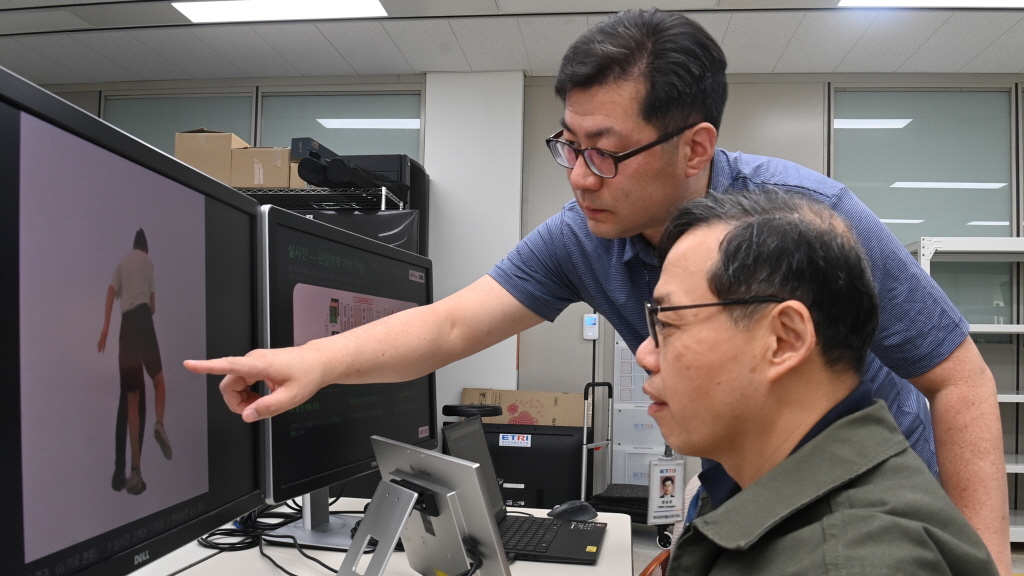
ETRI has unveiled three next-generation media technologies optimized for AI. These include AI-based video encoding (VCM), 3D human generation based on sparse cameras, and generative AI-based pre-visualization technology. In environments where AI directly processes video such as autonomous vehicles, robots, and drones, these technologies enable efficient compression and transmission of large-scale data, and can be applied across various industrial sectors including smart cities, video security, and sports broadcasting.
2026.10.12by 배종인 기자

KETI Connects Domestic and Uzbekistan Museums Through Robot Telepresence for Remote Exhibition
The Korea Electronics Technology Institute (KETI) has hosted a remote experiential exhibition that connects domestic museums with an Uzbekistan museum in real-time using robot telepresence technology. Elementary school students in the Sangju area were able to directly operate autonomous robots to remotely view 7th-century Goguryeo envoy palace murals at the Afrasiab Museum in Samarkand, and the exhibition provides spatial experience comparable to on-site visits by combining real-time high-quality video transmission, AI docent, and autonomous driving technologies.
2026.10.12by 배종인 기자

Arduino UNO Q Technical Whitepaper: MPU·MCU Hybrid Board for Cloud-Free Edge AI
Arduino UNO Q is a product that integrates a Qualcomm Dragonwing QRB2210 microprocessor (MPU) running Debian Linux and an STM32U585 microcontroller (MCU) executing Arduino sketches on Zephyr RTOS into a single UNO form factor board. The two processors do not share RAM and resources, exchanging data only through remote procedure calls (RPC) of Arduino_RouterBridge, and the development environment Arduino App Lab and apps reside within the board. This whitepaper describes the design intent of this hybrid architecture, development workflow, hands-on verification results, and limitations in industrial application based on webinar presentation materials and technical Q&A.
2026.10.09by 편집부











