



Korea's digital potential is worth $220 billion, and deregulation is essential.
 Published2022.10.11 15:26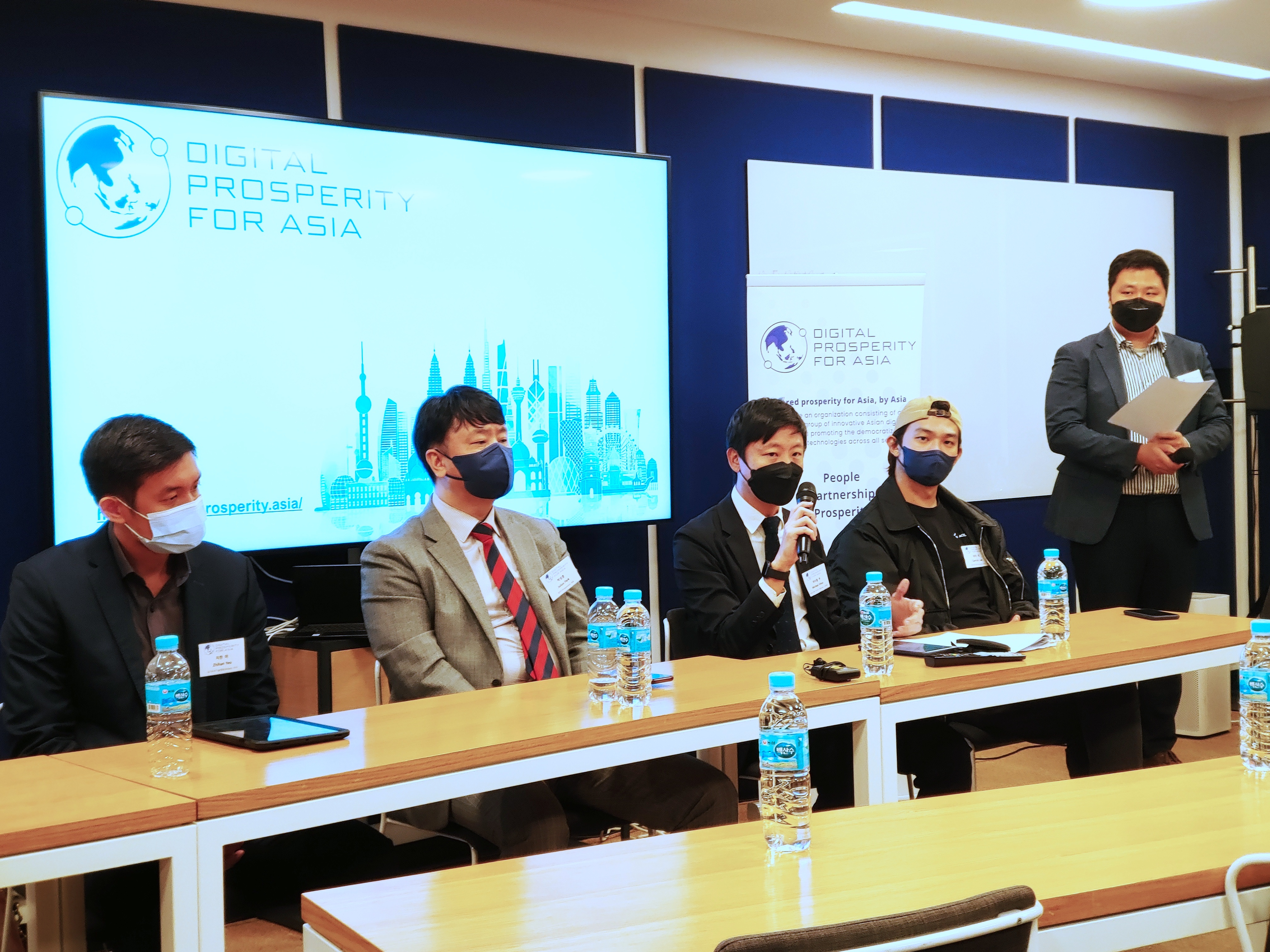
▲The launch ceremony of the Digital Prosperity Asia Alliance. Secretary-General Michael Koo (second from left) speaks.
Key elements of policy, capacity, infrastructure, and accessibility must be improved.
"The digital economy market in Asia holds enormous potential. 70% of the market remains unrealized, with an unrealized value of $2 trillion."
Michael Koo, Secretary General of the Digital Prosperity Asia Coalition, said: It has been argued that the voices of digital companies should be brought together to shape digital policy and foster the growth of the digital economy.
On the 11th, the Coalition for Digital Prosperity for Asia (DPA) held its official launch ceremony at the conference room of WeWork Tower in Gangnam, Seoul.
DPA was established to represent the voice of digital companies in the Asian region and promote related policies and infrastructure development. It was launched with 10 foreign digital companies, including domestic company App Media, as its initial members.
At the launch, the DPA released a research report titled “Digital Economy Drivers in the Asia-Pacific Region,” which quantifies the economic potential of digital technologies in the region and the economic benefits that governments and industries can derive from them.
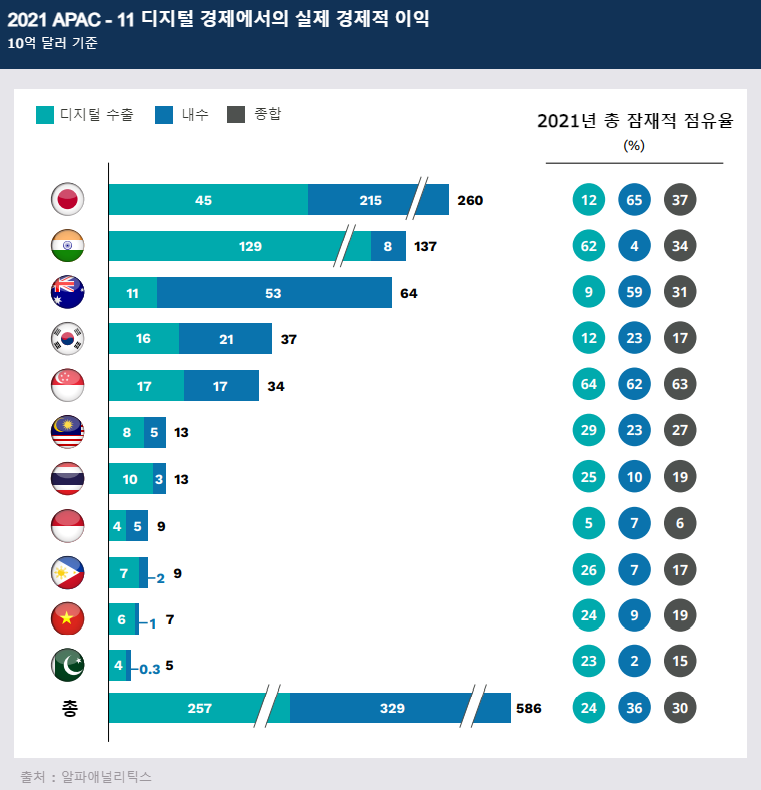
▲2021 APAC-11 Real Economic Benefits in the Digital Economy (Source: DPA)
According to the report, the Asia-Pacific region's economy accounted for 37% of global gross domestic product (GDP) in 2021, a figure attributed to rapid growth following the COVID-19 pandemic, driven by high internet penetration, increased purchasing power, and expanded intra-regional trade.
In particular, the digital economy of 11 APAC countries, including Korea, Japan, and Australia, was estimated to reach $586 billion in 2021, and is projected to expand to $2.2 trillion by 2030. It is projected that this could increase to $3.1 trillion if governments adopt flexible regulatory policies and a global technology approach.
The DPA report stated that APAC-11 must further utilize four support elements to ensure the continued growth of the digital economy: △easing digital policy regulations, △strengthening corporate competitiveness, △improving the digital capabilities of governments, companies, and consumers, and △expanding digital technology infrastructure, including digital connectivity, cloud, and security.
The DPA report estimated that Korea's digital economy would reach US$37 billion in 2021, representing only 17% of its market potential of US$222 billion. This figure falls short of the 30% average for the Asian region, as well as Singapore (63%), Japan (37%), India (34%), and Australia (31%). Korea's digital economy is projected to reach US$52 billion by 2030.
The DPA analyzed that while Korea is strong in digital capabilities and digital technology infrastructure, among the four driving factors of the digital economy, improvements in government policies and corporate competitiveness are needed to unlock the potential of digital growth.
"The DPA promotes a more open digital economy by minimizing potential barriers to cross-border data flows," said Secretary-General Michael Koo. "It aims to build regional industries that ensure appropriate data management safeguards." As an organization that implements corporate ideas, the DPA is gathering participating companies to achieve its vision.

Comments
Related news

Establishing a New Supply Chain, Digital Transformation is Important
Manufacturers are placing the highest priority on digital transformation when establishing new supply chain strategies.
2022.08.23by 배종인 기자
.jpg)
Strengthening digital productivity is essential
Huawei held "Huawei Connect 2022," an annual event in the global ICT industry, in Bangkok on the 19th. Ken Hu, rotating chairman, said "digitalization is clearly the right choice" and stated "both demand and technology depend on digitalization. The world is triggering digital productivity, and this is happening right now."
2022.09.20by 명세환 기자

“Electronic Paper, Future Smart Logistics and Distribution Food”
The global e-paper industry is experiencing growth driven by digitalization trends and ESG-oriented sustainable development initiatives. Currently, the e-paper market is predominantly occupied by foreign companies, indicating a need for domestic companies to enter the relevant market and localize core technologies.
2022.09.20by 명세환 기자
Nvidia invests $5 billion in Intel
NVIDIA and Intel, leaders in global AI computing technology, are now forging ahead in providing cutting-edge solutions through NVLink-based architecture integration. NVIDIA and Intel have officially announced a strategic partnership and stated that they will jointly develop customized data center and personal computing products to accelerate diverse applications and workloads ranging from hyperscale to enterprise and consumer markets, thereby laying the foundation for the next generation computing era.
2025.09.22by 배종인 기자
.jpg)
Applied Materials Launches Environmental Protection Campaign to Mark World Cleanup Day
Applied Materials Korea (CEO Park Kwang-seon) is carrying out environmental cleanup activities with employees and their families around the Dongtan Sinricheon area on the occasion of World Cleanup Day, evolving into a company that engages with the local community beyond technological innovation.
2025.09.22by 명세환 기자











