


Ministry of Science and ICT to Build 'K-Cloud' with Domestic AI Semiconductors
 Published2022.12.12 17:05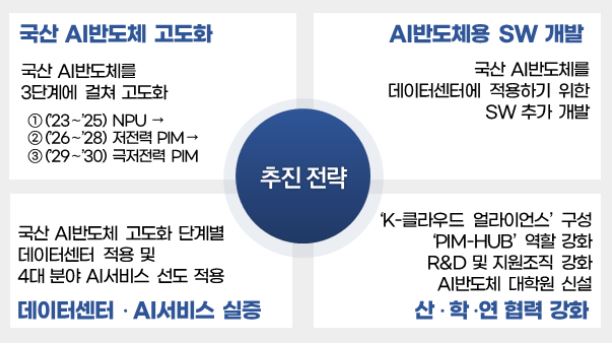
한국형 클라우드 생태계, 2030년 80% 목표

인터넷 기반 자원 공유 경쟁력의 근간인 데이터센터의 성능을 결정짓는 것은 반도체이다. 그 중 인공지능 반도체는 비용 대비 효율이 높으며, 아마존 등 세계적인 클라우드 서비스를 제공하며 AI반도체를 활용해 인터넷 기반 자원 공유 경쟁력을 선도적으로 확보해 나가고 있다.
과학기술정보통신부가 12일 경기창조경제혁신센터에서 ‘국산 인공지능 반도체를 활용한 케이(K)-클라우드 추진방안’을 발표했다. 이날 이종호 장관이 ‘인공지능 반도체 최고위 전략대화’를 주재했으며, ‘대한민국 디지털 전략’을 이행하기 위해 마련된 추진방안인 것으로 전해졌다.
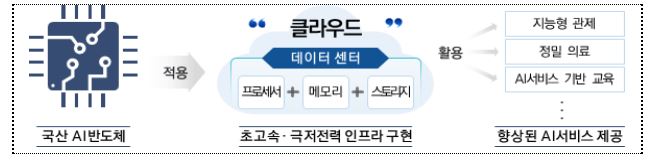
K-클라우드 추진방안은 세계 최고 수준의 초고속·저전력 국산 AI반도체를 개발해 이를 데이터센터에 적용하는 것을 목표로 한다. 이를 통해 국내 인터넷 기반 자원 공유 경쟁력을 강화하고, 국민들에게 향상된 인공지능 및 인터넷 기반 자원 공유 서비스를 제공하기 위함이다.
정부는 차세대 지능형 반도체 기술개발 및 PIM 인공지능 반도체 핵심기술 개발 사업 등 기존 AI반도체 사업을 종합하고 체계화해 2023년부터 2030년까지 총 8,262억원을 투자해 고도화 이행안을 마련할 예정이다.
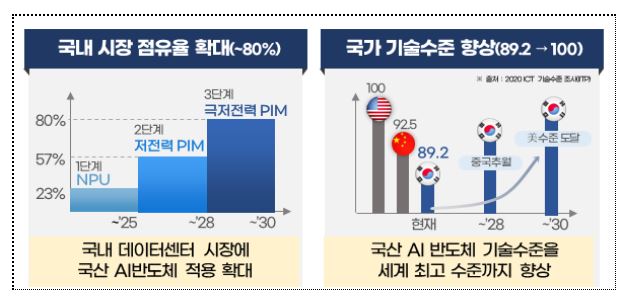
먼저 3단계에 걸쳐 국산 AI반도체를 고도화할 계획인 것으로 전해졌다. 2025년까지 1단계로 현재 상용화 초기 단계에 있는 국산 NPU를 지속적으로 고도화하고, 데이터센터에 적용해 성공 실적 확보 및 초기 시장 창출을 지원할 것이라고 발표했다.
이어 2단계는 2028년까지 D램 기반 상용 PIM과 국산 NPU를 접합해 세계적 수준의 연산 성능을 저전력으로 구현하는 것을 목표로 설정했다.
3단계는 2030년까지 비휘발성 메모리를 활용해, 아날로그 MAC 연산 기반의 NPU 및 PIM을 개발해 극저전력화를 달성한다는 계획을 구상하고 있다. 이를 통해 2030년까지 국내 데이터센터 시장에서 국산 AI반도체 점유율을 80%까지 끌어올린다는 목표를 설정했다.
이외에도 △데이터센터용 AI반도체에 필요한 소프트웨어 예타 사업 추진 △단계별 데이터센터 적용 및 서비스 제공 추진 △산학연 협력 강화 등을 명시했다. 이 과정에서 국산 NPU 데이터센터 구축사업과 기존 인공지능·인터넷 기반 자원 공유 서비스 개발 사업을 연계해 2025년까지 약 1,000억원을 잠정 투자할 계획이라고 밝혔다.
더불어 ‘케이-클라우드’ 추진을 위한 민·관 협업 창구 마련 및 주요 과제 발굴을 위해, ‘국산 인공지능반도체 기반의 케이-클라우드 얼라이언스’를 구성한다. 2·3단계 핌(PIM) 고도화·실증을 위한 메모리 반도체 대기업과 산·학·연 간 기술 연계 등을 위해 ‘핌 허브(설계연구센터, 한국과기원)’의 역할을 강화하고, 관련 분야(인공지능반도체·인터넷기반자원공유·인공지능 등) 협업 강화를 위해 연구개발 지원기관인 한국전자통신연구원(ETRI)과 정보통신기획평가원(IITP) 조직을 강화한다.
또한, 인공지능반도체 기업과 대학이 협력하여 교육과정을 개발하는 ‘인공지능반도체 대학원’을 신설해 현장에서 요구되는 설계역량을 갖춘 최고급 인재를 양성한다는 계획도 밝혔다.
이종호 과기정통부 장관은 “우리나라는 메모리 반도체 분야에서 세계 최고 수준의 경쟁력을 가지고 있으며, 이러한 기술력을 바탕으로 인공지능 시대의 핵심 기반 기술이자 반도체 산업의 새로운 성장 동력이 될 인공지능반도체를 세계 최고 수준으로 육성할 수 있다”며, “‘K-클라우드’ 사업을 통해 국내 인공지능반도체 및 인터넷기반자원공유 경쟁력을 높여 국민들이 보다 좋은 인공지능 서비스를 제공받을 수 있도록 산·학·연이 힘을 모으겠다”고 밝혔다.

Comments
Related news
Samsung Electronics and Naver Join Hands for Next-Generation AI Semiconductor
Samsung Electronics and Naver will collaborate on AI semiconductor solution development for AI algorithm development and verification, as well as convergence of AI service experience and technology.
2022.12.06by 김예지 기자
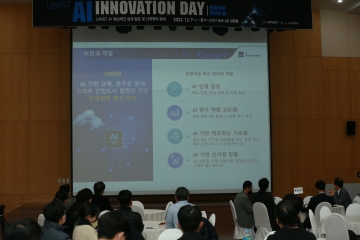
UNIST Leads the Southeast Region's AI Innovation Ecosystem
Ulsan is taking the lead in AI technology development and ecosystem building as a regional hub to foster specialized AI talent and promote the AI industry.
2022.12.08by 명세환 기자
NVIDIA and Deutsche Bank to Develop AI Financial Services
The potential of AI in the financial industry is limitless. McKinsey estimates that if AI technology is adopted in global banking, it could provide up to 1 trillion dollars in added value annually.
2022.12.08by 명세환 기자
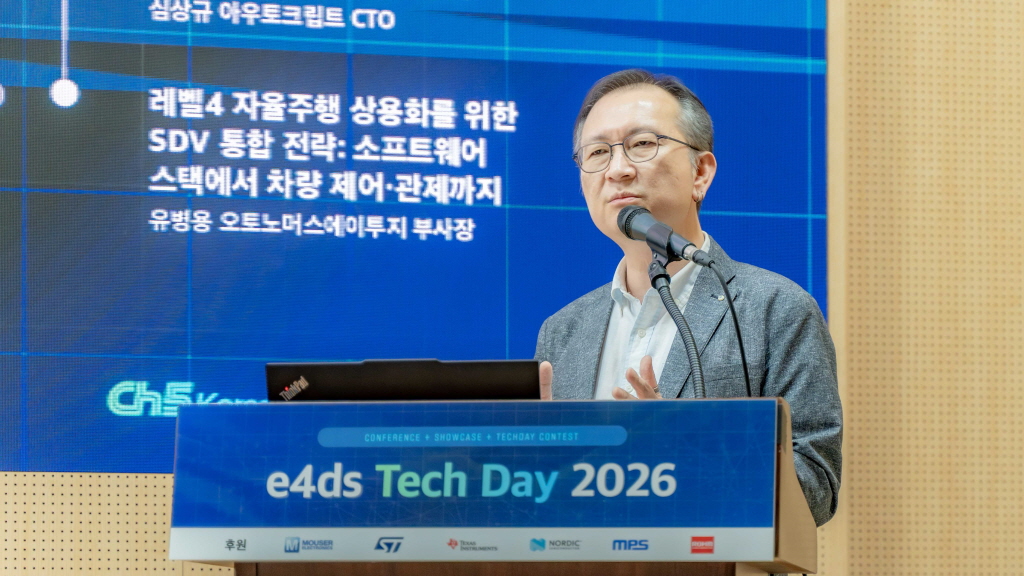
[e4ds Tech Day 2026 ⑨] Sim Sang-gyu, Autocrypt CTO: "In the Physical AI Era, Automotive Security Must Extend Beyond the Vehicle"
At e4ds Tech Day 2026, Sim Sang-gyu, CTO of Autocrypt, explained automotive cybersecurity strategies in the era of Physical AI and SDV (Software-Defined Vehicle). Automobiles are evolving as part of an ecosystem connected to AI, cloud, chargers, IoT, and robots, and he emphasized that the scope of security must expand beyond the vehicle interior to the entire connected environment. In particular, AI model tampering, adversarial attacks, OTA updates, and EV charger hacking were identified as major threats. He explained that response measures require zero trust, AI model integrity protection, intrusion detection, Security by Design and Default, and full lifecycle security management, and that proactive security system establishment beyond regulatory compliance is critical for securing future mobility competitiveness.
2026.10.12by 배종인 기자
NVIDIA to Invest $1 Billion in U.S. Science Over Next Five Years
NVIDIA has announced plans to invest $1 billion over the next five years to strengthen U.S. scientific and technological competitiveness. The company will enhance cutting-edge artificial intelligence research and development capabilities in key areas including quantum computing, healthcare, and energy security, while expanding support for higher education research institutions and cloud service providers. NVIDIA is participating as a major industry partner in the White House Office of Science and Technology Policy's Genesis Mission, and is promoting supercomputer construction in collaboration with national laboratories including Argonne and Los Alamos.
2026.10.12by 배종인 기자











