


Low-code market grows 20%, enabling non-IT professionals to develop without coding knowledge.
 Published2022.12.14 14:50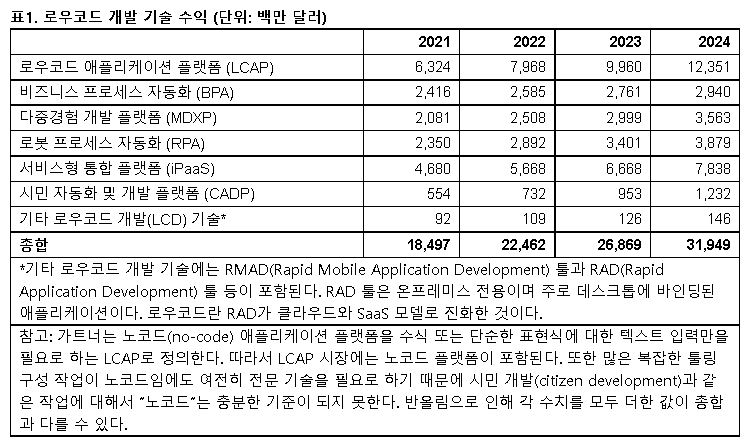
Boost the digital capabilities of business technology professionals with low-code.
No-code and low-code platforms that enable code-free application development are expected to support next-generation hyperautomation. Solution companies are rushing to offer various no-code solutions and low-code services, empowering not only IT professionals but also non-technical business technology leaders to strengthen their digital capabilities.
According to Gartner, the global low-code development technology market is projected to reach $26.9 billion in 2023, a 19.6% increase from 2022. The growing number of business technology professionals and the rise of hyperautomation and composable business initiatives across the enterprise are expected to be key drivers accelerating the adoption of low-code technologies through 2026.
In particular, low-code application platforms (LCAPs) are expected to grow by 25% in 2023, reaching a market size of approximately $10 billion. This is expected to become the largest component of the low-code development technology market.
“As demand for rapid application delivery and highly customized automated workflows grows, more and more enterprises are turning to low-code development technologies to meet this demand,” said Varsha Mehta, senior market research specialist at Gartner. “Both professional IT developers and non-IT business technology professionals can now use a variety of low-code tools to achieve the digital capabilities and delivery velocity required in modern agile environments.”
When segmenting the market, the largest segment is low-code application platforms (LCAPs), but citizen automated development platforms (CADPs) are projected to be the fastest-growing segment, growing 30.2% in 2023.
Common use cases for CADP include workflow automation, building web-based forms, connecting data and content across multiple software-as-a-service applications, and generating reports and visualizing data.
“The high cost of technical talent and the rise of hybrid or borderless workforces will drive the adoption of low-code technologies,” said Jason Wong, Distinguished VP Analyst at Gartner. “Empowered by the intuitive capabilities of low-code development tools, business and citizen technology professionals are developing lightweight solutions, often working as integrated teams, to meet their needs for increased productivity, efficiency and agility.”
Gartner predicts that by 2026, at least 80% of the low-code development tool user base will be part of a formal IT department.It is expected that “these will be external developers, not affiliated with the company,” which is an increase from 60% in 2021.
Hyperautomation and composability, which drive low-code adoption, have been driving continued interest due to: increasing demand for operational optimization; widening skills gaps; and increasing economic pressures.
Gartner predicts that spending on software technologies enabling hyperautomation will reach $720 billion by 2023. A portion of this spending will go to low-code development technologies such as LCAP, iPaaS, RPA, CADDP, and MXDP to support process automation, integration, decision analytics, and intelligence use cases.
Investments in low-code technologies that support innovation and composable integration are also expected to increase as organizations embrace the composable enterprise. Composable enterprises need to more efficiently reuse existing packaged business capabilities (PBCs) to build agile application development and customized user experiences for new workflows and processes.
“Low-code development technologies are supporting composable enterprises by enabling the development of more agile and resilient software solutions,” Wong said. “These technologies enable organizations to compose and reconfigure modular components and PBCs to create adaptive, custom applications that meet evolving business needs.”

Comments
Related news
HashiCorp, “Building Infrastructure-as-Code (IaC) for Multi-Cloud Automation”
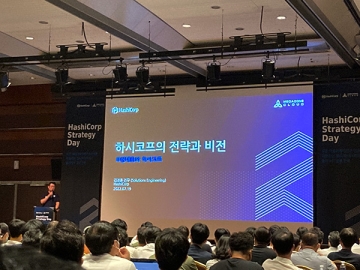
HashiCorp, a cloud infrastructure automation software company, held the 'Korea HashiCorp Strategy Day' with Megazone Cloud at COEX on the 17th and introduced a multi and hybrid cloud operation strategy supporting all applications and infrastructure. HashiCorp argued that an efficient workflow can be achieved through a cloud operation model based on Infrastructure as Code (IaC) approach, which enables automation of multi-cloud infrastructure.
2022.07.20by 김예지 기자

OutSystems, Increasing Trend of 'Low Code' Utilization
A low code platform has been attracting attention in the IT industry as it enables the rapid and efficient development of applications without relying on complex coding techniques or traditional programming methods.
2022.12.01by 명세환 기자
.jpg)
SalePoint Signs Multi-Year Partnership Agreement with AWS… Promoting Identity Security that Integrates Even AI Agents
Sailpoint has entered into a multi-year strategic partnership agreement with AWS and is moving forward with establishing an integrated governance system that manages both human and non-human identities together. The plan is to consistently manage access permissions in an environment where AI agents are increasing as work execution entities, while applying the principle of least privilege and automated policy enforcement. The two companies plan to jointly expand capabilities to manage the identities of various entities, including AI agents, within a single layer in the AWS environment. This collaboration is interpreted as a move to design security and governance together in corporate environments where AI adoption is expanding.
2026.03.26by 배종인 기자
.png)
Databricks Unveils Open AI Security Monitoring 'Lakewatch'
Databricks entered the security market on March 24 by unveiling LakeWatch, an open-source agentic SIEM. The core functionality of this product is to integrate and analyze security, IT, and business data in a single environment to support AI-based threat detection and investigation. The company explained that it reduces the limitations of existing security operations centers, which have had to forgo some data due to high cost structures, and enables large-scale data analysis and automation based on open formats and ecosystems. LakeWatch is currently offered as a private preview, with Adobe and Dropbox mentioned as early customers. Databricks also announced an expanded partnership with Anthropic as well as the acquisition of Antimatter and SiftD.ai.
2026.03.26by 배종인 기자
Ecolab Expands AI Data Center Cooling Business Through Acquisition of CoolIT
Ecolab has agreed to acquire CoolIT Systems, a liquid cooling company for AI data centers, for approximately $4.75 billion. The transaction is expected to close by Q3 2026, subject to regulatory approvals. CoolIT has been supplying direct-to-chip cooling-based coolant distribution units, cold plates, and manifolds, serving hyperscale data centers and colocation operators as customers. This acquisition is a measure to address the high-heat and high-density server environments created by AI proliferation. Ecolab plans to combine its water management and digital monitoring capabilities with CoolIT's hardware technology to expand its data center cooling business.
2026.03.26by 명세환 기자











