


Three Mobile Carriers 'Confirm' Limits on 5G 28GHz Allocation
 Published2022.12.26 11:08
SKT Shortening · LGU+ · KT Cancellation, Public Wi-Fi Exception
3 Companies "Premature for Commercialization" vs. Government "Active Support"
With the allocation of 5G 28GHz band frequencies to the three mobile carriers finalized without dissent, concerns are spreading regarding future 5G advancement and the entry into 6G.
The Ministry of Science and ICT announced on the 23rd that it has finalized the disposition details and released the results, following the completion of the compliance inspection and the hearing of opinions under the Administrative Procedures Act regarding the allocation conditions imposed during the 2018 allocation of 5G 28GHz band frequencies.
SKT will have its allocation cancelled if it fails to install 15,000 units, which is the original allocation condition, by May 31, 2023, prior to the application for reallocation, along with a 10% (6-month) reduction in the usage period (5 years), and the cancellation of allocations for LGU+ and KT has been confirmed.
However, it was announced that the use of the frequency was exceptionally permitted for subway Wi-Fi utilizing 28GHz as a subway backhaul, taking into consideration the public interest.
■ Three Mobile Carriers Reluctant to Commercialize 5G 28GHz
Meanwhile, there was a view that this cancellation of 5G 28GHz was a foreseen event.
Last NovemberThe Ministry of Science and ICT notified the three mobile carriers in advance of sanctions for non-compliance with allocation conditions, and accordingly, SKT was ordered to shorten its usage period, while LGU+ and KT were ordered to cancel their allocations.
A hearing was held to hear the opinions of the subjects prior to the final disposition; however, it was reported that while the three telecommunications companies expressed regret for failing to meet the allocation conditions during the hearing, they did not express any separate objections regarding the disposition that had been pre-notified.
Ultimately, the three mobile carriers have effectively expressed the position that they have low willingness to commercialize 5G 28GHz.
5G bands include Sub-6 (3.5/4.7GHz) and mmWave (28GHz). Industry experts explain that while 3.5/4.7GHz is utilized for nationwide networks, 28GHz enables ultra-high speeds, but commercialization is premature as there are few applications compared to the high construction and operation costs currently required.
In fact, there have been a series of complaints from consumers in Korea who find it difficult to experience 5G 28GHz because it is not currently supported.
The fact that the three mobile carriers accepted the result without objection prior to the cancellation of the 5G 28GHz allocation appears to be a move to effectively "wash their hands of it" due to the economic burden.
■ Ministry of Science and ICT: "Will Actively Support New Operators"
Government and industry officials have made it clear that they plan to continue pushing forward with 5G advancement and 6G development, despite concerns that it is premature.
In particular, it was emphasized that the development of advanced technologies such as AI and the metaverse is an inevitable path for handling large-scale traffic and 6G.
On the other hand, some are raising concerns about whether new operators will be able to easily 'challenge' the 5G 28GHz market, where even the three major mobile carriers have no intention of commercializing it.
The Ministry of Science and ICT announced that it plans to encourage new operators to enter one of the two cancelled bands, form a dedicated team for new operators to continue discussions on practical and diverse support, and make an announcement in January of next year.
As one of the alternatives, the government has also been striving to expand the 28GHz-based 5G specialized network (Eum 5G) convergence service business. In 2022, 11 consortia and 42 companies and institutions launched the project with a total budget of 48 billion won.
Eum 5G can be utilized in the public sector for logistics robots, the establishment of integrated safety control systems, disaster situation relay services, digital twin virtual substations, autonomous security robots, etc. It is also expected to be applicable to the private sector, including support for remote work in manufacturing environments, medical education, and the implementation of theme parks.
Choi Woo-hyeok, Director General of the Radio Policy Bureau at the Ministry of Science and ICT, said, "It is regrettable that this result was reached despite the government's various efforts," adding, "We will continue to make efforts to ensure that the public can enjoy higher-level 5G services by preparing and implementing various support measures to encourage the entry of new operators into the canceled 28 GHz band and by revitalizing competition in the telecommunications market."
Comments
Related news

5G 28GHz Allocation Limits for the Three Major Telecom Companies
The Ministry of Science and ICT announced the results on the 18th as the compliance verification procedure for allocation conditions imposed during the 2018 5G frequency allocation was completed. To activate 5G 28 GHz, it appears most urgent to establish various use cases to eliminate questions about whether current 5G 28 GHz is suitable.
2022.11.21by 김예지 기자

5G, nuclear power plant safety management, etc. to be expanded nationwide
NewGens, Korea Hydro & Nuclear Power, SK Networks Service, and Unangela have received 5G frequency supply through Eeum 5G.
2022.11.28by 배종인 기자
Practical policies are essential to activate 5G connectivity.
Expansion of 5G convergence services is expected to meet the surging demand for traffic data. Government support for spreading 5G specialized network projects is being actively continued.
2022.12.16by 김예지 기자
.png)
5G Specialized Network Performance Sharing Session Held
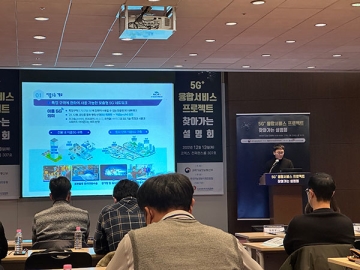
The government is actively continuing its support to expand the 5G specialized network business. The Ministry of Science and ICT, Korea Intelligence Information Society Promotion Agency, and Information and Communications Industry Promotion Agency held the '5th Generation Specialized Network Convergence Service Achievement Sharing Meeting' at COEX on Tuesday the 20th.
2022.12.21by 김예지 기자
Keysight and Nokia Join Forces to Accelerate 5G and 6G
Keysight Technologies has been selected by NOKIA Bell Labs to use Keysight's sub-terahertz testbed for performance validation of 5G Advanced and 6G transceiver (TRX) modules.
2022.12.22by 김예지 기자











