



Ministry of Science and ICT to Discover New Operators for '5G 28GHz', a Bulky Dilemma
 Published2023.02.03 16:02
Step-by-step customized support, such as establishing a frequency supply chain
While the burden of initial entry has been eased, securing profitability is inevitable.
The Ministry of Science and ICT is seeking out new operators to provide 5G 28 GHz services.
On January 31, the Ministry of Science and ICT announced the "Support Plan for Entry of New 5G 28GHz Operators." This is a follow-up measure to the confirmation made last December regarding the cancellation of 5G 28GHz frequency allocations for the three major mobile carriers—SKT, KT, and LG Uplus—and targets one of the two 28GHz bands. The selection of new operators will be carried out during the fourth quarter.
Many countries consider the 5G 28 GHz band to be a key frequency for providing ultra-high-speed and low-latency services. The government plans to actively promote the use of the 5G 28 GHz band to allow consumers to experience differentiated services and to gain experience in utilizing high-frequency bands ahead of the development of upcoming 6G technology.
According to the Ministry of Science and ICT, new operators are preferentially allocated an 800 MHz bandwidth, one of the two bands, to secure market position. The other band is allocated three years after the initial operator begins service, thereby lowering the barrier to market entry.
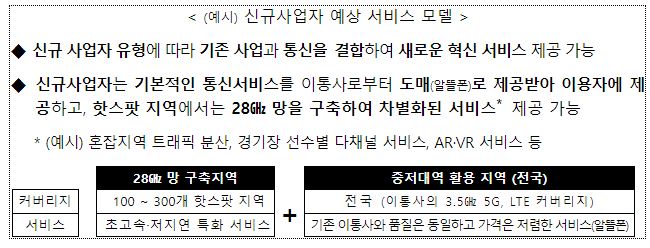
It also supports all stages of terminal procurement and distribution. We will consult with manufacturers to procure network equipment, smartphone terminals, etc., and also promote the inclusion of 28 GHz unlocked smartphones.
New operators provide services in 100 to 300 hotspot areas with high user density, such as subways, stadiums, and performance venues, to disperse traffic in congested areas and provide AR and VR services. For the nationwide network, new operators receive 3.5 GHz and LTE support from mobile carriers and pay usage fees on a wholesale basis, similar to budget mobile phone services. New operators can choose between a nationwide network and a metropolitan area level for the frequency allocation unit.
The allocation fee is calculated taking into account factors such as the increasing uncertainty regarding the 28 GHz ecosystem. Regarding the payment method, measures are being devised to reduce the initial burden and allow the payment amount to gradually increase after business maturity. Existing tax credits for network construction investments—3% for large corporations, 6% for mid-sized enterprises, and 12% for small and medium-sized enterprises—will continue to be provided, and a temporary increase in the tax credit rate for investments made in 2023 is also being pursued.
Meanwhile, despite the government's policy to discover a fourth mobile carrier, the industry views the entry of new operators negatively.
This is because, although policies for new business operators to facilitate initial entry have been established to alleviate the investment burden, identifying sources of business demand and securing profitability remains the most significant challenge. In particular, there are concerns that it will not be easy for new operators to jump into a business that even the three major mobile carriers have withdrawn from.
It is also argued that even if frequencies are allocated and initial construction is completed, continuous government regulations, as well as costs for maintaining future service quality, cannot be avoided.
In addition, while policies to expand 5G specialized network convergence services are continuing, mobile operators' confidence in the effectiveness of commercializing 28 GHz is becoming increasingly waning. Although 5G specialized networks are currently being developed and applied primarily in the Sub-6 band, the opinion is that developing specialized networks based on the advantages of the 28 GHz band is a realistic alternative.
"The reality is that the 28 GHz frequency is perceived as a burdensome asset due to a lack of investment from mobile carriers, but it possesses excellent frequency characteristics that allow for many use cases overseas," said a telecommunications industry official. "Currently, rather than expecting services from mobile carriers, it is anticipated that 28 GHz will be utilized in 5G specialized networks. In industrial settings, installation environments and cases where the high performance of 28 GHz can be utilized can be found."
Comments
Related news

Korea Airports Corporation Successfully Implements '5G Specialized Network' in Airport Environment
According to the "5G Specialized Network Small Cell Network Technology Verification (PoC) Implementation Result Report" disclosed by the Korea Airports Corporation's Smart Airport Promotion Division, a 5G-grade wireless communication network can now be established even at aeronautical radiobeacons not serviced by the three telecom carriers, enabling a communication system for emergency response.
2022.12.22by 김예지 기자

Three Mobile Carriers 'Confirm' Limits on 5G 28GHz Allocation
The Ministry of Science and ICT finalized the disposition details and announced the results on the 23rd, following the completion of compliance inspections regarding the allocation conditions imposed during the 2018 5G 28GHz band frequency allocation and the opinion hearing procedures under the Administrative Procedure Act.
2022.12.26by 김예지 기자
SKT Enters U.S. Terrestrial Broadcasting with '5G MEC'
SK Telecom successfully conducted terrestrial broadcast transmission on the 28th (local time) utilizing MEC and virtualization technologies in collaboration with US-based Sinclair and CastDotEra, a media tech company under SK Square.
2022.12.29by 김예지 기자
"2022 5G speed, ↑11.8% YoY"
The Ministry of Science and ICT and the Korea Information Society Development Institute conducted a survey on telecommunications service coverage areas and quality evaluations in 2022 and announced the results to provide users with information on wired and wireless communication service reception areas and quality.
2022.12.30by 김예지 기자

[Planning] 2023 Telecommunications Market Outlook "5G, Still a Hot Potato"
In 2022, the telecommunications market was dominated by the issue of 5G frequency band allocation. With the government taking active steps to secure a leading position in 6G services, controversies surrounding 5G are expected to continue. Continuous calls are being made for additional frequency band allocation in the 3.7~3.72GHz range for the three telecom operators. Meanwhile, discussions between the Ministry of Science and ICT and telecom operators regarding 5G mid-tier pricing plans are expected to continue. The long-standing issue of "network usage fee surcharges" between domestic Internet Service Providers (ISPs) and Content Providers (CPs) is intensifying, drawing attention to the direction of related legislation.
2023.01.02by 김예지 기자











