



ETRI Develops 98% Accuracy AI Skin-Attached Sensor
 Published2023.02.09 10:05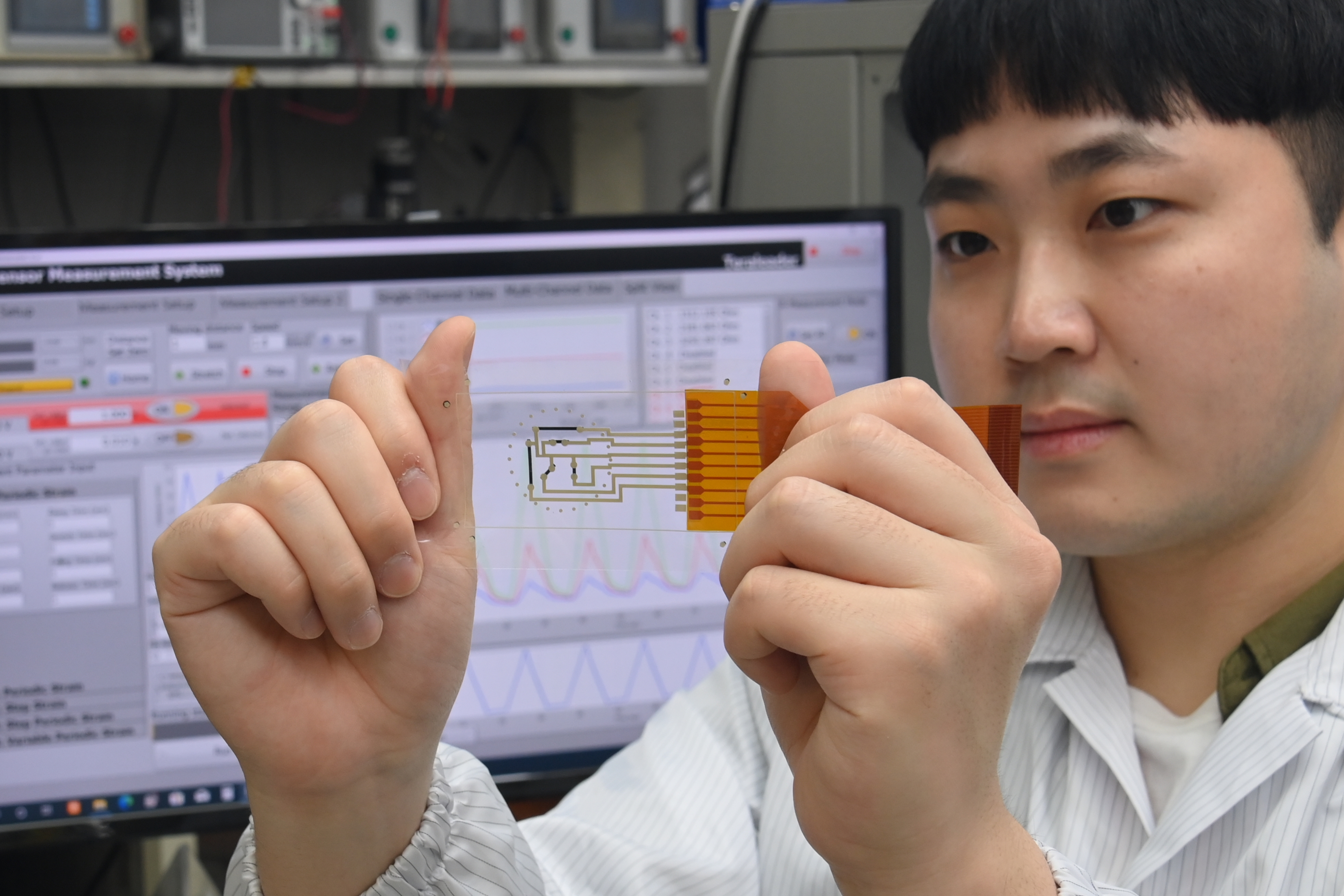
▲Demonstrating a strain sensor (Photo: ETRI)
A domestic research team has developed a skin-attachable strain sensor that can accurately measure the size and direction of skin stretching simultaneously. By applying artificial intelligence (AI) algorithms to the new sensor structure, accuracy and reliability have been dramatically improved, and it is expected to be widely used in the future for electronic skin in rehabilitation, healthcare, and robots.
The Electronics and Telecommunications Research Institute (ETRI) announced on the 8th that it, together with a research team from Chung-Ang University, developed a strain sensor that can detect the amount of expansion and contraction and the direction of deformation in all 360 degrees with 98% accuracy.
Existing skin-attached strain sensors create a stretchable conductive channel by adding elastic materials such as rubber and conductive nanomaterials such as graphene and carbon nanotubes (CNTs), and then detect the size of the deformation by measuring the electrical resistance value that changes as the channel expands and contracts.
However, this structure has the limitation that it can only detect deformation applied in a specific, predetermined direction, and thus cannot accurately measure the characteristics of skin that stretches in various directions depending on the situation, even in the same area.
The ETRI-Chung-Ang University research team has developed the world's first strain sensor capable of simultaneously measuring the size and direction of stretching, and has also succeeded in predicting the size and direction with 98% accuracy by applying an AI algorithm using an artificial neural network structure.
This technology can be attached to human skin to measure human movement, and is expected to be used in industrial fields such as rehabilitation, healthcare, and robotics.
The key is a new directional sensor structure. The research team has completed a patent application for a new structure that exhibits periodic resistance increase and decrease characteristics along the 360-degree stretching direction, spanning a linear stretchable conductor channel between two rigid, non-stretching regions.
Additionally, by placing three sensors adjacent to each other in different directions, the direction of stretch and the amount of deformation of a specific area can be simultaneously extracted by combining these signals.
Previously, a large number of individual sensors were required to recognize various senses, making it difficult to avoid delays due to signal interpretation time. However, by learning and analyzing various sensor data through an artificial neural network algorithm, it was possible to extract the direction of stretch and the amount of deformation with 98% accuracy within a 30% stretch range. A method was presented to simultaneously extract various sensory characteristics by applying an AI algorithm through cognitive learning to the composite signal obtained from a single cross-reaction sensor.
The materials used are harmless to the human body and can be widely used for skin attachment and motion detection of various parts of the human body. ETRI emphasized that it has the advantage of being easy to manufacture through a printing process, low manufacturing cost, short manufacturing time, and can be used as a disposable sensor.
ETRI Flexible Electronics Research Lab Principal Researcher Kim Seong-hyeon said, “The high-precision strain sensor developed by the research team can accurately measure the complex deformation patterns of the skin even with a simple structure, so it can be widely used in fields that require electronic skin, such as rehabilitation therapy and healthcare, robots, prosthetic limbs, and wearable devices.”
Professor Park Sung-kyu of Chung-Ang University also stated, “The developed technology is a groundbreaking attempt that can simultaneously recognize various characteristics with a simple sensor module using an artificial intelligence algorithm and overcome the spatiotemporal limitations of existing methods. It can be widely applied to artificial intelligence-based systems.”
The research team said that they plan to apply this technology to measuring muscle and joint movements under various movements and to use it for diagnosis and ongoing rehabilitation treatment of musculoskeletal diseases, with the goal of commercialization within three years.
Meanwhile, this study was published online on January 5th in the world-renowned academic journal 'Advanced Materials'.

Comments
Related news
ETRI to Release Expanding Displays
Domestic researchers have developed elastic inorganic semiconductor device technology for implementing stretchable displays that can be stretched like rubber bands, and it is expected to lead the next-generation display semiconductor field in the future.
2022.12.08by 배종인 기자
ETRI Develops Ultra-High-Speed Optical Input/Output Semiconductor Using Light
The Electronics and Telecommunications Research Institute (ETRI) has developed a silicon photonics optical semiconductor chip and related modules capable of transmitting data at 100 gigabits per second (100Gbps) in next-generation data centers and high-performance computing networks.
2022.12.22by 배종인 기자
ETRI Unveils Cancer Diagnosis Technology Earlier Than CT and MRI
Domestic researchers have developed femtosecond laser-based real-time Raman molecular vibration imaging technology (CARS) combined with semiconductor light-emitting diode for the first time in the world. The technology can provide specific real-time imaging according to the types of chemical bonds of targets within cells, and is expected to be useful for future cancer diagnosis and new drug development.
2023.01.19by 배종인 기자
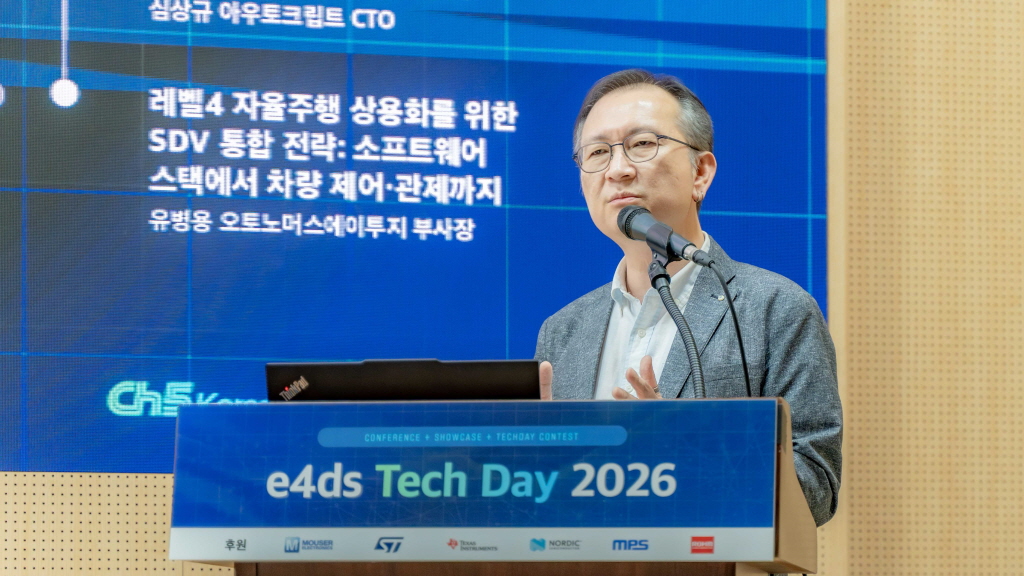
[e4ds Tech Day 2026 ⑨] Sim Sang-gyu, Autocrypt CTO: "In the Physical AI Era, Automotive Security Must Extend Beyond the Vehicle"
At e4ds Tech Day 2026, Sim Sang-gyu, CTO of Autocrypt, explained automotive cybersecurity strategies in the era of Physical AI and SDV (Software-Defined Vehicle). Automobiles are evolving as part of an ecosystem connected to AI, cloud, chargers, IoT, and robots, and he emphasized that the scope of security must expand beyond the vehicle interior to the entire connected environment. In particular, AI model tampering, adversarial attacks, OTA updates, and EV charger hacking were identified as major threats. He explained that response measures require zero trust, AI model integrity protection, intrusion detection, Security by Design and Default, and full lifecycle security management, and that proactive security system establishment beyond regulatory compliance is critical for securing future mobility competitiveness.
2026.10.12by 배종인 기자
NVIDIA to Invest $1 Billion in U.S. Science Over Next Five Years
NVIDIA has announced plans to invest $1 billion over the next five years to strengthen U.S. scientific and technological competitiveness. The company will enhance cutting-edge artificial intelligence research and development capabilities in key areas including quantum computing, healthcare, and energy security, while expanding support for higher education research institutions and cloud service providers. NVIDIA is participating as a major industry partner in the White House Office of Science and Technology Policy's Genesis Mission, and is promoting supercomputer construction in collaboration with national laboratories including Argonne and Los Alamos.
2026.10.12by 배종인 기자











