


SKT Successfully Develops RIS Technology for 6G Candidate Frequencies
 Published2023.02.09 14:08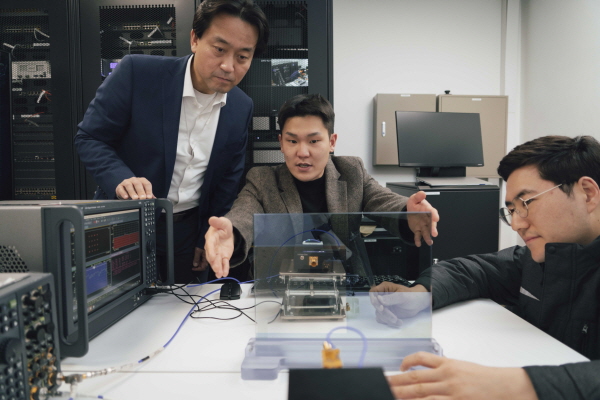
SKT employees demonstrating RIS technology for 6G candidate frequencies.
SK Telecom (CEO Yoo Young-sang) has developed the world's first glass technology applying RIS (Reconfigurable Intelligent Surface) to 6G candidate frequencies, and quality improvements, such as enhanced indoor 6G quality, are expected.
SK Telecom announced on the 9th that it has succeeded in developing RIS technology for 6G candidate frequencies through research cooperation with chemical materials company Dongwoo Finechem (CEO Line Ho).
RIS (Reconfigurable Intelligent Surface) is a technology that adjusts transmission power according to radio wave characteristics to reflect or transmit radio waves.
Through this research, SKT has developed, for the first time in the world, a technology that applies RIS to Low-E glass, which is widely used as a building exterior material, to allow 6G candidate frequencies in the high-frequency band to pass through.
Low-E glass is widely used as a building exterior material due to its excellent thermal insulation properties, but it also has the characteristic of blocking radio waves, making it disadvantageous for the transmission of mobile communication frequencies.
On the other hand, SKT's development of RIS application technology has made it possible to produce 6G RIS glass that transmits light and radio waves while maintaining thermal insulation performance.
SKT expects that commercializing the newly developed 6G RIS glass will contribute to improving wireless communication quality, such as expanding 6G indoor coverage.br />
SKT's RIS applied to Low-E glass is attracting attention as an important technology for preparing for the 6G era.
In this study, SKT measured the penetration characteristics of the Upper Midband (7–24 GHz) and Sub-THz (92–300 GHz) bands, which are being discussed as new frequency bands among the various bands being considered as 6G candidate frequencies, and conducted comparative tests with commercial 5G frequencies.
High-frequency bands, including the upper-midband and subterahertz, are suitable for ultra-high-speed, high-capacity wireless services due to their wide bandwidth; however, they have limitations in that service coverage is reduced because their short wavelengths cause significant transmission loss when passing through obstacles and their diffraction properties are poor.
Therefore, it is essential to conduct proactive research and development on technologies to overcome high-frequency limitations and determine how to utilize the corresponding bands through the study of radio wave characteristics according to frequency bands.
RIS is a technology that helps to pass through obstacles by reflecting these high-frequency bands, or to enter indoors by transmitting them. Test results showed that while signal loss was about 4 to 2,000 times greater than that of commercial 5G frequencies, it was confirmed that it was improved by about 40% when RIS was applied.
SKT developed transparent antenna and RIS technology for the 5G and LTE bands last August and successfully commercialized the application of transparent antennas to LTE modems used for public Wi-Fi on some city buses in the metropolitan area.
We plan to secure key technologies ranging from 5G Advanced to 6G through technologies that overcome the limitations of high-frequency bands, such as innovative antenna technologies.
Ryu Tak-ki, Head of Infrastructure Technology at SKT, stated, “The development of this 6G RIS technology is a meaningful result achieved through the natural evolution of technological capabilities secured through 5G/LTE into 6G, and it will serve as an exemplary case for 5G advancement and preparation for the 6G era,” adding, “We will continue to do our best to develop technologies for the continuous evolution and advancement of mobile communications.”

Comments
Related news
SKT, Applying AI Technology to Mobile Base Stations...Cornerstone of 6G
SKT has completed performance verification of AI-based wireless network Link Adaptation technology in collaboration with global mobile communication network manufacturer Ericsson, and has begun full-scale application of the technology to its commercial network.
2022.09.15by 김예지 기자
Catching 6G band electromagnetic waves
A material that absorbs ultra-high frequency in the 6G band has been developed, and expectations are gathering for diverse applications in information and communications as well as future mobility sectors going forward.
2022.11.25by 배종인 기자
The three major mobile carriers are locked in a fierce battle for 5G and 6G's core "Open LAN" technology.
Competition among the three domestic telecom carriers for leadership in 'Open RAN (O-RAN)' technology is intensifying. <br><br>Open RAN is an 'open radio access network' technology that separates wireless base station equipment and software from mobile telecommunications equipment, standardizes the interfaces required for equipment connectivity, and enables interoperability between equipment from different manufacturers. <br><br>#SKTelecom #LGUplus #KT #OpenRAN #Huawei #Nokia #Ericsson #Samsung Electronics
2023.01.18by 김예지 기자
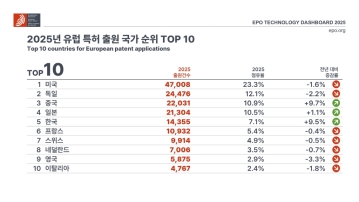
European Patent Applications Surpass 200,000 for the First Time… South Korea Maintains 5th Place, Led by Batteries and Telecommunications
According to the European Patent Office (EPO)'s 'Technology Dashboard 2025', European patent applications last year reached 201,974, surpassing 200,000 for the first time. Korean companies and inventors filed 14,355 applications, representing a 9.5% increase from the previous year and maintaining 5th place by country. Battery, digital communication, and semiconductor technologies led the growth, with Samsung ranking as the top EPO applicant for the second consecutive year and LG reaching 3rd place. The presence of major domestic cities such as Seoul, Suwon, and Yongin was also confirmed. It was also revealed that Korea's European patent strategy is expanding beyond individual technologies to span the entire industry.
2026.03.24by 명세환 기자

SK Telecom First Applies AI-Based Network Operations at Gwanghwamun K-Pop Concert
SK Telecom announced that it applied an AI-based network operation system for the first time at a large-scale K-pop concert held in the Gwanghwamun area of Seoul on March 21st, managing communication quality throughout the event. Mobile data usage during the three hours before and after the concert reached 12.15TB, approximately doubling compared to the same time slot the previous weekend. SK Telecom monitored traffic using the AI system 'A-One' in five-minute and 50-meter units to respond to potential overload situations, while also operating temporary communication facilities and on-site personnel in parallel. This case is interpreted as confirmation of the practical applicability of AI-based autonomous network operation in an environment where demand from dense events and foreign users increases simultaneously.
2026.03.23by 명세환 기자











