



Bluetooth SIG Introduces Wireless Standard for Electronic Shelf Label Market
 Published2023.02.09 14:21
 The Bluetooth Special Interest Group (SIG), a non-profit organization that manages and oversees Bluetooth® technology standards, is launching a new wireless standard for the Electronic Shelf Label (ESL) market, which is expected to overcome limitations of using existing proprietary protocols and open a new chapter in retail digital innovation.
The Bluetooth SIG announced on the 9th that it recently developed an ultra-low-power and stable ESL wireless standard based on Bluetooth technology.
Until now, ESL systems have had to use proprietary protocols for wireless communication, which has created potential barriers to adopting global standards; however, the development of this wireless standard is expected to overcome these limitations.
“Interoperability and standardization are inherent in the DNA of Bluetooth technology,” said Mark Powell, CEO of the Bluetooth SIG. “Bluetooth’s member companies have a long history of developing standards that expand markets and enable mass adoption in new product categories. “The introduction of wireless standards for the ESL market is expected to open a new chapter in retail digital innovation to provide an enhanced experience for both stores and consumers,” he said.
Traditionally, retail pricing has relied on labor-intensive, error-prone paper price tags and manual processes that must be performed repeatedly multiple times a day.
Electronic Shelf Labeling (ESL) is a network of small, battery-powered electronic paper (e-paper) terminals that replace paper labels by displaying product and pricing information on shelves and using wireless technology to communicate with a central hub to automate real-time pricing.
ESL systems help retailers automate pricing and run their stores more efficiently, thereby increasing customer satisfaction.
Bluetooth® ESL products will leverage features in the forthcoming ESL Profile Specification, including a method for creating interoperable ESL systems, along with new features included in today’s release of Bluetooth Core Specification Version 5.4.

Comments
Related news
Bluetooth devices, '4 billion units shipped in 2020 → 6.4 billion units in 2025'
With the spread of remote work and telemedicine, the completion of LE Audio specifications, and the activation of connected lighting, the Bluetooth peripheral device market—including earbuds, wearables, sensors, and smart lighting—is experiencing rapid growth. The Bluetooth SIG forecasts that annual Bluetooth device shipments in 2025 will reach 6.4 billion units, a 60% increase from 4 billion units in 2020.
2021.04.15by 이수민 기자

Bluetooth LE, Key to Micro-mobility Connectivity
Alf Helge Omre, Nordic Manager, explains wireless connectivity and reliable interoperability between micro-mobility and smart devices.
2021.10.25by 명세환 기자

TI Launches Bluetooth® LE Wireless MCU Family
Texas Instruments (TI) has launched a Bluetooth® LE wireless MCU product family that delivers high-quality RF and power performance at a reasonable price point, generating expectations that it will reduce the cost burden on engineers.
2022.06.27by 배종인 기자
European Patent Applications Surpass 200,000 for the First Time… South Korea Maintains 5th Place, Led by Batteries and Telecommunications
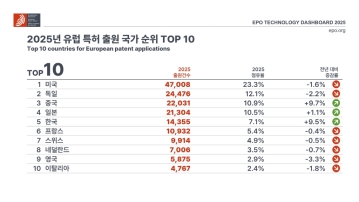
According to the European Patent Office (EPO)'s 'Technology Dashboard 2025', European patent applications last year reached 201,974, surpassing 200,000 for the first time. Korean companies and inventors filed 14,355 applications, representing a 9.5% increase from the previous year and maintaining 5th place by country. Battery, digital communication, and semiconductor technologies led the growth, with Samsung ranking as the top EPO applicant for the second consecutive year and LG reaching 3rd place. The presence of major domestic cities such as Seoul, Suwon, and Yongin was also confirmed. It was also revealed that Korea's European patent strategy is expanding beyond individual technologies to span the entire industry.
2026.03.24by 명세환 기자

SK Telecom First Applies AI-Based Network Operations at Gwanghwamun K-Pop Concert
SK Telecom announced that it applied an AI-based network operation system for the first time at a large-scale K-pop concert held in the Gwanghwamun area of Seoul on March 21st, managing communication quality throughout the event. Mobile data usage during the three hours before and after the concert reached 12.15TB, approximately doubling compared to the same time slot the previous weekend. SK Telecom monitored traffic using the AI system 'A-One' in five-minute and 50-meter units to respond to potential overload situations, while also operating temporary communication facilities and on-site personnel in parallel. This case is interpreted as confirmation of the practical applicability of AI-based autonomous network operation in an environment where demand from dense events and foreign users increases simultaneously.
2026.03.23by 명세환 기자











