



SKT Introduces AI Location Analysis Platform in Seocho-gu
 Published2023.02.16 09:06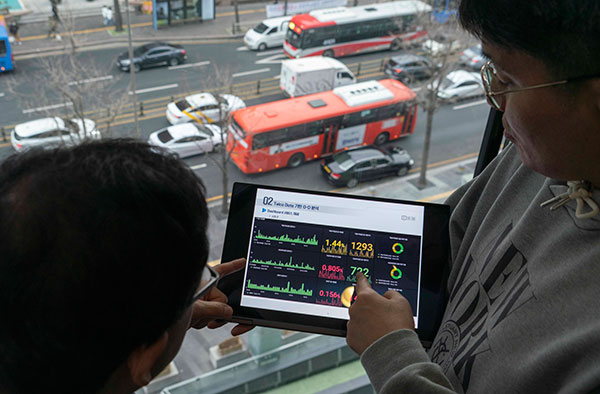
Accurate traffic volume measurement… Expected to alleviate traffic congestion
Technology that uses AI to learn from SKT's telecommunications data to measure traffic volume has been introduced in Seocho-gu, contributing to the alleviation of traffic congestion.
SKT announced on the 15th that it will apply and commercialize its AI-based location analysis platform 'LITMUS' for the 'Digital Twin National Territory-based Traffic Impact Assessment Support Model Project' commissioned by the Seocho District Office.
SKT's AI location analysis platform 'Litmus' is a technology that uses AI to analyze base station location data and provides intelligent location data, such as movement status and means of transport. SKT stated that it has improved the location accuracy of its service and provides efficiency in data collection and analysis, expecting this to bring significant changes to the location information business in the future.
While existing traffic impact assessment methods have limitations in that the scope of data collection is restricted because surveyors investigate traffic volume and vehicle speed during specific periods, 'Litmus' does not require separate traffic information collection devices or survey personnel, and measurements can be taken anywhere, 365 days a year, which can increase the accuracy and efficiency of data collection.
Seocho-gu plans to develop a traffic impact assessment model based on telecommunications data and apply it to planned reconstruction sites in the Banpo-dong Express Bus Terminal area. To this end, it will simulate changes in traffic volume and flow before and after the completion of reconstruction and formulate traffic countermeasures.
In addition, it is expected to contribute to alleviating urban traffic congestion by providing predicted information on road congestion times and sections to relevant agencies, such as the police and the Seoul Metropolitan Government.
Meanwhile, the 'Litmus' technology developed by SKT originated as network technology originally developed to improve base station quality, and has evolved into a traffic impact assessment support model through the addition of AI technology, data processing, and simulation.
SKT announced that it plans to leverage the characteristics of telecommunications data to expand its service scope from existing vehicle-centric services to include personal mobility devices such as electric scooters and pedestrians. In addition, it promotes various projects such as △generation and verification of road and traffic information △ITS (Intelligent Transportation Systems) △smart mobility (shared vehicles, shared bicycles, etc.) △smart cities.
Jang Hong-sung, Head of SKT’s AdTech CO, stated, “We plan to expand our business into user-centric mobility services based on technology for generating and verifying real-time traffic information utilizing telecommunications data,” adding, “We will continue to expand our business areas through ongoing cooperation with the government and local authorities.”
Comments
Related news
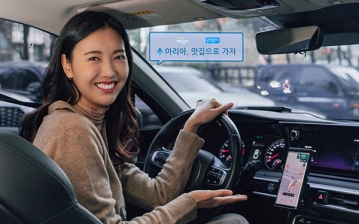
SKT Launches In-Vehicle Navigation Service Featuring "NUGU AI"
SKT announced on the 20th that it has launched Telecons and T-UUD services together. The existing T HUD navigation service controlled the HUD and app through app touch input, but the upgraded T HUD now enables safe and seamless navigation service through voice recognition by incorporating the 'Nugu AI' service.
2022.12.20by 김예지 기자

SKT, 2023 New Year's Address "AI Company Will Leap Forward"
SK Telecom CEO Lim Young-sang unveiled his ambition in a New Year's message email sent to all members of SK Telecom and SK Broadband on the 2nd, positioning 2023 as "the foundational year for executing the vision of leap and transformation into an AI company."
2023.01.02by 김예지 기자

The ever-growing "hyper-large AI" market
Since Google's AlphaGo competed against Go champion Lee Sedol 9-dan in 2016, AI that has permeated our daily lives has continued to evolve and become increasingly closer to humans. <br><br>'Super-large AI' refers to AI that can learn and reason on its own like humans by processing massive data sets hundreds of times larger than conventional AI. <br><br>#AI #SuperLargeAI #AISemiconductor #OpenAI #MultimodalAI #LargeLanguageModel #Naver #SamsungElectronics #SKT #LGUplus #KT
2023.01.25by 김예지 기자
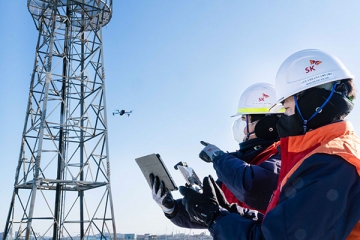
SKT Conducts Drone and AI Safety Inspections of Apartment Communication Towers
SK Telecom has developed a system to inspect the safety of communication towers using drones and image analysis AI, and has applied it on-site. Through this system, not only can accidents caused by aging communication towers be prevented, but safety can also be secured by allowing inspectors to avoid climbing the towers directly through drone-based inspections.
2023.01.31by 김예지 기자
.jpg)
SKT, Doubles GPU of Ultra-Large AI 'Adot' Supercomputer
SKT has been building and operating its own supercomputer since 2021. This time, it expanded the system with 1040 NVIDIA A100 GPUs.
2023.02.13by 김예지 기자











