



Intel: "13th Gen Processors and Evo Certification Enhance User Experience"
 Published2023.03.02 17:06
이보 플랫폼, 주변기기 생태계 확장 도모
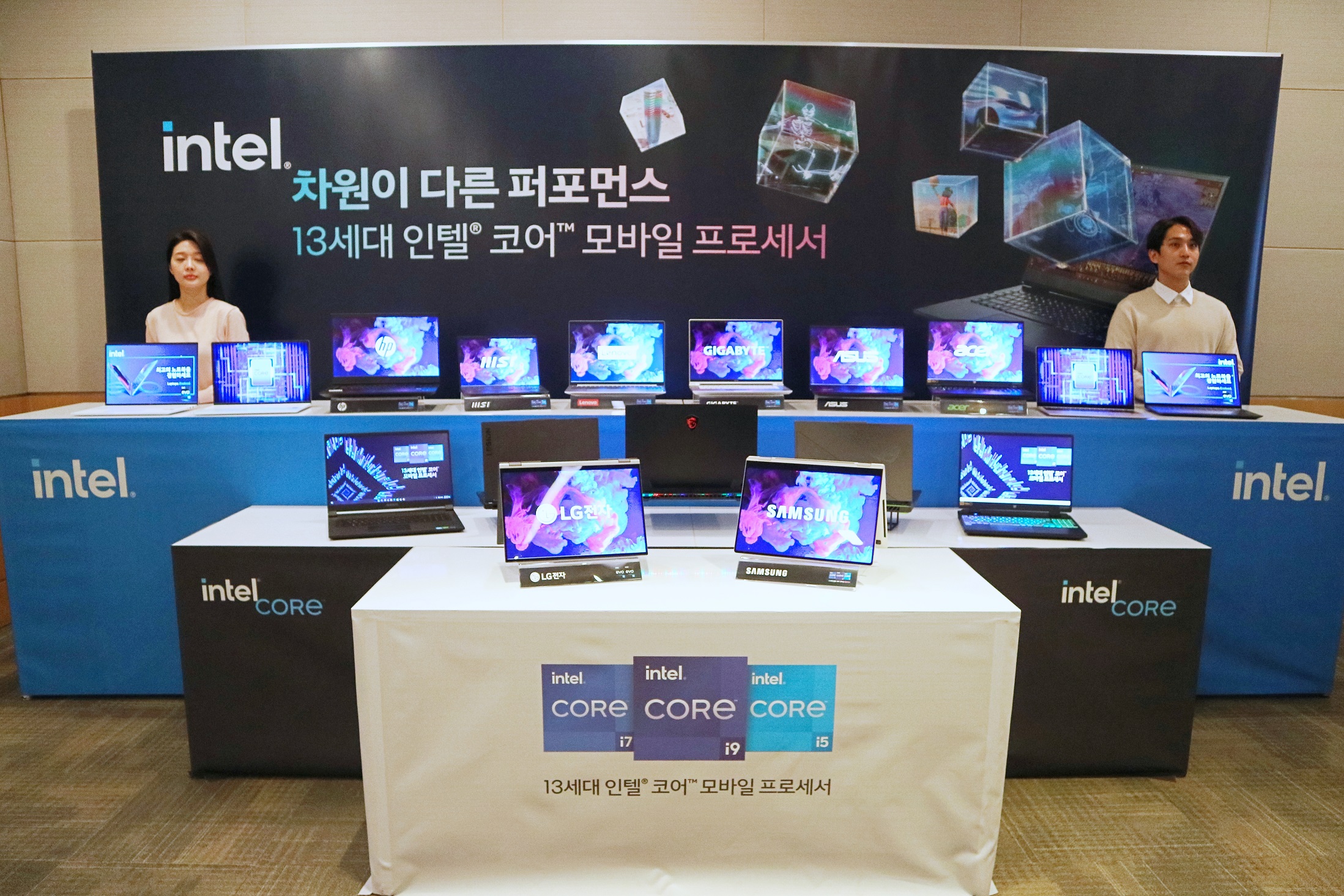
▲13세대 인텔 코어 모바일 프로세서 탑재 제품 라인업이 전시된 모습
글로벌 경기침체와 인플레이션으로 PC·노트북 등 소비자 디바이스 수요가 급감한 상황에서 인텔이 새로운 13세대 모바일 프로세서를 국내 출시하며 하반기 수요 회복 견인을 기대했다.
인텔코리아가 2일 전경련회관에서 13세대 인텔 코어 모바일 프로세서 국내 출시 기자간담회를 개최했다. 이날 인텔은 신규 제품군 라인업과 인텔 이보 업데이트를 발표했다.
인텔코리아는 신규 제품 및 이보(EVO) 인증 프로그램을 바탕으로 노트북 시장에서의 리더십을 강화하고 국내 소비자들에게 더 넓은 노트북 선택지를 제공한다고 밝혔다.
13세대 인텔 코어 모바일 프로세서는 △삼성전자 △LG전자 △HP △레노버 △MSI △에이수스 △에이서 △기가바이트 등 국내외 제조사들이 채택해 노트북 신제품을 프로세서 출시와 동시에 선보이고 있다. 전세계적으로 약 350종의 13세대 프로세서가 노트북에 탑재돼 출시될 예정이다.
인텔의 13세대 모바일 프로세서는 H·P·U 3가지 시리즈로 구성되며 인텔코리아는 “해당 제품군이 최대 10% 향상된 업무 생산성과 더불어 △인텔 와이파이 6E △블루투스 LE 오디오 △썬더볼트 4의 다양한 연결성을 제공한다”고 강조했다.
인텔은 고성능의 HX·H 시리즈를 통해 게이머 및 엔지니어 등 전문가 사용자층을 타겟하고 얇고 가벼운 폼펙터의 P·U 시리즈는 전세계 80%를 차지하는 주요 라인업으로서 “특히 한국은 P 시리즈를 찾는 고객들이 많다”고 덧붙였다.
■ HX시리즈, 데스크탑급 성능 노트북서 구현
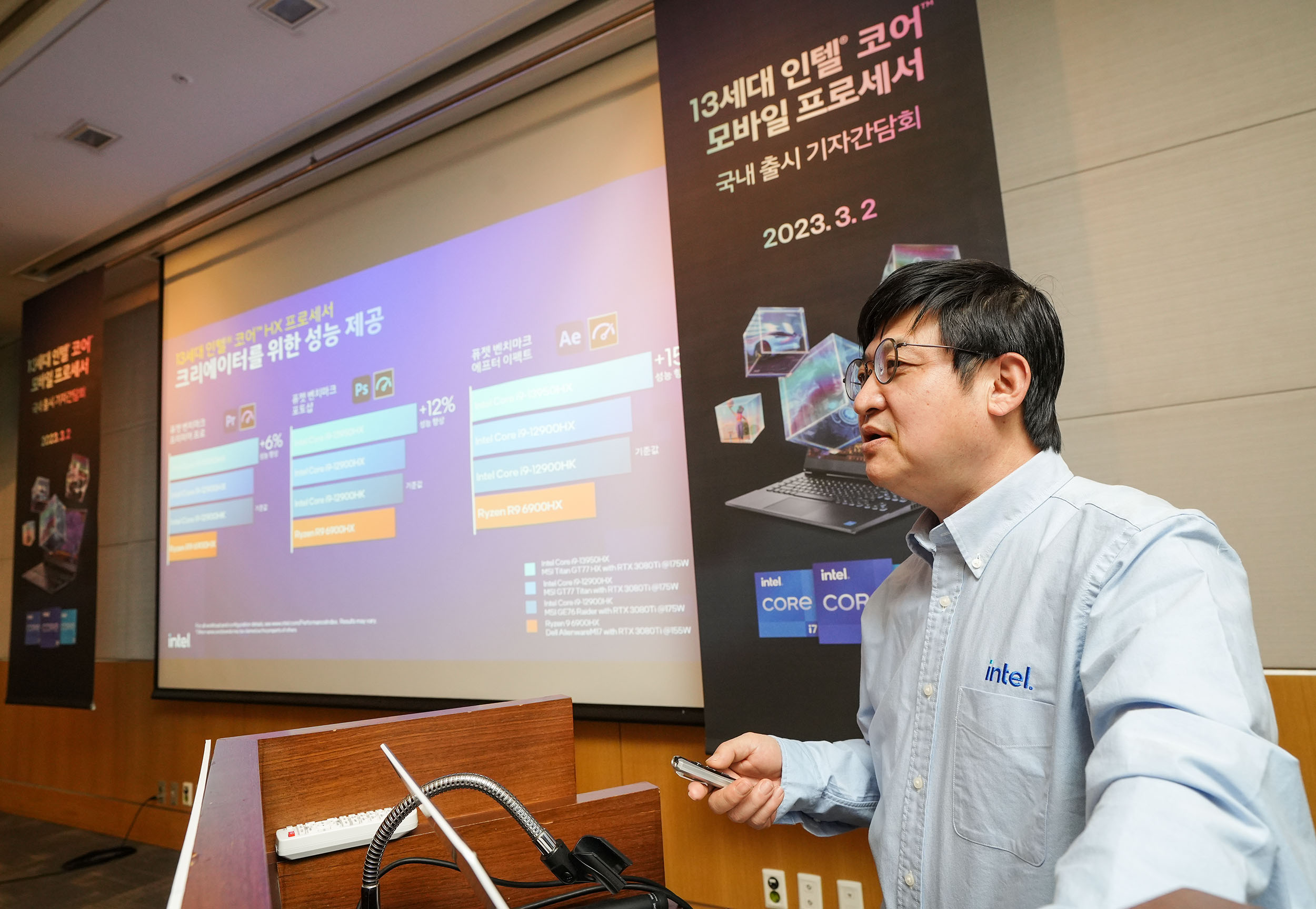
▲최원혁 인텔코리아 PC 클라이언트 사업 담당 상무(사진:인텔코리아)
13세대 인텔 코어 모바일 프로세서 HX시리즈는 모바일 워크스테이션용으로 타겟한 라인업으로 게이머 및 콘텐츠 크리에이터, 엔지니어 및 과학자 등 전문가용 사용자층을 위한 제품이다.
현재 가장 빠른 모바일 프로세서로 24코어 CPU는 8개의 퍼포먼스 코어(P코어)와 16개의 이피션트 코어(E코어)로 구성된 구조로 최대 5.6GHz 클럭속도를 지원하며 이러한 하이브리드 구성은 무거운 작업과 빠른 처리가 필요한 작업을 각각 분산 담당해 최적화된 작업을 구현할 수 있다.
향후 패러다임을 주도할 DDR5 5600 메모리를 지원함과 동시에 DDR4 3200까지 지원해 선택폭을 넓혔다. 내장 그래픽의 경우 32EU의 성능으로 H·P·U시리즈에서 최대 96EU인 것과 비교하면 상당히 낮은 데 이는 하이엔드 라인업에선 외장 그래픽을 채택하는 경우가 많기에 이러한 구성을 채택했다고 설명했다.
13세대 인텔 코어 i9-13950HX 프로세서의 경우 12세대 인텔 코어 i9-12900HK 대비 싱글 스레드 및 멀티태스킹 부문에서 각각 11% 및 49% 성능 향상을 기록했다. 더불어, 최대 79% 향상된 3D 렌더링 성능과 최대 24% 향상된 오토데스크 애플리케이션 성능을 기록했다고 설명했다.
최원혁 인텔코리아 상무는 “올 상반기 HX시리즈를 탑재한 60개 이상 노트북 모델이 출시될 예정이다”라며 “인텔은 13세대 인텔 코어 HX 프로세서를 필두로 하는 신규 제품 라인업과 노트북 성능 및 사용자 경험을 보증하는 인텔 이보 프로그램을 바탕으로 노트북 시장에서의 리더십을 더욱 공고히 할 것”이라고 밝혔다.
■ 인텔 이보 프로그램, 사용자 경험 강화 인증
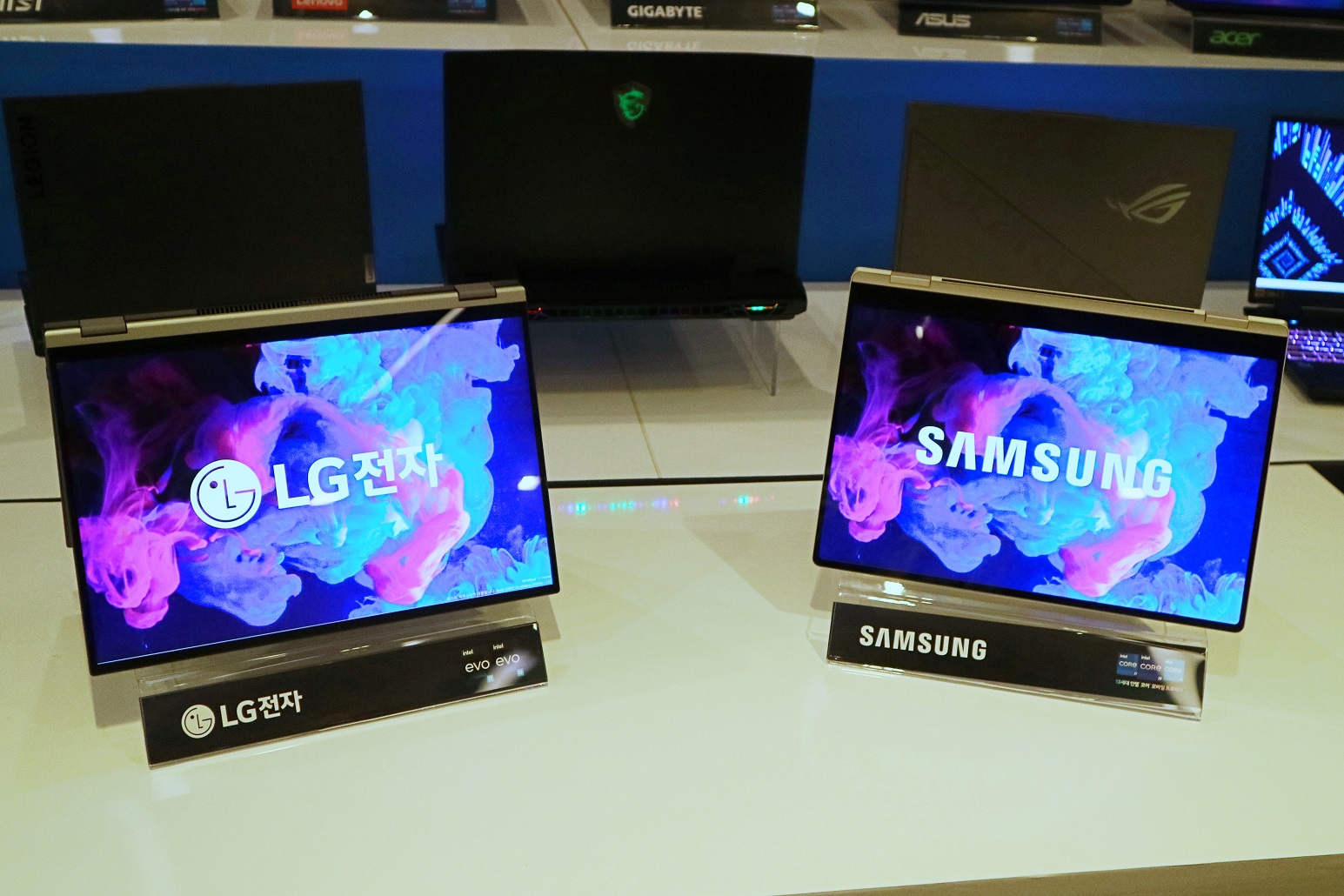
▲이보 인증을 받은 LG전자 제품이 삼성전자 제품과 나란히 전시돼 있다.
현재 기준 이보 노트북의 기준은 13세대 인텔 코어 프로세서 및 인텔 Iris Xe 그래픽 기반 노트북으로 △인스턴트 액션 △플랫폼 레벨에 걸쳐 구축된 인텔리전스 △실생활을 위한 배터리 수명 △광속에 달하는 연결성 △혁신적인 폼팩터 등의 카테고리에 속하는 25가지 기준을 만족해야만 이보 인증을 달성할 수 있다.
예컨대 최상무는 인스턴트 액션에는 적응형 연결 대기 및 숙면 모드 기준이 있는데 일시 절전 혹은 덮혀 있던 노트북이 다시 동작하기까지 걸리는 시간이 기준 이내여야 한다고 설명했다.
이보 플랫폼에 더해 검증된 주변기기 등 생태계 확장을 위해 인텔은 파트너사를 확대하고 있다. △레노버 △아수스 △델 △HP 등 노트북 메이커를 비롯해 △로지텍 △마이크로소프트 △Plugable 등 부품, 소프트웨어, OS 등의 전방위적 생태계 구축을 도모하고 있다.
인텔은 이보 플랫폼에 신규 라인업으로 △블루투스 헤드셋 △마우스 및 키보드 △액세스 포인트 등 검증된 주변기기로의 확장을 제시했다.
기자간담회에서 최 상무는 “이전 세대 대비 이보 플랫폼의 변화는 △멀티 디바이스 지원을 통한 연결성 강화 △사람들과의 모임 △타협 없는 모바일 성능”이라며 “사용자 경험을 세세하게 연구하고 고려해 이보 디자인에 반영하고 있으며 이를 바탕으로 이보 액세서리까지 준비 중이다”라고 밝혔다.

Comments
Related news
.jpg)
Intel Targets Laptop Market with 24-Core CPU
Intel has launched 32 new mobile processor products, led by the i9-13980HX, the world's fastest 24-core mobile CPU, and has begun full-scale market penetration with over 300 notebook products ranging from high-end to entry-level segments.
2023.01.04by 배종인 기자
.jpg)
Intel Launches Sapphire Rapids, Bringing PCIe 5.0 and DDR5 Interfaces to Life
With the surge in data transmission expanding the server and communications market, customer requirements are diversifying across various sectors including cloud providers and compute-intensive markets, resulting in increased complexity of business solutions. Accordingly, Intel's new processors are entering the market and are expected to contribute to customer-centric workload optimization.
2023.01.11by 명세환 기자
.jpg)
Intel Launches Ultimate Workstation Processor Xeon w9-3495X
Intel announced the Intel® Xeon® W-3400 and Intel® Xeon® W-2400 desktop workstation processors (codename Sapphire Rapids), led by the Intel® Xeon® w9-3495X, Intel's most powerful desktop workstation processor in history.
2023.02.21by 배종인 기자
ESP32 Development Environment Selection and GPS Application Implementation
The ESP32 is a microcontroller that integrates Wi-Fi, Bluetooth, 12-bit ADC, capacitive touch, PWM, DAC, and UART in a single SoC. However, the abundance of features does not by itself solve the designer's problems. The real challenges lie in selecting the appropriate development environment, determining which pins can be used and which must be avoided, and converting raw data from modules into usable information. This document addresses ESP32 peripheral constraints (ADC2 and Wi-Fi coexistence limitation, UART1 occupancy, ADC non-linear regions), the trade-offs between Arduino IDE and ESP-IDF, and the process from connecting NEO-6M/NEO-M8N GPS modules to UART2, parsing NMEA sentences, and visualizing routes in Google Earth, all organized based on documented references.
2026.10.12by 편집부
MIPI CSI-2, DSI-2, C-PHY, D-PHY Test Solution Technical White Paper
The MIPI interface adopts a burst mode that transitions between low-power (LP) and high-speed (HS) states for low-power consumption, and in return, strict timing rules are imposed on state transitions. Additionally, the high-speed section operates as a packet-based protocol with headers, ECC, and CRC, so verification engineers must handle waveforms and protocols simultaneously. Traditional configurations combining general-purpose oscilloscopes and AWGs reveal limitations in setup complexity, measurement uncertainty, and lack of reproducibility when faced with these requirements. This white paper, based on webinar materials, organizes the structure of this problem and describes how the SV5C-DPTXCPTX generator for receiver testing and SV5C-DPRXCPRX analyzer for transmitter testing integrate state transition testing, stressed eye testing, and protocol analysis into a single bench, along with their application boundaries.
2026.10.12by 편집부











