


Microchip Launches FPGA-Based Satellite System Development Kit
 Published2023.03.09 09:22
.jpg)
An integrated development kit for satellite system design that enables prototyping using low-power, high-throughput, radiation-tolerant FPGAs for space flight is expected to benefit space application developers.
Microchip Technology Inc. (NASDAQ: MCHP), a leading provider of microcontroller, mixed-signal, analog and Flash-IP solutions, today announced the combination of its space-qualified RT PolarFire® FPGAs with a development kit and interface that enables designers to evaluate design concepts against real-world, in-flight electrical and mechanical characteristics.
Developers using FPGAs can prototype with space-certified devices rather than commercial-off-the-shelf (COTS) devices to meet satellite payload and throughput requirements, accelerating design and development.
The RT PolarFire development kit supports a variety of daughter boards and features two full-featured high-pin count (HPC) FPGA mezzanine card connectors, DDR3 DIMMs, RT Gigabit Ethernet connectivity, SPI flash memory, and a SubMiniature Version A (SMA) connector, as well as the Libero ® software tool suite for programming radiometric data and the PT PolarFire FPGA.
Microchip's RT PolarFire FPGAs offer increased compute performance and connectivity throughput, up to a 50 percent reduction in power consumption compared to SRAM-based FPGAs, and immunity to radiation-induced Single Event Upsets (SEUs), reducing congestion in satellite signal processing required for demanding space missions. RT PolarFire FPGAs are currently certified to MIL-STD-883 Class B and are in the process of achieving QML Class Q and Class V certification.
Microchip offers kits with several options based on four versions of the RTPF500T RT PolarFire FPGA, varying in package pin count and speed.
“Microchip’s new integrated development platform for space applications includes the features and interfaces ideal for prototyping,” said Shakeel Peera, vice president of marketing for Microchip’s FPGA business unit. “Designers can evaluate high-speed transceivers, control, DSP, communications and image processing algorithms, all in the same packages and silicon used in Earth-orbit satellites and deep-space devices.”

Comments
Related news
.jpg)
Microchip Launches Cosmic Radiation-Tolerant Memory
It is known that approximately 30% of malfunctions in electrical equipment used in the space industry are caused by space radiation. Energy particles from space radiation can collide with electrical equipment and cause malfunctions, and as components become increasingly integrated, concerns about exposure effects are growing. Accordingly, radiation hardness of components has become an important factor in space system design options.
2022.04.25by 명세환 기자
.jpg)
Microchip Launches Radiation-Tolerant FPGA for Aerospace Applications
Microchip Technology (Asia General Manager and Korea Representative Han Byeong-don) has launched a new radiation-tolerant FPGA suitable for aerospace applications, contributing to the development of aerospace systems.
2022.08.18by 배종인 기자
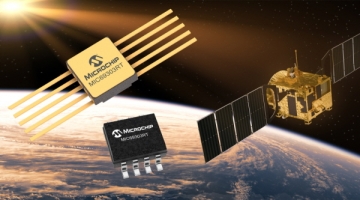
Microchip Launches Radiation-Resistant Power Semiconductor for Low Orbit Space
Microchip Technology (Asia General Manager and Korea Representative Han Byung-don) is launching radiation-hardened power semiconductors capable of withstanding the harsh space environment in the Low-Earth Orbit (LEO) region, approximately 1,200 miles above Earth, thereby accelerating the development pace of space application developers.
2023.01.18by 배종인 기자
Mouser Expands Domestic Supply of ST Semiconductor Solutions
Global electronic components distributor Mouser Electronics is stably supplying a wide range of products from world-leading semiconductor manufacturer STMicroelectronics to the domestic market and strengthening the electronic design environment.
2026.03.24by 배종인 기자

Mouser Expands Online Resource Center to Support Real-World Deployment of Autonomous Vehicles
Global electronics distribution company Mouser has strengthened its autonomous vehicle (AV) resource hub, focusing on design challenges and system architecture necessary for implementing production-ready autonomous driving systems.
2026.03.17by 배종인 기자











