



The Ministry of Science and ICT announced the abolition of the mandatory wholesale price system for discount mobile phones.
 Published2023.03.30 11:13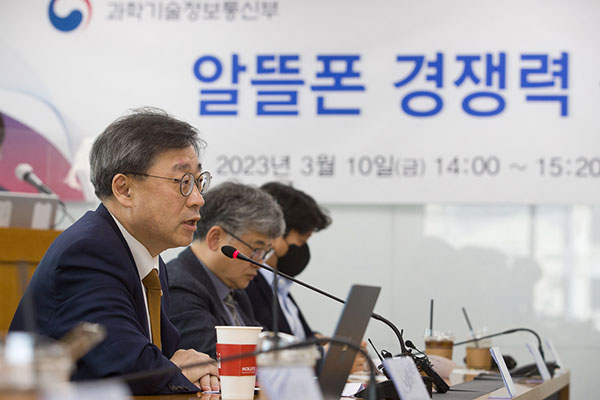
▲The Ministry of Science and ICT held the second meeting of the Special Task Force (TF) on Promotion of Competition in the Telecommunications Market. The photo shows Park Yoon-gyu, 2nd Vice Minister of Science and ICT, attending a meeting to strengthen competitiveness of low-cost mobile phones on the 10th.
Diversification of calculation methods for 5G wholesale prices for affordable mobile phones, etc.
Incentives for new 28GHz operators presented
The Ministry of Science and ICT agreed that the wholesale provision obligation system should be maintained in order to invigorate competition in the mobile communications market, as the sunset clause has been abolished.
The wholesale price is what mobile carriers, which provide telecommunication services through their networks, pay to the three major mobile carriers. The abolition of the sunset provision ultimately means that the wholesale price must continue to be paid by maintaining the effect of the regulation.
Along with this, it was suggested that the wholesale price calculation method for LTE and 5G needs to be diversified and the calculation time needs to be changed.
In addition, there was a conflict of opinions: one was to limit the share of the budget phone market held by subsidiaries of the three major mobile carriers; the other was to regulate unfair discrimination between budget phone service providers affiliated with mobile carriers and independent budget phone service providers, taking into account the contribution of subsidiaries of mobile carriers to the growth of the budget phone market.
The Ministry of Science and ICT announced that on the 29th, it held the second meeting of the 'Special Task Force (TF) on Promotion of Competition in the Telecommunications Market' in the conference room of the National Science and Technology Advisory Council Support Group, reviewed the results of discussions in the Telecommunications Policy Division and the Radio Policy Division within the TF, and exchanged opinions with experts from various fields.
This general meeting reviewed entry restrictions such as foreign ownership restrictions, the wholesale provision obligation system related to low-cost mobile phones, the wholesale price calculation method, and the 28GHz frequency allocation policy.
Regarding the 28GHz frequency allocation policy, it is to ensure that new operators entering the already mature telecommunications market can be competitive. They agreed that allocation policies, such as construction obligations and allocation fees, should serve as incentives for new businesses rather than excessive burdens.
Regarding the 28GHz frequency allocation announcement, opinions were raised that sufficient time should be provided to allow companies wishing to participate to carefully assess the feasibility of the business.
Regarding the foreign ownership restriction system, it was suggested that there are not many institutional barriers to foreign investment as there are public interest review systems in place under the current system, and that entry restrictions should be reviewed taking into account the needs of new businesses.
The Ministry of Science and ICT announced, “In the future, the special task force (TF) will work with relevant ministries, including the Korea Communications Commission, to review the need to improve the Mobile Device Distribution Act to promote competition, ways to improve convenience such as improving the process of subscribing to low-cost mobile phones, and regional market entry.”
Comments
Related news
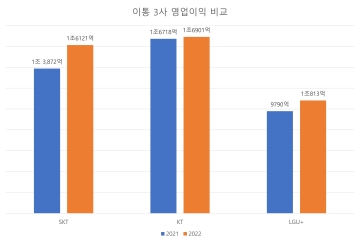
Three Mobile Carriers Record-Breaking Performance
According to the 2022 annual revenue announced by the three telecom companies, their combined operating profit for last year reached approximately 4.38 trillion won, marking a record-breaking performance. SKT announced on the 8th that based on its 2022 consolidated financial statements, it recorded annual revenue of 17.305 trillion won, operating profit of 1.6121 trillion won, and net profit of 947.8 billion won. This represents a 3.3% increase in revenue, a 16.2% increase in operating profit, and a 60.8% decrease in net profit, respectively.
2023.02.15by 김예지 기자

Communications, Cyber Attacks Intensify Security Urgent
Recent developments in AI, IoT, and cloud technologies have transformed daily life, yet domestic and overseas companies and organizations are growing increasingly anxious about exposure to mounting cyber attacks without adequate defenses. Behind the innovation brought about by digital transformation, supply chain security threats are becoming increasingly diverse, and the importance of cyber security continues to grow. The three major telecom operators have strengthened supply chain security by building cyber security competitiveness.
2023.02.28by 김예지 기자
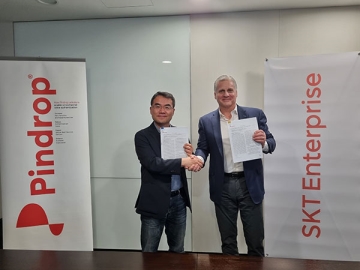
SKT Launches Customer Center Voice Authentication AI Service
SK Telecom launches voice authentication AI services targeting AI contact centers in partnership with Pindrop, a global voice technology development company. The AI-based voice authentication technology identifies a user's unique voice and authenticates individuals with just a simple voice input without requiring additional authentication.
2023.03.16by 김예지 기자
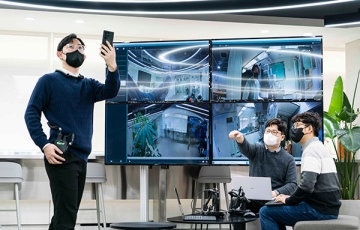
SKT Establishes 5G Open RAN Demonstration Network Inside Bundang Headquarters
SKT has constructed a 5G Open Radio Access Network (Open RAN) in-building demonstration network within its Bundang headquarters for open technology cooperation with domestic small and medium-sized enterprises, and has confirmed stable service interoperability quality.
2023.03.23by 김예지 기자
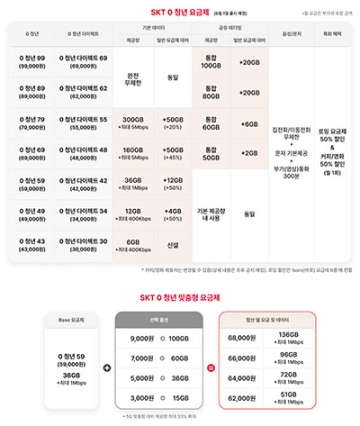
SKT Launches 25 New 5G Intermediate Rate Plans
The Ministry of Science and ICT approved on the 23rd SKT's application for new 5G rate plans that was filed on the 17th, taking into consideration customer usage patterns and age group characteristics. The 5G terms of service filed this time include the following: △establishment of three types of 5G senior rate plans for users aged 65 and over △establishment of four types of 5G mid-tier rate plans △establishment of 11 types of 5G youth rate plans for users aged 34 and under △establishment of seven types of 5G youth online rate plans.
2023.03.23by 김예지 기자











