


Hyundai Motor to invest 24 trillion won in electric vehicles
 Published2023.04.12 11:03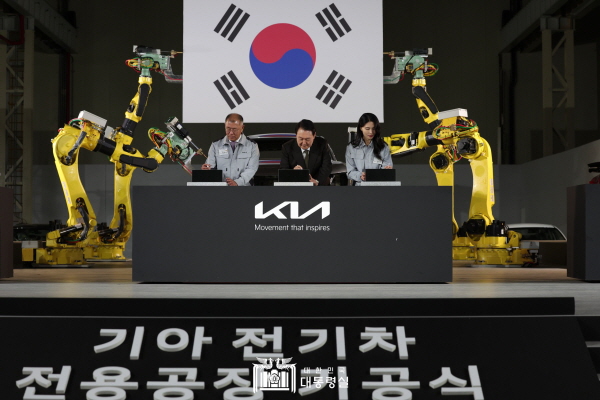
▲President Yoon Seok-yeol attended the groundbreaking ceremony for Kia's electric vehicle plant. (Photo source: Office of the President)
Strengthening the role of a global future automotive industry innovation hub
Domestic electric vehicle production target of 1.51 million units by 2030
Hyundai Motor Group announced plans to invest 24 trillion won in the domestic electric vehicle sector by 2030 at a groundbreaking ceremony for a dedicated customer-focused electric vehicle factory held at AutoLand Hwaseong on the 11th.
Song Ho-sung, President of Kia Motors, said, “Hyundai Motor Company, Kia Motors, and Hyundai Mobis plan to invest a total of 24 trillion won in the domestic electric vehicle sector by 2030, contributing to Korea’s leap forward as one of the top three global electric vehicle powerhouses.” He added, “We will strengthen the competitiveness of the domestic electric vehicle R&D, production, and infrastructure ecosystems, and lead the change and innovation of the future automobile industry.”
Hyundai Motor Group announced its goal of strengthening its role as a global future automobile industry innovation hub, including the advancement of the electric vehicle industry through large-scale domestic investment, by expanding domestic annual electric vehicle production to 1.51 million units (920,000 units exported) by 2030 and planning global electric vehicle production to 3.64 million units.
Hyundai Motor Group's large-scale investment in the domestic electric vehicle sector is expected to advance the domestic electric vehicle ecosystem and strengthen its role as a hub for innovation in the global future automobile industry. This is expected to promote a virtuous cycle among domestic electric vehicle production, R&D, infrastructure, and related industries.
Hyundai Motor Group will first expand its domestic electric vehicle production capacity by building new, customized electric vehicle-only factories and converting existing factories to electric vehicle-only lines. />
In particular, industrial robots in the electric vehicle production plants being built by the Hyundai Motor Group will be installed with domestically produced intelligent robots, resulting in a 99% localization rate for the equipment. Furthermore, most of the investment in factory equipment will be returned to domestic companies, contributing to the strengthening of the domestic economy and national industrial competitiveness.
We will also focus on R&D, including developing a next-generation electric vehicle platform, expanding our product lineup, developing core components and advanced technologies, and establishing research facilities. We will also revitalize domestic technology development in collaboration with our partners.
Through this, we will strengthen the integrated product competitiveness encompassing both hardware and software, such as diversifying the dedicated platform product lineup, enhancing the PE (Power Electric) system, including batteries and motors, which are the core of electric vehicle performance, and developing technologies to increase the driving distance on a single charge.
We are also accelerating the acquisition of next-generation platforms to fundamentally improve the performance of electric vehicles. The company plans to sequentially develop various dedicated platforms for each vehicle class under the 'Integrated Modular Architecture (IMA)' system, including a dedicated passenger electric vehicle platform to be introduced in 2025.
Platforms that utilize an integrated modular architecture are expected to standardize batteries and motors, thereby improving product development speed and efficiency.
Meanwhile, Hyundai Motor Group plans to have a total of 31 electric vehicle lineups by 2030, with Kia planning to launch the EV9 this year and Hyundai Motor Company planning to launch the Ioniq 7 in 2024.
Meanwhile, the Kia electric vehicle factory, which held its groundbreaking ceremony this time, is the first completed vehicle manufacturing plant built in Korea in 29 years.
This is the first dedicated electric vehicle plant in Korea, and is scheduled to begin mass production in the second half of 2025, with an annual production capacity of up to 150,000 units.
Kia plans to exclusively produce customized electric vehicles at this new plant, and the first model in its Purpose Built Vehicle (PBV) lineup, SW (project name), which will be launched in 2025, will be developed as a mid-size vehicle.
Based on a skateboard-shaped PBV electric vehicle platform, it can flexibly combine various types of vehicle bodies.
Following the launch of the SW, a mid-size PBV, Kia plans to expand its product lineup to include large-size PBVs that can be used for general logistics, fresh food delivery, multi-person shuttles, mobile offices and stores, as well as small-size PBVs and mid-size robotaxis equipped with autonomous driving technology.
Meanwhile, Hyundai Motor Group has been operating a 'New Mutual Cooperation Program' worth 5.2 trillion won since last year to strengthen the competitiveness of the parts industry in the era of electrification.
Hyundai Motor Group announced last year that it would promote 'automobile industry coexistence and In order to 'strengthen competitiveness in the era of future vehicles,' the company announced a new win-win cooperation program and announced plans to significantly expand support not only to first-tier suppliers but also to over 5,000 second- and third-tier suppliers with whom it does not have direct transactions, thereby playing a leading role in accelerating the transition to electrification in the parts industry and contributing to the qualitative growth of the domestic automobile industry.
A Hyundai Motor Group official said, “We plan to strengthen our competitiveness in the global electric vehicle sector, focusing on Korea, through concentrated investment in Korea,” adding, “We will strengthen the competitiveness of the domestic electric vehicle ecosystem and lead changes and innovation in the global future automobile industry.”
Comments
Related news
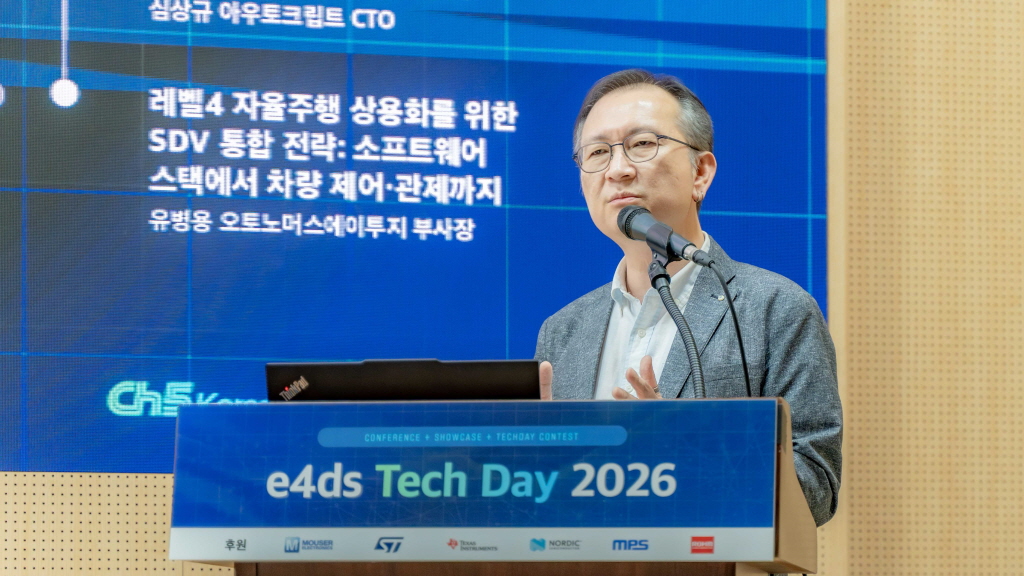
[e4ds Tech Day 2026 ⑨] Sim Sang-gyu, Autocrypt CTO: "In the Physical AI Era, Automotive Security Must Extend Beyond the Vehicle"
At e4ds Tech Day 2026, Sim Sang-gyu, CTO of Autocrypt, explained automotive cybersecurity strategies in the era of Physical AI and SDV (Software-Defined Vehicle). Automobiles are evolving as part of an ecosystem connected to AI, cloud, chargers, IoT, and robots, and he emphasized that the scope of security must expand beyond the vehicle interior to the entire connected environment. In particular, AI model tampering, adversarial attacks, OTA updates, and EV charger hacking were identified as major threats. He explained that response measures require zero trust, AI model integrity protection, intrusion detection, Security by Design and Default, and full lifecycle security management, and that proactive security system establishment beyond regulatory compliance is critical for securing future mobility competitiveness.
2026.10.12by 배종인 기자

Practical HIL Construction Strategy for Automotive and Off-Highway Controller Validation
As vehicle E/E architecture transitions to zonal structures and shifts to software-defined vehicles (SDV), the number of controllers (ECUs) requiring validation and software complexity are surging dramatically. Meanwhile, real vehicle testing cannot provide repeated verification under identical conditions and entails lead time and safety concerns. This white paper explains the principles of HIL (Hardware-in-the-Loop) validation and the structure of the NI platform composed of PXI, SLSC, and VeriStand, and through two actual implementation cases—Camera Record & Replay HIL for In-Cabin Monitoring Controller (ICMU) and Forklift Controller (VCU) HILS—describes how controller-level regression testing becomes possible. Additionally, it explicitly states application boundaries and limitations, such as lack of A2B support.
2026.10.12by 편집부
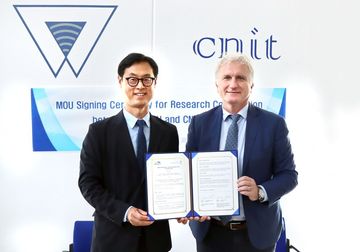
Korea Automotive Research Institute Signs MOU with Italy National Institute for Wireless Communications
The Korea Automotive Research Institute will sign an MOU with Italy's National Institute for Wireless Communications and launch joint research on next-generation mobility technologies based on 6G, V2X, and connected vehicles. The two organizations will conduct research to apply advanced wireless communication technologies to vehicles and discover international joint projects to advance next-generation connected vehicle technology development.
2026.10.12by 배종인 기자
Color Accuracy Issues in Vehicle Interior Ambient Lighting and Intelligent LED Drivers
Vehicle interior ambient lighting is spreading across all price segments, and the level of color accuracy required of lighting designers is rising accordingly. This white paper quantitatively addresses why temperature drift and individual variations of RGB LEDs cannot be corrected by standard constant-current drivers, and explains an intelligent LED driver approach that integrates an MCU, calibration data, and a LIN network interface into the driver. It covers implementation details of the LITIX Interior TLD4020-3ET currently in production, portfolio roadmap, and evaluation/development environments, and clarifies application boundaries including lack of 48V support, lack of RGBi/ISELED support, and absence of direct optical degradation diagnostics.
2026.10.08by 명세환 기자
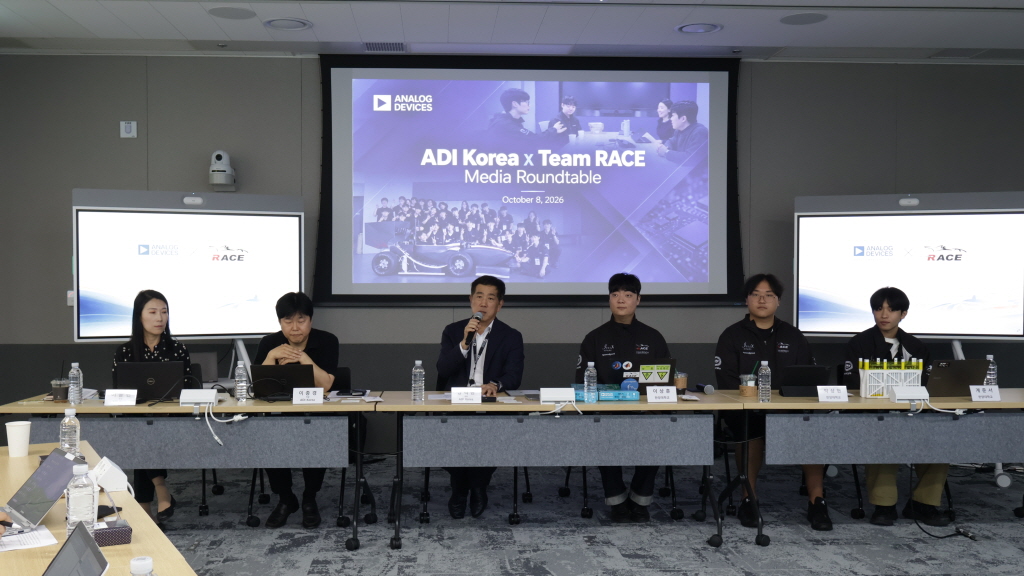
ADI, "Fostering Future Engineers Beyond Component Support"
Global semiconductor company Analog Devices (ADI) is drawing attention for moving beyond simply sponsoring university student car projects to serve as a partner in nurturing future engineers. Over the past three years, ADI has collaborated with Hanyang University's automotive research club Team RACE to support electric formula vehicle development, and recently has been providing technical consultation and semiconductor solutions to enable students to directly develop battery management systems (BMS), creating a model case of industry-academic cooperation.
2026.10.08by 배종인 기자











