


Intensifies Search for New 5G Specialized Network Operators… Excluding the Three Major Mobile Carriers
 Published2023.04.20 11:07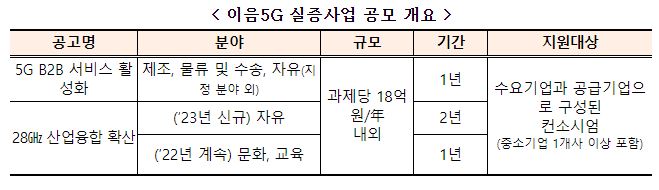
Joining the Alliance and Maintaining It for 2 Years… Accelerating Early Market Creation
The Ministry of Science and ICT is providing full support for demonstration projects to expand 5G specialized network convergence services.
The Ministry of Science and ICT announced on the 19th (Wed) that it has opened a call for proposals for a demonstration project to support the discovery and expansion of 5G specialized network convergence services based on linkages between private companies, in order to achieve the national agenda of 'expanding 5G specialized networks (Eum 5G) and convergence services.'
The plan is to more effectively encourage the discovery of new operators and the expansion of participation by small and medium-sized enterprises by limiting support targets to companies excluding the three mobile carriers and their subsidiaries that were canceled last year after being allocated 28GHz commercial network frequencies.
The '5G B2B Service Activation' project is designed to discover, apply, and expand Eeum B2B convergence service models that utilize the characteristics of 5G specialized networks across all industrial sectors. Last year, we supported the development of an augmented reality (AR)-based surgical guide and convergence services for the digitalization of the KF-21 manufacturing, design, and testing environments.
This year, a total of three projects will be selected in two fields—manufacturing, logistics, and transportation—and one free field, with approximately 1.8 billion won to be provided per project.
The '28GHz Industrial Convergence Expansion' project operates for a two-year period with the aim of discovering high-speed, high-capacity, immersive convergence services that the public can directly use, based on the advantages of the frequency. One project each was selected in the fields of education and culture, and the development of a medical education and training service utilizing 3D HoloLens and an immersive, realistic virtual experience attraction service is currently underway.
This year, an open call for proposals will be conducted for one project to allow companies to freely propose service models, providing a total of approximately 3.6 billion won (approximately 1.8 billion won/year) in support over two years. In addition, we create and operate an experience space where users can directly use the developed services.
In particular, starting this year, the selected consortium will participate in the '5G Specialized Network Alliance,' disclose key details of the service to relevant companies, and accelerate the creation of an initial market by maintaining the developed service for at least two years.
Jeon Young-soo, Director General of Information and Communication Industry Policy at the Ministry of Science and ICT, stated, “We expect that various services utilizing Eum 5G, which enables ultra-high-speed and low-latency services, will be developed both domestically and internationally to provide new experiences to users and create new markets,” adding, “We will actively support Korea to lead the relevant market by discovering and spreading new services applying Eum 5G across all industrial sectors, thereby expanding the participation of new operators and service implementation experience.”
Comments
Related news
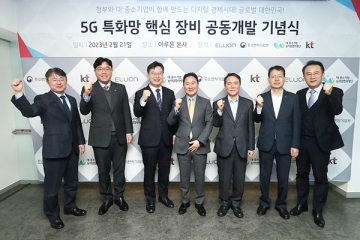
KT and the Ministry of SMEs and Startups Successfully Develop Essential Equipment for 5G Specialized Networks
KT announced on the 21st that it held a ceremony commemorating the completion of joint development of core equipment, a key component of 5G private networks, at its headquarters in Pangyo, Gyeonggi Province, called "Iruwon."
2023.02.22by 김예지 기자

[Interview] Jihoon Kang, Ericsson LG Team Leader - “Ericsson EP5G, 5G Specialized Network Construction in 1 Hour”
With the introduction of 5G private networks driving transformation in manufacturing and logistics sectors, Ericsson LG is moving forward to capture the 5G private network equipment market. We met with Kang Ji-hoon, team leader at Ericsson LG, to hear about the company's solutions for 5G application and service development.
2023.02.28by 김예지 기자
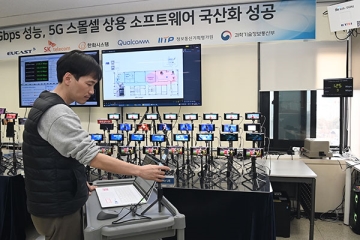
ETRI develops 5G small cell software...speeding up 5G specialized networks
The Electronics and Telecommunications Research Institute (ETRI) announced on the 21st that it has developed commercial-grade software technology for a 5G small cell that provides downlink speeds of 2.2Gbps in the 5G millimeter wave band.
2023.03.02by 김예지 기자
.jpg)
Introduction of a plan to build a smart factory based on a 5G specialized network
e4ds news has organized a venue to examine the latest trends in smart manufacturing and this year's outlook, while presenting 5G-based IIoT solutions.
2023.03.06by 김예지 기자
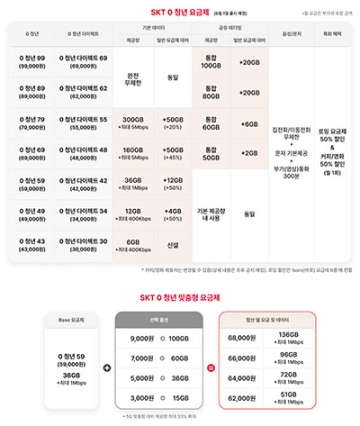
SKT Launches 25 New 5G Intermediate Rate Plans
The Ministry of Science and ICT approved on the 23rd SKT's application for new 5G rate plans that was filed on the 17th, taking into consideration customer usage patterns and age group characteristics. The 5G terms of service filed this time include the following: △establishment of three types of 5G senior rate plans for users aged 65 and over △establishment of four types of 5G mid-tier rate plans △establishment of 11 types of 5G youth rate plans for users aged 34 and under △establishment of seven types of 5G youth online rate plans.
2023.03.23by 김예지 기자











