


30 million 5G subscribers are within sight.
 Published2023.05.08 14:32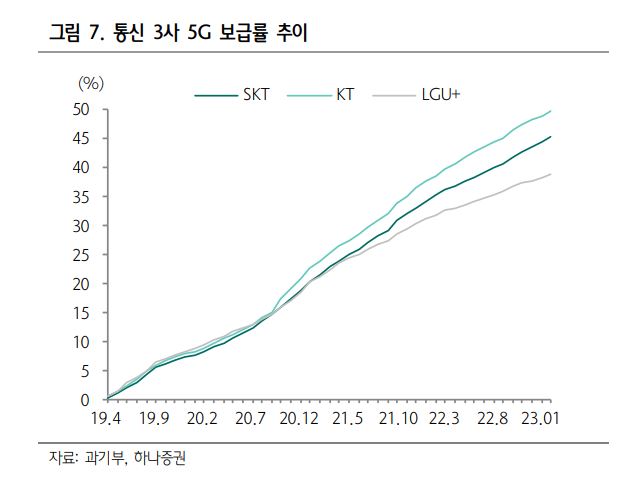
Government Discusses Selection of 5G Specialized Network and Fourth Mobile Operator
The number of domestic 5G mobile subscribers is projected to have surpassed 30 million.
According to wireless communication service statistics released by the Ministry of Science and ICT on the 7th, the number of domestic 5G subscribers stood at 29,600,502 as of the end of March.
Given the trend of approximately 500,000 new subscribers every month, it is predicted that the number of 5G subscribers exceeded 30 million in May as of the end of last month.
The total number of 5G subscribers for the three mobile carriers was 29,380,397, with SKT recording 14,147,664 (47.8%), KT 8,881,924 (30%), and LG Uplus 6,350,809 (21.5%). The number of 5G subscribers for budget mobile carriers was 220,105 (0.7%).
It is notable that the number of 5G subscribers for budget mobile carriers has surpassed 200,000. As of last January, the number of 5G subscribers for budget mobile carriers stood at approximately 170,000, and it increased by roughly 20,000 in just two months.
The number of number porting and new subscribers for budget mobile carriers were 218,906 and 434,873, respectively, comparable to the three major mobile carriers. The total number of number porting for the three major mobile carriers was 209,910, and the number of new subscribers was 508,188. Budget mobile phone operators have recently been releasing affordable rate plans through various promotions.
Against this backdrop, the Ministry of Science and ICT announced last March that it would expand the budget phone market to revitalize competition in the telecommunications market. However, it appears that no points of discussion have yet been found, as it was decided on March 30 to maintain the validity of the regulation by abolishing the sunset clause regarding the wholesale price calculation method.
■ Where the government and the three mobile carriers are turning their attention
The three major mobile carriers, which recorded a combined operating profit of 4 trillion won last year, are set to announce their first-quarter 2023 earnings, starting with SKT on May 10. While the increase in 5G plan subscribers is considered a major factor contributing significantly to the carriers' improved performance, a tug-of-war continues between the government, the three carriers, and budget mobile phone operators.
As the Ministry of Science and ICT recommended that the three mobile carriers launch mid-range 5G plans, SKT and LGU+ launched new, more affordable mid-range 5G plans in March and April to compete against budget phone operators.
However, actual consumer adoption remained minimal due to factors such as stringent benefit conditions. The proportion of new subscribers to mid-range plans offering 30GB or more per month was not high, accounting for less than 20% of new subscribers.
As budget phone operators promote low marketing costs and affordable rates, such as 0-won promotions, the trend of young people adopting budget phones is increasing.
Meanwhile, the government is continuing discussions on the selection of 5G specialized network operators, the selection of a fourth mobile carrier, and frequency allocation policies. With SKT facing allocation restrictions and KT and LGU+ having their allocations cancelled for the 28GHz frequency last year, the government is proceeding with the allocation of the 28GHz frequency, which will take place simultaneously with the selection of the fourth mobile carrier.
The Ministry of Science and ICT announced that it expects the frequency auction to take place by November of this year at the latest. Recently, while the three major telecommunications companies have been targeting the B2B market for their 5G specialized network businesses, some voices suggest that the participation of the existing three carriers could lead to the early introduction of 5G Advanced.
Although there have been difficulties in discovering B2C services for 28GHz, it is predicted that it would be a shame to give up on 28GHz, which stands as a gateway to 5.5G and 6G, given that the company is staking its future on B2B business.
What is clearly evident right now is that the three mobile carriers are seeking hope for future growth in non-telecommunication businesses such as AI, as the growth of the existing telecommunications industry is slowing down due to the inevitable adoption of 6G communication as well as 28GHz.
Positioning itself as an AI company, SKT is introducing various convergence services featuring mega-AI into its existing telecommunications business. KT is also actively creating new value through Digico, while LG U+ is developing customer-centric platforms and services for DX across its entire business.
Ultimately, as the government demonstrates its commitment to investing in next-generation communication networks, such as 28GHz, through the expansion of investment in a fourth mobile carrier, the three major mobile carriers are also showing signs of rapidly increasing investment in new industries. Attention is focused on whether the fourth mobile carrier desired by the government will emerge or if a compromise will be reached with the existing three carriers.
Comments
Related news

5G plans starting at around 30,000 won per month are now available, marking the first anniversary of 5G commercialization.
SK Telecom is providing 5G rate plans wholesale to six MVNO operators. The operators are Smartel, Aizvision, Freetelecom, S-One, SK Telink, and Keun Saram. These six companies will sequentially launch 5G MVNO rate plans starting from the 30th and will begin recruiting 5G subscribers.
2020.03.30by 이수민 기자

Ministry of Science and ICT to Discover New Operators for '5G 28GHz', a Bulky Dilemma
The Ministry of Science and ICT announced on January 31st the "Support Plan for New Entrants in the 5G 28GHz Sector." This is a follow-up measure to the confirmed cancellation of 5G 28GHz frequency allocation to the three telecom operators—SKT, KT, and LG Uplus—announced in December of last year, targeting one of the two 28GHz bands. The selection of new entrants will be promoted during the fourth quarter. Meanwhile, the industry is viewing the entry of new operators negatively in response to the government's policy to discover a fourth mobile carrier operator.
2023.02.03by 김예지 기자
Three Mobile Carriers Record-Breaking Performance
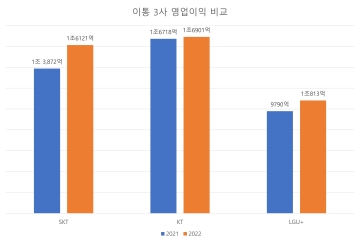
According to the 2022 annual revenue announced by the three telecom companies, their combined operating profit for last year reached approximately 4.38 trillion won, marking a record-breaking performance. SKT announced on the 8th that based on its 2022 consolidated financial statements, it recorded annual revenue of 17.305 trillion won, operating profit of 1.6121 trillion won, and net profit of 947.8 billion won. This represents a 3.3% increase in revenue, a 16.2% increase in operating profit, and a 60.8% decrease in net profit, respectively.
2023.02.15by 김예지 기자

The Ministry of Science and ICT plans to expand the number of Korean mobile carriers.
The Ministry of Science and ICT announced that it held a roundtable discussion on the 10th at the Korea Intelligence Information Society Promotion Agency to strengthen the competitiveness of MVNOs, where major MVNO operators, experts, and government officials participated in in-depth discussions. At the roundtable on that day, government officials and experts met with MVNO operators including Viva Republica (Toss), KB Kookmin Bank, and EyesVision, as well as telecom subsidiary companies SK Telink and KT M-Mobile.
2023.03.13by 김예지 기자
SKT Launches 25 New 5G Intermediate Rate Plans
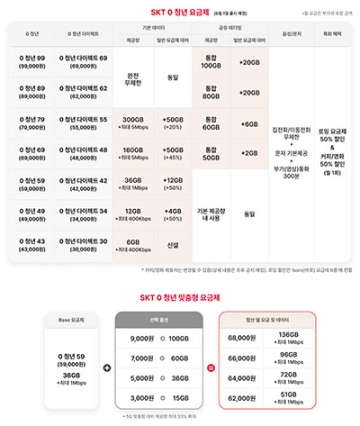
The Ministry of Science and ICT approved on the 23rd SKT's application for new 5G rate plans that was filed on the 17th, taking into consideration customer usage patterns and age group characteristics. The 5G terms of service filed this time include the following: △establishment of three types of 5G senior rate plans for users aged 65 and over △establishment of four types of 5G mid-tier rate plans △establishment of 11 types of 5G youth rate plans for users aged 34 and under △establishment of seven types of 5G youth online rate plans.
2023.03.23by 김예지 기자











