


[2023 International AI Expo] AltoAir CEO Doo-won Jeong: "It's crucial to identify appropriate load distribution and balance between embedded edge AI software and hardware."
 Published2023.05.15 11:34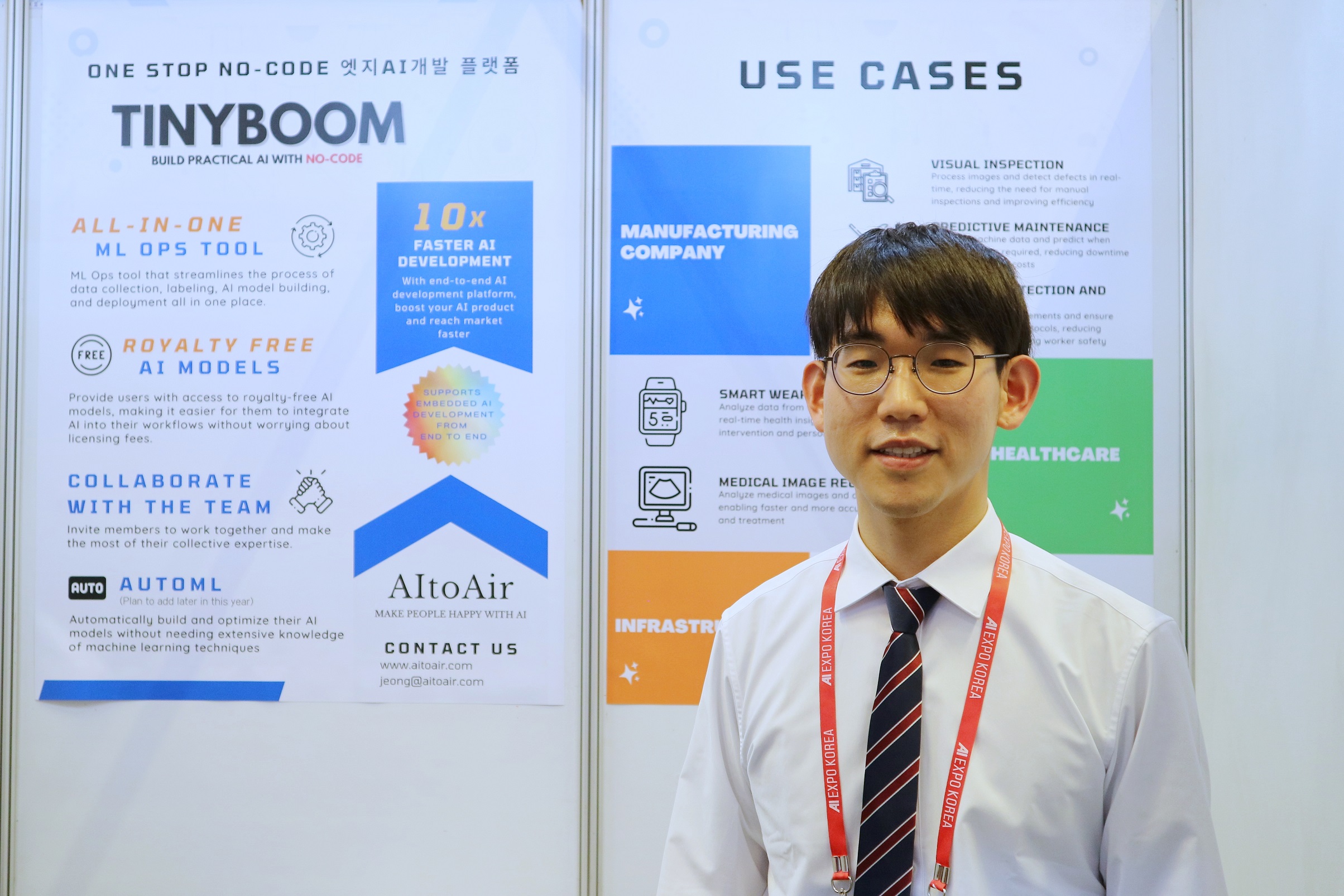
▲AltoAir CEO Jeong Du-won
Edge AI Development: Minimizing Model Redesign Is a Must
A large number of AI solution service providers participated in the 2023 International Artificial Intelligence Competition. Amidst the exhibition of various image analysis, recognition, and detection technologies used in computer vision, a trend toward no-code development was also gaining traction among AI developers.
We met with CEO Duwon Jeong of AltoAir, a no-code edge AI development platform service company that supports end-to-end embedded AI development.
Edge AI development faces increasing development costs.
The edge AI development process involves the following stages: field data collection, data labeling, AI model training, AI model lightweighting, and AI model deployment, and it takes 3 to 4 months to complete a single project. If issues such as decreased accuracy, insufficient memory, slow processing speed, or labeling issues arise during the project stage, the project must return to the previous stage and redesign, which leads to increased development time and costs.
AltoAir CEO Jeong Du-won cited three reasons why AI models return to the design stage: △ difficulty in predicting the memory usage of the design model, △ hardware constraints used in model design, and △ lack of know-how to confirm optimization of AI models in terms of accuracy and processing speed.
In particular, edge AI generally has limitations in processing power, memory, and storage capacity, so the AI model process necessarily involves developing a model that is 'fit' and optimized for these limitations. This optimization process involves numerous trials and errors, and repeated redesigns and modifications.
CEO Jeong emphasized that because computational load, processing speed, and memory usage are trade-offs, finding the right balance and appropriate load distribution between software and hardware is paramount. Consequently, individual developers designing AI models on their own inevitably invest excessive time, energy, and resources in a single model training session.
AltoAir Launches No-Code Edge AI Development Platform
AltoAir Corporation ambitiously presented its no-code edge AI development platform, Tiny Boom, at this year's International Artificial Intelligence Competition.
Most companies offer AI solution services for each technology and often provide customized technical responses to customers. On the other hand, through an AI development platform, the entire process from data collection to AI model training and lightweighting, and AI model deployment can be executed in one stop using an intuitive UI/UX.
CEO Jeong Du-won, who developed Tiny Boom, emphasized, “This is a product that allows even companies with no AI capabilities to develop edge AI models with simple UI operations,” and “It can reduce development time by more than 1/10 of the existing time, and it can also realize the effect of improving the efficiency of AI expert engineer resources.”
The types of AI models that can be developed through TinyBoom include image data analysis models, such as image classification and object recognition, and time-series data analysis models, such as signal classification and anomaly detection. CEO Jeong added that examples include supplying the AI model to quality inspection processes at steel manufacturing companies and medical image interpretation.
CEO Jeong emphasized, “Tinyboom is a solution specialized in the development of edge AI models that are relatively inexpensive enough to operate on microcontrollers (MCUs) and can operate on low-power processors,” and added, “In the second half of 2023, we plan to provide a ‘HW-NAS’ function to minimize the edge AI development cycle by applying technology that finds the optimal balance between HW and SW.”

Comments
Related news

KESSIA, "Edge AI Development, Embedded Technology is a Must"
Edge AI, which has recently garnered significant attention in the technology sector, has reached commercialization in the market as numerous companies have progressed beyond the product development phase in areas such as △video security △IoT devices △automotive solutions △wireless communications. Against this backdrop, there has been a sharp increase in models equipped with edge AI technology. In response to these developments, the embedded industry, which forms the foundation for digital transformation through edge AI, has convened to reinforce its commitment to expanding related industrial technology and strengthening the ecosystem.
2023.04.07by 명세환 기자
ST Supports Easy Development of Intelligent Motion Sensor-Based Edge Processing
STMicroelectronics (hereinafter referred to as ST), a global semiconductor company supporting diverse electronic applications and customers, facilitates easy development of intelligent motion sensor-based edge processing.
2023.05.09by 배종인 기자
[2023 International Artificial Intelligence Fair] Vision AI Solutions: A Must-Have for Consumer Choice
At the International AI Expo, where various AI technology companies participated, a wide range of vision AI-based services and products were showcased. We examined companies that presented AI vision products spanning from servers to edge devices and inquired about related trends and the key factors that each company considers essential in product selection.
2023.05.15by 명세환 기자

[e4ds Tech Day 2026 ⑨] Sim Sang-gyu, Autocrypt CTO: "In the Physical AI Era, Automotive Security Must Extend Beyond the Vehicle"
At e4ds Tech Day 2026, Sim Sang-gyu, CTO of Autocrypt, explained automotive cybersecurity strategies in the era of Physical AI and SDV (Software-Defined Vehicle). Automobiles are evolving as part of an ecosystem connected to AI, cloud, chargers, IoT, and robots, and he emphasized that the scope of security must expand beyond the vehicle interior to the entire connected environment. In particular, AI model tampering, adversarial attacks, OTA updates, and EV charger hacking were identified as major threats. He explained that response measures require zero trust, AI model integrity protection, intrusion detection, Security by Design and Default, and full lifecycle security management, and that proactive security system establishment beyond regulatory compliance is critical for securing future mobility competitiveness.
2026.10.12by 배종인 기자

NVIDIA to Invest $1 Billion in U.S. Science Over Next Five Years
NVIDIA has announced plans to invest $1 billion over the next five years to strengthen U.S. scientific and technological competitiveness. The company will enhance cutting-edge artificial intelligence research and development capabilities in key areas including quantum computing, healthcare, and energy security, while expanding support for higher education research institutions and cloud service providers. NVIDIA is participating as a major industry partner in the White House Office of Science and Technology Policy's Genesis Mission, and is promoting supercomputer construction in collaboration with national laboratories including Argonne and Los Alamos.
2026.10.12by 배종인 기자











