


Intel, Flex Series GPU SW Update
 Published2023.05.22 15:47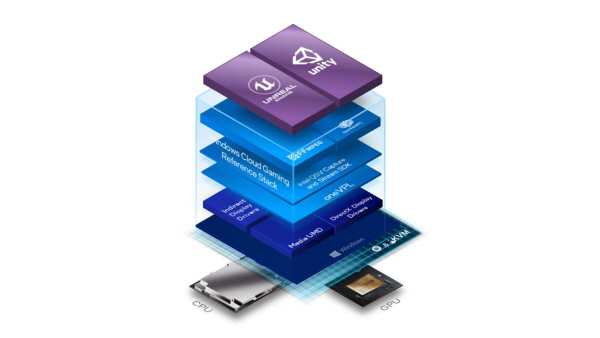
Intel has enhanced cloud gaming and AI workloads for Windows with continuous software updates as the adoption of Flex Series GPUs increases.
Intel announced on the 22nd that it has expanded the production-grade software capabilities of its Intel Flex Series GPUs, including new support for cloud gaming, AI inference, and digital content creation for Windows.
Intel® Data Center GPU Flex Series has introduced flexible general-purpose graphics processing units (GPUs) for data centers and intelligent visual clouds.
As the industry increasingly adopts Flex Series GPUs, customers, solution providers, and developers are utilizing the hardware's capabilities in various ways.
For example, cloud service providers are deploying cloud game instances for Windows with streaming and media acceleration, and Media Studio is testing and deploying Flex Series GPUs for high-density streaming and transcoding.
In addition, digital content creators are using the platform for real-time rendering utilizing ray tracing hardware acceleration.
In particular, the Flex series GPUs have added cloud gaming for Windows to keep pace with the growth of the gaming market. Intel's new software features for Intel Flex Series GPUs, combined with 3rd and 4th Gen Intel Xeon Scalable processors, enable the realization of new capabilities and benefits across real-world workloads.
It provides excellent performance even in AI workloads.
In AI inference, Intel Flex Series GPUs support most common AI frameworks, such as TensorFlow and PyTorch, through the Intel® AI Analytics Toolkit. Intel has completed the validation of more than 100 AI inference models.
AI Visual Inference includes the open-source GStreamer multimedia framework, the Intel® OpenVINO™ toolkit inference engine, and open-source sample implementations of media analysis frameworks for creating complex visual inference and analysis pipelines.
In autonomous driving (AD), it demonstrates better performance than data center competitors in CARLA benchmark performance utilizing the open source solution Unreal Engine 4.
In a single 1080p sensor scenario, a single Intel® Data Center Flex 170 GPU achieves 56 frames per second (fps), which is 16% faster than the NVIDIA A10G (48fps), 40% faster than the NVIDIA GPU Tesla T4 (40fps), and 60% faster than the AMD Radeon Pro V520 MxGPU (35fps).
The performance of the Intel Data Center Flex 170 GPU scales according to four 1080p sensors, reaching 23fps, while the Nvidia A10G records 19fps.
In relation to digital content creation, real-time rendering is provided through ray tracing hardware acceleration on the Intel Flex Series via Intel® Embree.
Using the latest Intel® Open Image Denoise, AI-based noise removal can be completed in milliseconds. Productivity can be further increased by using a single SYCL codebase for CPU/GPU rendering through a single API.
The Flex Series provides customers with comprehensive graphics solutions, an open full software stack, free licensing costs, and an integrated programming model for CPUs and GPUs, delivering performance and productivity through a single API. Software stacks and development tools supporting workloads can be found in the software for Intel Data Center GPU Flex Series.
System manufacturers are preparing more than 70 designs featuring Flex Series GPUs, and more than 40 designs are scheduled to be released by the middle of this year.
Cisco, Dell, H3C, HPE, IEIT, Lenovo, Nettrix, PowerLeader, Supermicro, xFusion, and others are launching products equipped with Intel Flex Series GPUs.
The latest updates on system design, release timing, and product updates can be found on the Intel Data Center GPU Flex Series page at Intel.com.

Comments
Related news
.jpg)
SalePoint Signs Multi-Year Partnership Agreement with AWS… Promoting Identity Security that Integrates Even AI Agents
Sailpoint has entered into a multi-year strategic partnership agreement with AWS and is moving forward with establishing an integrated governance system that manages both human and non-human identities together. The plan is to consistently manage access permissions in an environment where AI agents are increasing as work execution entities, while applying the principle of least privilege and automated policy enforcement. The two companies plan to jointly expand capabilities to manage the identities of various entities, including AI agents, within a single layer in the AWS environment. This collaboration is interpreted as a move to design security and governance together in corporate environments where AI adoption is expanding.
2026.03.26by 배종인 기자
.png)
Databricks Unveils Open AI Security Monitoring 'Lakewatch'
Databricks entered the security market on March 24 by unveiling LakeWatch, an open-source agentic SIEM. The core functionality of this product is to integrate and analyze security, IT, and business data in a single environment to support AI-based threat detection and investigation. The company explained that it reduces the limitations of existing security operations centers, which have had to forgo some data due to high cost structures, and enables large-scale data analysis and automation based on open formats and ecosystems. LakeWatch is currently offered as a private preview, with Adobe and Dropbox mentioned as early customers. Databricks also announced an expanded partnership with Anthropic as well as the acquisition of Antimatter and SiftD.ai.
2026.03.26by 배종인 기자

Ecolab Expands AI Data Center Cooling Business Through Acquisition of CoolIT
Ecolab has agreed to acquire CoolIT Systems, a liquid cooling company for AI data centers, for approximately $4.75 billion. The transaction is expected to close by Q3 2026, subject to regulatory approvals. CoolIT has been supplying direct-to-chip cooling-based coolant distribution units, cold plates, and manifolds, serving hyperscale data centers and colocation operators as customers. This acquisition is a measure to address the high-heat and high-density server environments created by AI proliferation. Ecolab plans to combine its water management and digital monitoring capabilities with CoolIT's hardware technology to expand its data center cooling business.
2026.03.26by 명세환 기자
Arm Unveils First Data Center CPU Targeting 'Agentic AI' Era… Securing Both Cost-Effectiveness and Scalability for Large-Scale AI Infrastructure
Arm has unveiled the 'Arm AGI CPU,' the first data center CPU that simultaneously secures cost-efficiency and scalability for large-scale AI infrastructure, marking a new turning point in artificial intelligence (AI) infrastructure as it targets the 'agentic AI' era.
2026.03.25by 배종인 기자
.jpg)
ETRI Develops Multimodal AI Technology That Retains Existing Information Even When Learning New Knowledge
The Electronics and Telecommunications Research Institute (ETRI) has developed a technology that reduces the "catastrophic forgetting" problem, where multimodal AI loses existing information while learning new knowledge. This technology works by separately storing image and text information and connecting them only when needed, focusing on reducing knowledge loss in existing models while improving response accuracy to complex questions. The research results were accepted at the NeurIPS 2025 artificial intelligence academic conference, and potential applications were suggested for fields requiring continuous updates, such as policies and regulations, product information, and industrial data.
2026.03.24by 명세환 기자











