


The K-Cloud Project is now fully operational, with a 100 billion won investment over three years.
 Published2023.06.27 10:28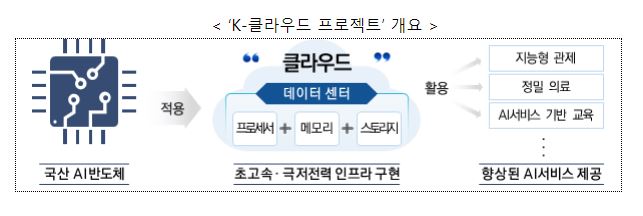
Participation in a consortium of domestic cloud, AI semiconductor, and AI service companies
A 1 trillion won K-Cloud technology development feasibility study is underway.
As ultra-large AI-based generative AI models proliferate, the need for high-performance, low-power AI semiconductors is growing. The government is launching Phase 1 of the "K-Cloud Project" in earnest to foster domestic AI semiconductor and cloud competitiveness.
Minister of Science and ICT Lee Jong-ho announced on the 26th that he presided over the 3rd 'Artificial Intelligence Semiconductor High-Level Strategic Dialogue' at NHN Cloud in Pangyo and held a report meeting on the launch of the 1st phase of the 'K-Cloud Project'.
In December of last year, the government announced the 'K-Cloud Promotion Plan Utilizing Domestic AI Semiconductors'. The 'K-Cloud Project' is a policy to develop domestic AI semiconductors and apply them to data centers to strengthen domestic cloud competitiveness in order to enter the AI semiconductor development market that is attracting attention from global big tech companies such as Nvidia, AMD, MS, and Amazon.
The government will invest a total of KRW 826.2 billion from 2023 to 2030 to advance domestically produced AI semiconductors in three stages (NPU → low-power PIM → ultra-low-power PIM), and will also pursue a demonstration project to apply them to data centers in stages to provide cloud-based AI services.
This first phase of the project, now in full swing, is a demonstration project that will apply domestically produced NPUs, currently in the early stages of commercialization, to data centers and provide cloud-based AI services. Approximately KRW 37.6 billion will be invested in 2023, with a total investment of approximately KRW 100 billion through 2025. The project, which began with the project announcement in February, will be officially launched with this launch briefing.
The government also aims to secure a reference by applying NPUs to actual data centers and services. The "Domestic NPU Data Center Construction Project" consists of two projects: 1) AI Semiconductor Farm Construction and Demonstration (private sector) and 2) AI Semiconductor Testing and Verification Environment Creation (public sector, Gwangju AI Complex). At the time of announcement, the target for each business was to start with a total scale of 39.9PF, doubling the operating capacity.
■ Announcement of domestic cloud and AI semiconductor companies' initiatives and plans
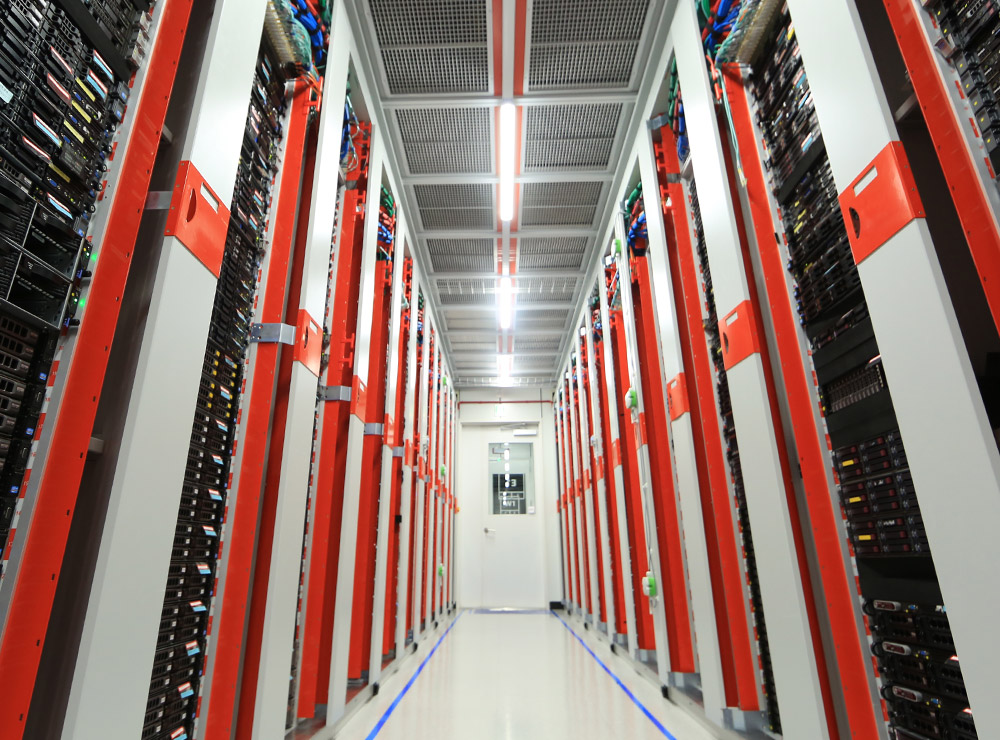
▲NHN Cloud Data Center
This project will involve a consortium of domestic cloud, AI semiconductor, and AI service companies. Cloud companies include Naver Cloud, NHN Cloud, and KT Cloud, while AI semiconductor companies include Rebellion, Sapion Korea, and Furiosa AI.
Through this project, NHN Cloud will build a domestically produced AI semiconductor-based data center with a total scale of over 22 PF, with 11 PF each in the private and public sectors. This represents the largest scale of the project, accounting for over 50% of the total.
Naver Cloud will build a data center based on domestically produced AI semiconductors, totaling 9 PF, comprising private and public sectors (4.5 PF each). Focusing on efficiency, Furiosa AI chips will be used to verify demonstration services in natural language processing, education, and safety control. Additional domestically produced AI semiconductors will be added later.
In this project, KT Cloud will demonstrate a domestically produced AI semiconductor-based data center, cloud platform, and AI application service worth 8.9PF, including private and public sectors (4.45PF each). KT's massive AI 'Trust' is also verifying the commercialization potential based on domestic AI semiconductors, completing the AI full-stack.
On the 30th of last month, KT Cloud became the first in Korea to commercialize a cloud-based NPU infrastructure service equipped with Rebellion's 'ATOM'.
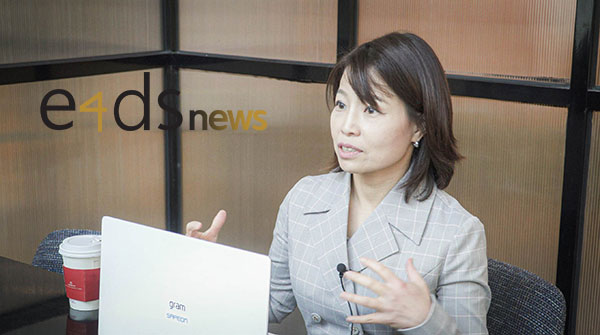
▲Sapion CEO Ryu Su-jeong
AI semiconductor companies also expressed their commitments. Sapion Korea will supply chips for this project, the largest among AI semiconductor companies, totaling 20PF (10PF public, 10PF private). This year, it will apply the X220, and next year, the X330, which offers a more than fourfold increase in performance efficiency in floating-point operations.
Rebellion is currently the only company in Korea that supports floating-point operations using ATOM™, an AI semiconductor manufactured using Samsung Electronics' 5nm EUV process. Utilizing ATOM for this project, Rebellion will supply over 2PF of chips in the first year and over 8.9PF in total by the third year, demonstrating intelligent control solutions and healthcare AI solutions.
Furiosa AI plans to provide its NPU, Warboy, and next-generation chip, RENEGADE, to cloud companies to demonstrate AI services in the fields of control, natural language, and education. Renegade is a 5nm process and is used for large language models (LLMs), personalized recommendations, vision, and voice.
Furiosa AI has signed a strategic partnership with LG AI Research Center and plans to verify commercial 'generative AI' technology based on the ultra-large AI EXAONE.
■ K-Cloud Technology Development Preliminary Project Promotion
Meanwhile, after the commencement report meeting, the plan for the 'K-Cloud' technology development feasibility study was discussed.
Based on the K-Cloud promotion plan utilizing domestically produced AI semiconductors announced in December of last year, the Ministry of Science and ICT is planning a feasibility study worth approximately 1 trillion won to provide cloud services utilizing domestically produced AI semiconductors in Phases 2 and 3. This study focuses on the development of data center infrastructure and hardware, data center computing software, and AI semiconductor-specific cloud technology. The plan report for the feasibility study selection process is scheduled to be submitted in the second half of this year.
In addition, the Ministry of Science and ICT announced a government support plan for fostering talent with AI semiconductor development and AI/software capabilities through the 'AI Semiconductor Graduate School Operation Plan', as well as the main educational plans of the three universities (Seoul National University, Hanyang University, and KAIST) selected for this year's project.
This was followed by the announcement of a joint declaration on cooperation between industry, academia, and research. Representatives from industry, academia, and research gathered that day declared that they would join forces and cooperate to foster new industries and create a related ecosystem linked to AI semiconductors, cloud, edge, and AI services.
Minister of Science and ICT Lee Jong-ho said, “For the full-scale expansion of AI utilization, including ultra-large language models, a significant number of semiconductor chips must be in operation, and global companies are fiercely competing to create high-performance, low-power AI semiconductors optimized for AI operations.”
"Through this project, we will actively support domestically produced AI semiconductors to secure references and enter the global market. Furthermore, we will leverage our memory semiconductor capabilities to gradually advance AI semiconductors by 2030. We will also develop the hardware and software technologies necessary to apply these technologies to data centers and cultivate AI semiconductor experts. We will spare no effort in supporting Korea to secure world-class AI semiconductor technology," he said.
Comments
Related news
.jpg)
Super-large AI, high-quality data acquisition... domain-specific service is essential
The KIEI Industrial Education Research Institute held a 'Seminar on Business Models by Sector Utilizing Generative AI Technology' on the 14th. The seminar covered △introduction to generative AI technology paradigms and utilization research △legal and regulatory frameworks related to generative AI △AI technology development and business strategies by sector.
2023.04.18by 김예지 기자
Furiosa AI, Proving Korea's AI Semiconductor Commercialization Competitiveness
AI semiconductor specialist Furiosa AI announced on the 16th that it achieved favorable results in the selection of business operators for the AI semiconductor project led by the Ministry of Science and ICT.
2023.05.16by 김예지 기자

AI semiconductor demand surges… GPUs from Nvidia, FPGAs from Intel and AMD
Nvidia's market capitalization recently approached $1 trillion (approximately 1.3 quadrillion Korean won), marking an all-time high. Nvidia, the first semiconductor company to join the $1 trillion club, is showing remarkable growth in shipments driven by increased demand from the artificial intelligence (AI) boom.
2023.05.31by 명세환 기자
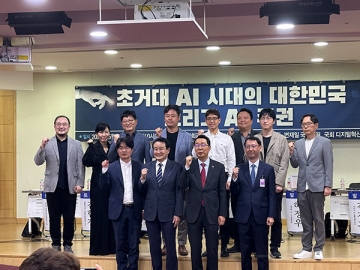
Securing AI Sovereignty: Minimizing Regulation and Tailored Support Are Essential
On May 31st, a discussion was held in Conference Room No. 2 of the National Assembly on "South Korea in the Era of Ultra-Large-Scale AI and AI Sovereignty." The discussion addressed strategies for expanding South Korea's ultra-large-scale AI ecosystem following the generative AI boom exemplified by ChatGPT. AI sovereignty refers to the possession of capabilities to independently build and operate the overall ecosystem through industrialization. South Korea is evaluated as maintaining competitiveness in ultra-large-scale AI-based technology and infrastructure ranking third after the United States and China.
2023.06.01by 김예지 기자
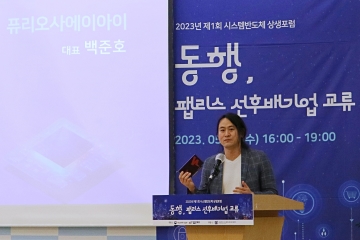
LG AI Research Institute and Furiosa AI Join Hands to Develop Next-Generation AI Semiconductor
As the artificial intelligence era gains full momentum, companies are showing intense interest in securing and developing AI semiconductors. FuriosaAI, a fabless company with leading capabilities in domestic AI semiconductors, has partnered with LG to embark on AI semiconductor development, breathing new vitality into the domestic system semiconductor ecosystem.
2023.06.08by 명세환 기자











