



Global IT Spending: A Crossroads Between Software, IT Services, and Devices
 Published2023.07.24 17:30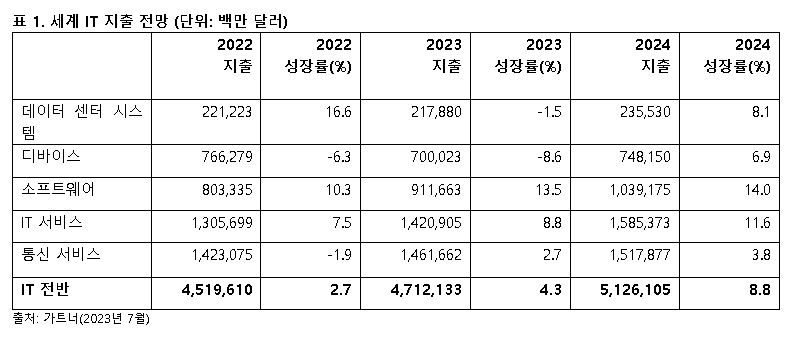
▲Global IT Spending Outlook (Table: Gartner)
Korea's growth rate only increased by 1.1%, but it must secure IT competitiveness.
The generative AI boom has had a limited impact on IT spending.
Global inflation and a consumer slump are slowing the clearing of backlogged inventory. With IT spending in the device sector declining significantly, it's expected that it will be difficult to recover to 2021 spending levels for the next three years.
Global IT spending to increase 4.3% in 2023
According to a report released by Gartner on the 24th, global IT spending this year is expected to reach a total of $4.7 trillion, a 4.3% increase from last year. As CIOs struggle to compete for IT talent, they are shifting spending toward technologies that support automation and efficiency to drive massive growth with fewer staff members.
It appears that IT spending growth is being driven by SW and IT services. In the global IT spending outlook, the device sector recorded negative growth, recording -8.6% year-on-year to $700 billion (approximately 900 trillion won), while the software and IT services sectors are predicted to show higher growth rates than last year, growing 13.5% to $910 billion (approximately 1,160 trillion won) and 8.8% to $1.42 trillion (approximately 1,821 trillion won), respectively.
In the 2024 outlook, devices showed a 6.9% growth recovery, while SW was the highest at 14%, followed by IT services at 11.6%.
The report said, "The software sector is expected to see double-digit growth this year as businesses increase software adoption and reallocate spending to core applications and platforms that drive efficiency, such as enterprise resource planning (ERP) and customer relationship management (CRM). Vendor price increases are also expected to continue to drive up software spending."
While the overall outlook for corporate IT spending is positive, inflation is expected to continue to impact consumer purchasing power, leading to an 8.6% decline in device spending this year.
“Digital business transformation is changing,” said John-David Lovelock, research vice president at Gartner. “IT projects are shifting their focus from external outcomes like revenue and customer experience to internal efforts focused on optimization.”
In fact, the replacement cycle of smartphones is counterpointAccording to Trend Research, a report released last year predicted that the replacement cycle for smartphones would increase to a record high of 43 months. The increase in the replacement cycle is attributed to factors such as a sluggish consumer spending due to inflation, a booming used phone market, and the development of after-sales service networks.
Experts predict that smartphone shipments will struggle to exceed the mid- to high-1 billion unit mark annually, indicating a saturated smartphone market. The widespread adoption of new hardware devices and platforms, such as VR/AR glasses, smart rings, and autonomous and software-defined cars, is expected to offset this sluggish device spending.
"The devices segment is experiencing its worst growth rate ever," said Lovelock, research vice president. "Despite some moderation in inflation in some regions, macroeconomic factors are still negatively impacting discretionary spending, lengthening device replacement cycles." Gartner predicts that device spending will not return to 2021 levels until at least 2026.
Korea's IT spending increases by 1.1%... Securing competitiveness in software and IT services is essential.
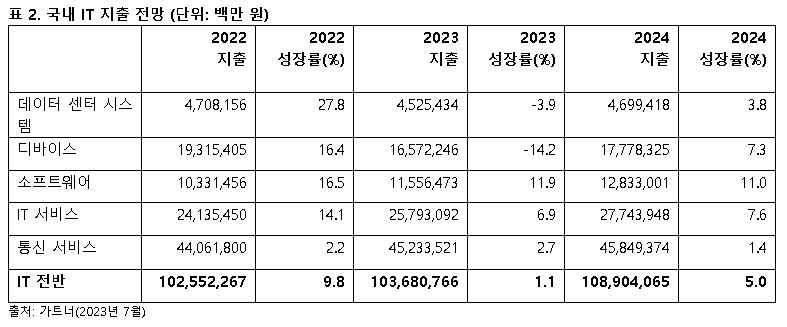
▲Domestic IT Spending Outlook (Table: Gartner)
Korea's IT spending is projected to exceed KRW 103 trillion in 2023, a 1.1% increase year-on-year, and is projected to increase even more sharply in 2024, reaching KRW 109 trillion, a 5% increase. This was also a mixed bag, with double-digit growth in the software sector contrasting with a 14.2% decline in device spending.
The overall IT spending growth rate in 2023 is expected to be just 1.1%, a tenth of last year's nearly 10% increase.
The domestic software and IT industries are unanimous in their call for urgent solutions to the problems of sluggish global expansion of IT services and high dependence on foreign products for SW-based technologies and key SW packages.
At a National Assembly seminar titled “IT Services Lead the Era of Successful Digital Transformation” held at the National Assembly Members’ Hall in February, Professor Cho Moon-jeung of Gyeongsang National University gave a presentation, stating that Korea’s IT services have had problems such as low value-added industries, dependence on foreign technology, and poor treatment of developers due to dispatch/overtime work, and that the reason for failing to dominate the cloud market was “insufficient transition to a business structure suited to the cloud era.”
Professor Cho emphasized that “software is all about people, and talent is the core competency,” and suggested that “improving the environment where key talent can work in specialized fields for a long time and competing through flexible architecture and abundant technological assets” are necessary.
The generative AI boom has had a limited impact on IT spending.
The generative AI trend sparked by ChatGPT has spurred companies to integrate generative AI into their existing tools.
Gartner said, "Many business and IT leaders view generative AI as the most important, but it has not yet had a significant impact on IT spending," and predicted, "In the long term, generative AI spending is expected to be largely absorbed within companies' existing spending levels."
“The best way for generative AI to enter the market is to leverage an organization’s existing software, hardware, and services,” said Lovelock, VP of Research. “New features are added to technology products and services every year in the form of upgrades and add-ons, but most companies will integrate generative AI in a gradual and controlled manner through upgrades to existing tools included in their IT budgets.”

Comments
Related news
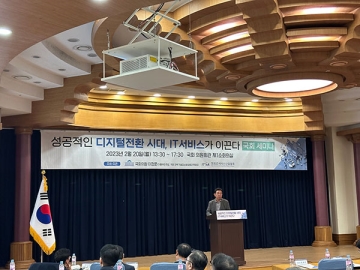
“Korean IT service industry must secure cloud-based competitiveness”
On the 20th, a forum titled 'Digital Transformation Success: IT Services Leading the Way' was held at the National Assembly Conference Room No. 1, providing a venue to share business strategies on the direction IT services industry should pursue in the digital transformation era. A consensus emerged that for the development of the IT services industry, cloud adoption is essential, and national-level efforts including institutional framework establishment and talent cultivation are crucial.
2023.02.21by 김예지 기자
“Global IT spending expected to increase by 5.5% in 2023”
While spending on the devices sector is projected to decline due to economic slowdown, the increase in software (SW) and IT services spending is expected to exceed this decline, maintaining overall IT spending on an upward trajectory this year as well. Against this backdrop, IT services dependence and spending are likely to increase further due to skilled talent shortages and rising labor costs, and the related market expansion is anticipated.
2023.04.10by 명세환 기자
Samsung Electronics, Q2 operating profit down 95%… L-shaped recession concerns
The semiconductor downturn is passing through its lowest point. As Samsung Electronics' second quarter provisional results have been announced, sending shocks through the market, there are conflicting views between expectations for improvement in the second half of the year and forecasts of an L-shaped downturn, where the slump is expected to be longer than anticipated.
2023.07.07by 명세환 기자

Intel Unveils Next-Generation 'Core Ultra Series 3' and vPro Platform for Enterprise PCs
Intel has officially unveiled the "Intel Core Ultra Series 3" for next-generation enterprise PCs and the latest vPro platform, addressing a wide range of demands from enterprise notebooks to high-performance workstations.
2026.03.26by 배종인 기자

ROHM Launches ESD Protection Diode Compatible with High-Speed Interfaces of 10Gbps or Higher
Semiconductor specialist ROHM has developed the 'RESDxVx series' of ESD (electrostatic discharge) protection diodes capable of responding to next-generation high-speed data communication environments exceeding 10Gbps, simultaneously enhancing both signal quality maintenance required in high-speed interfaces and IC protection performance.
2026.03.26by 배종인 기자











