



SKT's AI-based traffic signal optimization solution reduces vehicle travel times.
 Published2023.07.26 15:24
By applying AI technology to actual traffic signal systems by integrating communication location data, it has been proven that not only can vehicle travel time be shortened, but carbon emissions can also be reduced.
SK Telecom (CEO Yoo Young-sang) announced on the 26th that it recently developed a traffic signal optimization solution (T.Flow) based on traffic data analysis extracted from its AI-based location data analysis platform (Litmus), and applied it for the first time to a chronically congested section in Hwaseong City, achieving significant results such as reducing vehicle travel time.
The location-based data analysis platform 'LITMUS' is a technology that uses AI to analyze location data from communication base stations and provides location intelligence data such as movement status and means.
T.Flow, a traffic signal optimization solution, analyzes traffic signals and provides an optimal signal system using traffic volume information for each direction at intersections extracted through location-based mobile communication data analysis.
SKT, in cooperation with Hwaseong City, Gyeonggi Province, Hwaseong Dongtan Police Station, Hwaseong West Police Station, and the Road Traffic Authority, developed a signal system improvement plan for 15 intersections with chronic traffic congestion for three months starting in March and tested the traffic improvement effect, and achieved the effect of reducing actual vehicle travel time by 13%.
The actual application area is a 5.4km stretch from the Jaan Entrance Intersection on Samcheonbyeongma-ro in Hwaseong City to the Haegwang Metal Intersection. This area is chronically congested, with an average daily traffic volume exceeding 53,000 vehicles. SKT utilized AI technology to analyze traffic patterns by time of day and determine the optimal traffic signal cycle. As a result of comparing the travel time before and after applying the calculated traffic signal cycle, it was shortened by approximately 1 minute and 40 seconds (13%), from 11 minutes and 30 seconds before application to 9 minutes and 50 seconds after application.
This is expected to have an economic benefit of KRW 1.2 billion per year and reduce carbon emissions by 52 tons. If this is expanded to the entire city of Hwaseong in the future, it is expected to have an economic benefit of approximately KRW 52 billion per year and reduce carbon emissions by approximately 2,200 tons.
In order to optimize traffic signals, it is important to collect basic data such as traffic volume by direction. SKT's solution 'T.Flow' does not require separate devices or survey personnel to collect traffic volume, and can measure it anywhere, 365 days a year, regardless of environmental factors such as location, time, or bad weather, greatly improving the accuracy and efficiency of data collection.
SKT plans to participate in the smart signal operation project that the Ministry of Land, Infrastructure and Transport has been promoting since 2020 by continuously upgrading its technology to monitor traffic flow across the city and optimize traffic signals.
The smart signal operation project is a project to introduce a smart traffic signal operation system that controls signals in real time according to traffic volume to ensure smooth vehicle flow and gives priority signals to emergency vehicles such as fire trucks.
SKT Connectivity CO-President Shin Yong-sik said, “According to the Korea Transport Institute, the cost of nationwide traffic congestion in 2018 is estimated to be approximately 68 trillion won,” and added, “We will actively utilize advanced ICT technology to take the lead in solving the increasingly serious urban traffic problems and fulfill our social responsibility as the number one mobile carrier in Korea.”

Comments
Related news

[e4ds Tech Day 2026 ⑨] Sim Sang-gyu, Autocrypt CTO: "In the Physical AI Era, Automotive Security Must Extend Beyond the Vehicle"
At e4ds Tech Day 2026, Sim Sang-gyu, CTO of Autocrypt, explained automotive cybersecurity strategies in the era of Physical AI and SDV (Software-Defined Vehicle). Automobiles are evolving as part of an ecosystem connected to AI, cloud, chargers, IoT, and robots, and he emphasized that the scope of security must expand beyond the vehicle interior to the entire connected environment. In particular, AI model tampering, adversarial attacks, OTA updates, and EV charger hacking were identified as major threats. He explained that response measures require zero trust, AI model integrity protection, intrusion detection, Security by Design and Default, and full lifecycle security management, and that proactive security system establishment beyond regulatory compliance is critical for securing future mobility competitiveness.
2026.10.12by 배종인 기자

Practical HIL Construction Strategy for Automotive and Off-Highway Controller Validation
As vehicle E/E architecture transitions to zonal structures and shifts to software-defined vehicles (SDV), the number of controllers (ECUs) requiring validation and software complexity are surging dramatically. Meanwhile, real vehicle testing cannot provide repeated verification under identical conditions and entails lead time and safety concerns. This white paper explains the principles of HIL (Hardware-in-the-Loop) validation and the structure of the NI platform composed of PXI, SLSC, and VeriStand, and through two actual implementation cases—Camera Record & Replay HIL for In-Cabin Monitoring Controller (ICMU) and Forklift Controller (VCU) HILS—describes how controller-level regression testing becomes possible. Additionally, it explicitly states application boundaries and limitations, such as lack of A2B support.
2026.10.12by 편집부
NVIDIA to Invest $1 Billion in U.S. Science Over Next Five Years
NVIDIA has announced plans to invest $1 billion over the next five years to strengthen U.S. scientific and technological competitiveness. The company will enhance cutting-edge artificial intelligence research and development capabilities in key areas including quantum computing, healthcare, and energy security, while expanding support for higher education research institutions and cloud service providers. NVIDIA is participating as a major industry partner in the White House Office of Science and Technology Policy's Genesis Mission, and is promoting supercomputer construction in collaboration with national laboratories including Argonne and Los Alamos.
2026.10.12by 배종인 기자
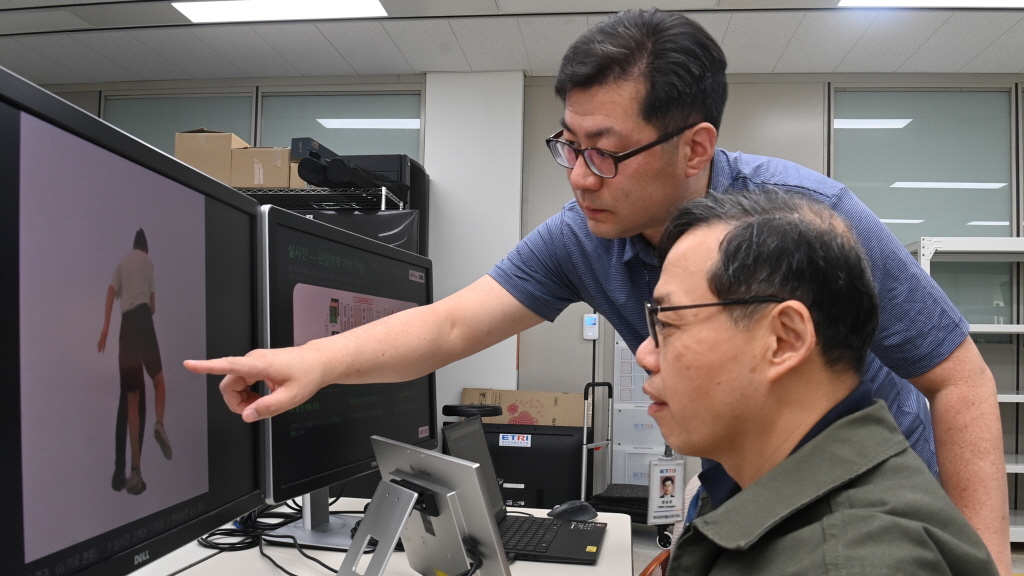
ETRI Unveils 3 Next-Generation Media Technologies Including AI-Dedicated Video Compression
ETRI has unveiled three next-generation media technologies optimized for AI. These include AI-based video encoding (VCM), 3D human generation based on sparse cameras, and generative AI-based pre-visualization technology. In environments where AI directly processes video such as autonomous vehicles, robots, and drones, these technologies enable efficient compression and transmission of large-scale data, and can be applied across various industrial sectors including smart cities, video security, and sports broadcasting.
2026.10.12by 배종인 기자
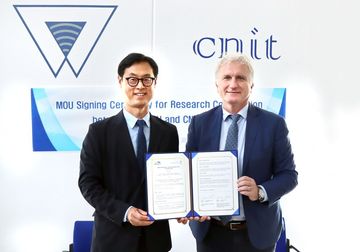
Korea Automotive Research Institute Signs MOU with Italy National Institute for Wireless Communications
The Korea Automotive Research Institute will sign an MOU with Italy's National Institute for Wireless Communications and launch joint research on next-generation mobility technologies based on 6G, V2X, and connected vehicles. The two organizations will conduct research to apply advanced wireless communication technologies to vehicles and discover international joint projects to advance next-generation connected vehicle technology development.
2026.10.12by 배종인 기자











