



Ministry of SMEs and Startups Hosts SME Innovation Network Forum
 Published2023.08.25 15:49
.jpg)
▲ The 3rd SME Innovation Network Forum (Photo: Ministry of SMEs and Startups)
Discussion on global linkage policy strategies for AI, carbon neutrality, bio, and semiconductors
With the urgent need to develop the domestic deep tech startup ecosystem to lead the market in future new growth sectors, a meeting was held where government ministries and innovative companies came together to discuss development strategies.
The Ministry of SMEs and Startups held the '3rd SME Innovation Network Forum' at the Ramada Plaza Hotel in Jeju from the 24th to the 25th.
The 3rd forum was held under the theme 'Next Challenge, Scale-up Strategies for Fostering Global Deep Tech'.
On the first day, following a keynote speech by Kim Jeong-bin, CEO of the AI-based climate tech startup Superbin, operational plans were announced for the five newly reorganized divisions: AI, Carbon Neutrality, Bio, Semiconductor, and Global Linkage & Policy.
In addition, discussions on carbon neutrality response strategies for SMEs proceeded, starting with a policy proposal for the restructuring of the Ministry of SMEs and Startups' R&D portfolio by Dr. Park Chan-soo of STEPI and a presentation by Chairman Jeon Ha-jin of the SDX Foundation.
Day 2 features a customized service for sole proprietors by CEO Kim Dong-ho of Korea Credit Data, which grew into a unicorn company in just six years.This was followed by a special lecture on the theme of "Leading DX," a presentation and discussion on global technology cooperation strategies for small and medium-sized enterprises and venture companies by CEO Ko Jong-seong of Genosco, a successful case study of a Boston biotech company.
In particular, at this event, the Ministry of SMEs and Startups will announce the newly revised 'SME R&D Structural Reform Plan,' based on the awareness that despite the expansion of the budget, R&D has remained limited to project-based execution, lacking long-term strategic depth for ecosystems across different corporate groups.
The plan involves simplifying compartmentalized structures and the excessive number of projects (48 as of 2023), and enhancing strategic depth through a two-track strategy based on innovation capabilities. It plans to promote large-scale innovation projects based on strategic technology themes for the group of leading innovation companies, while supporting the dissemination of practical R&D outcomes, such as industry-specific common demand R&D, for the general group of companies. In addition, we plan to expand joint R&D with leading global research institutions.
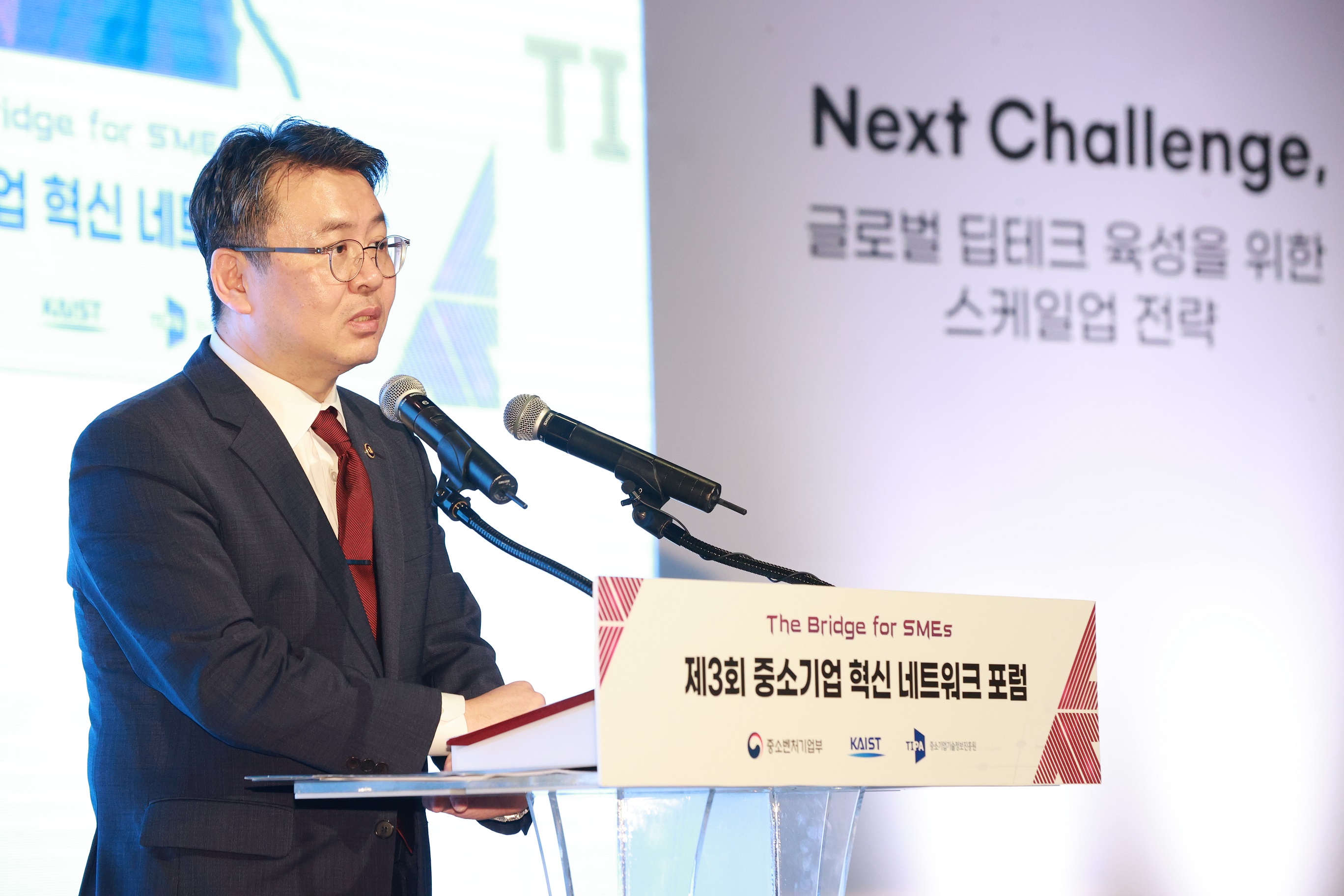
▲ Vice Minister of SMEs and Startups Oh Gi-woong (Photo: Ministry of SMEs and Startups)
Vice Minister Oh Gi-woong of the Ministry of SMEs and Startups stated, “I ask that the Innovation Network Forum, now in its third year, continue to provide direction as a think tank for technology innovation strategies. The Ministry of SMEs and Startups will also strengthen the strategic nature of R&D from the perspective of end-users in the field and actively support the innovation and scale-up of SMEs through collaboration with leading global research institutions.”
Meanwhile, the 'SME Innovation Network Forum' is a think tank that seeks strategic directions for technology innovation in SMEs and ventures. It was launched in July 2020 with experts from SMEs, venture companies, investors, researchers, and support organizations, and is operated by the Minister of SMEs and Ventures and the President of KAIST as co-chairs.
Comments
Related news
Ministry of SMEs and Startups to Support Metaverse Factories
Foreign companies and some large enterprises are strengthening their digital capabilities by building manufacturing infrastructure utilizing the metaverse. In contrast, domestic small and medium-sized enterprises were unable to venture into this due to insufficient funding and technological capabilities, but a solution has been proposed to address this issue.
2023.02.03by 명세환 기자
The Ministry of SMEs and Startups is expanding recruitment of companies participating in Free Tips.
Recruitment has begun for companies interested in participating in the Pre-TIPS program, which discovers startups with high growth potential, nurtures them as prospective TIPS startups, and promotes angel investment to support the revitalization of the regional startup ecosystem.
2023.02.27by 명세환 기자
.jpg)
Ministry of SMEs and Startups, Smart Manufacturing Innovation Act Enforcement
The Ministry of SMEs and Startups announced that it will implement subordinate regulations for the "Act on Promoting Smart Manufacturing Innovation for Small and Medium Enterprises," which was enacted last January, and will begin full enforcement starting from the 4th.
2023.07.05by 김예지 기자
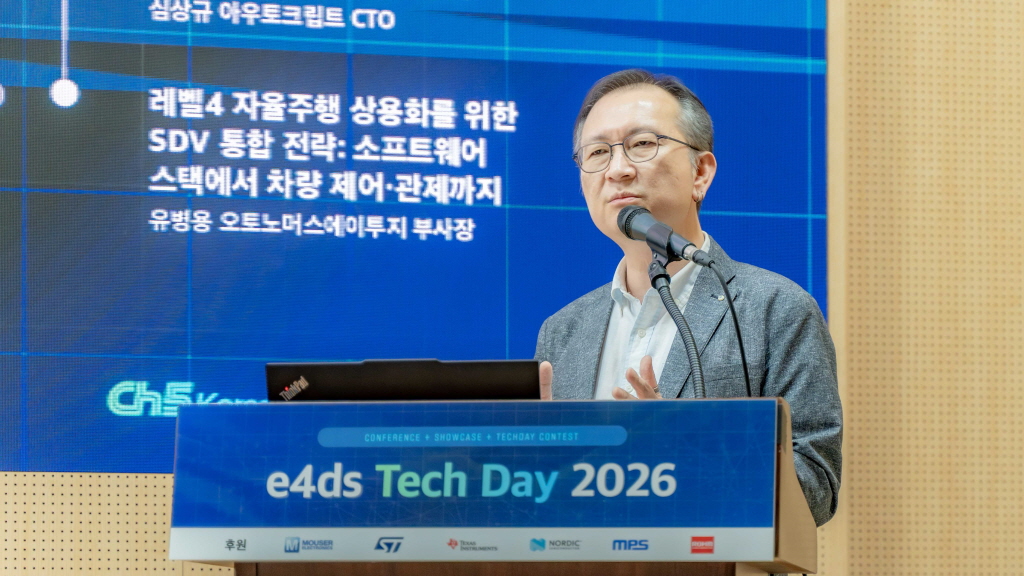
[e4ds Tech Day 2026 ⑨] Sim Sang-gyu, Autocrypt CTO: "In the Physical AI Era, Automotive Security Must Extend Beyond the Vehicle"
At e4ds Tech Day 2026, Sim Sang-gyu, CTO of Autocrypt, explained automotive cybersecurity strategies in the era of Physical AI and SDV (Software-Defined Vehicle). Automobiles are evolving as part of an ecosystem connected to AI, cloud, chargers, IoT, and robots, and he emphasized that the scope of security must expand beyond the vehicle interior to the entire connected environment. In particular, AI model tampering, adversarial attacks, OTA updates, and EV charger hacking were identified as major threats. He explained that response measures require zero trust, AI model integrity protection, intrusion detection, Security by Design and Default, and full lifecycle security management, and that proactive security system establishment beyond regulatory compliance is critical for securing future mobility competitiveness.
2026.10.12by 배종인 기자
NVIDIA to Invest $1 Billion in U.S. Science Over Next Five Years
NVIDIA has announced plans to invest $1 billion over the next five years to strengthen U.S. scientific and technological competitiveness. The company will enhance cutting-edge artificial intelligence research and development capabilities in key areas including quantum computing, healthcare, and energy security, while expanding support for higher education research institutions and cloud service providers. NVIDIA is participating as a major industry partner in the White House Office of Science and Technology Policy's Genesis Mission, and is promoting supercomputer construction in collaboration with national laboratories including Argonne and Los Alamos.
2026.10.12by 배종인 기자











