


“Possession of the Most Advanced Generative AI Determines Competition”
 Published2023.09.05 14:06
70% of CEOs to Reduce Workforce or Reduce Within One Year Due to Generative AI
Generative AI, such as ChatGPT and MidJourney, is sweeping across content previously considered the exclusive property of humans, including text, images, and videos. As CEOs predict that the possession of generative AI will change the competitive landscape, discussions regarding governance are intensifying as this technology impacts the workforce market and ethics in general.
According to a global research survey by IBM Institute for Business Value (IBV) on the 5th, corporate CEOs were found to prioritize productivity as the top priority for companies, followed by technological modernization.
CEOs have cited technology factors as the external factor having the greatest impact on their organizations over the next three years in four consecutive survey responses, indicating that advanced technology is exerting significant influence on recent business.
CEOs recognize that 'technological modernization' is a key element in achieving productivity goals, and accordingly, they have placed technology as the second highest priority after productivity. They expressed concern that they would encounter various obstacles while competing to modernize and introduce new technologies such as generative AI.
According to IBV’s annual CEO study, “CEO Decision-Making in the AI Era: Act with Intention,” 75% of respondents said that competitive advantage would be determined by which organization possesses the most advanced generative AI.
Half of CEOs (50%) said they are already integrating generative AI into products and services, and 43% said they are using generative AI for strategic decision-making.
It was found that there is a difference in opinion between CEOs and executives regarding AI readiness. Only 29% of executives participating in the survey stated that they possess the in-house expertise to adopt generative AI, and even among senior executives who are not CEOs, only 30% responded that their company is ready to responsibly adopt generative AI.
While CEOs perceived that they were ready to adopt generative AI, other executives took a reserved stance, perceiving a lack of in-house capabilities for AI adoption.
AI is also expected to impact workforce structures in the future. Approximately 43% of CEOs responded that they would reduce or reallocate their workforce due to generative AI, and 28% said they plan to do so within the next 12 months.
The management was also grappling with potential risks or obstacles to technology, such as bias, ethics, and security. It was found that more than half of CEOs (57%) are concerned about data security, and 48% are concerned about bias or data accuracy.
Jesus Mantas, Global Managing Partner at IBM Consulting, stated, “Generative AI can lower barriers to AI adoption, and half of the CEOs interviewed indicated they are actively considering its adoption to bring a new wave of productivity, efficiency, and service quality across industries.” He advised that “companies must plan new large-scale use cases for generative AI by evaluating their requirements regarding data privacy, intellectual property protection, security, and accountability and governance for algorithms.”
Meanwhile, IBV, in collaboration with Oxford Economics, interviewed 3,000 CEOs across 24 industries in more than 30 countries, including Korea, as part of the 28th edition of the IBM Executive Research Series, and a survey on generative AI was conducted with over 200 CEOs in the United States.
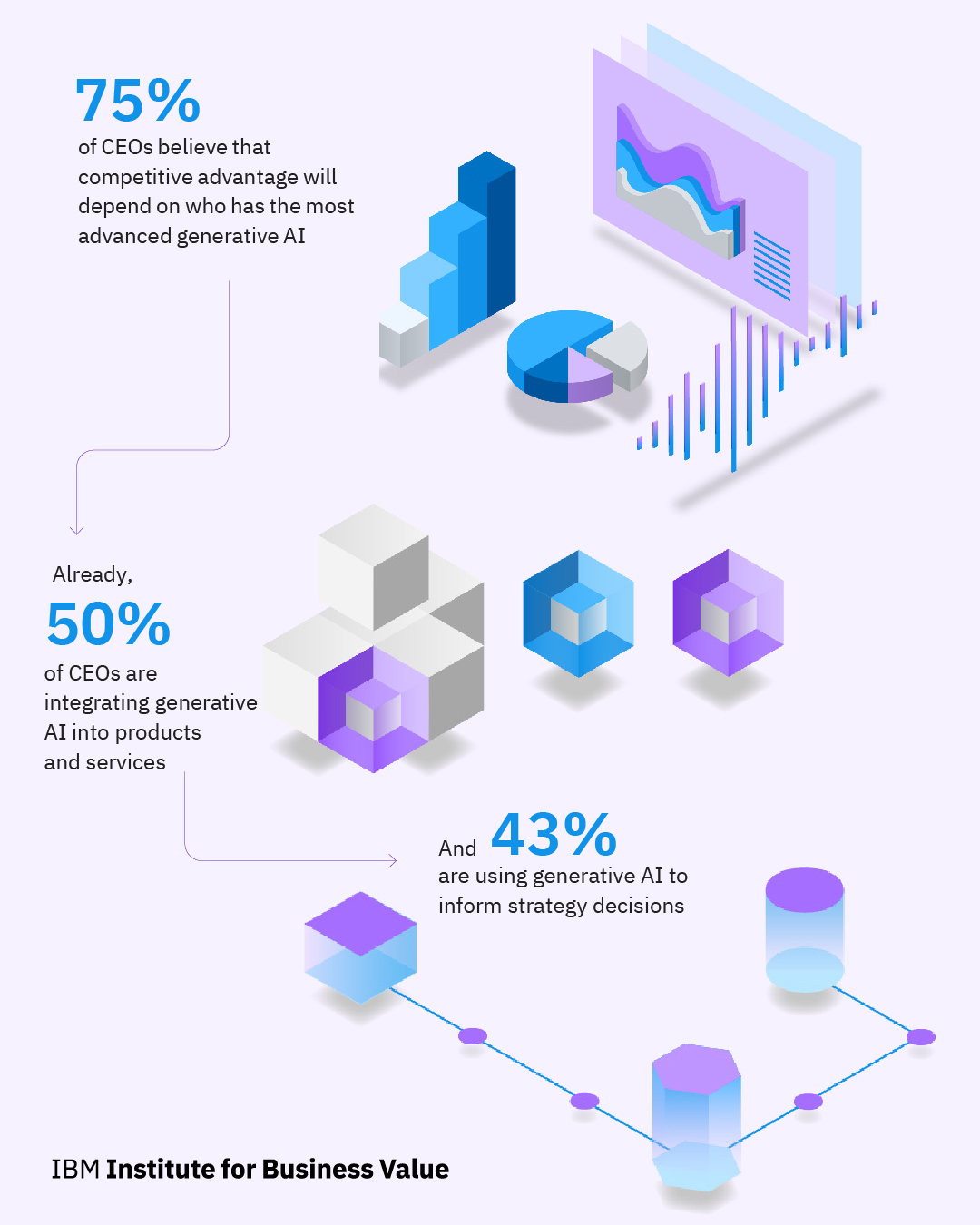
▲ Cover of IBM's annual CEO study, 'CEO Decision-Making in the AI Era: Act with Intention' (Image: IBM)

Comments
Related news
IBM Consulting Unveils Center of Excellence for Generative AI
Generative AI is rapidly advancing beyond the experimental phase. Enterprises have begun adopting AI technology for purposes such as improving customer service and identifying new market opportunities.
2023.07.14by 명세환 기자

IBM and Adobe Offer Generative AI Content Supply Chain Solution
IBM is expanding its partnership with Adobe to support enterprise customers with Adobe's Sensei GenAI services and Adobe's creative generative AI model products such as Adobe Firefly, as well as consulting services.
2023.08.09by 김예지 기자
IBM Unveils New Generative AI Product, 'Watson X Code Assistant'
Generative AI enables developers to evaluate, modify, verify, and test correct code more rapidly. Through this, it is expected to become a tool that modernizes large-scale applications more efficiently and allows developers to focus on high-impact tasks.
2023.09.01by 명세환 기자
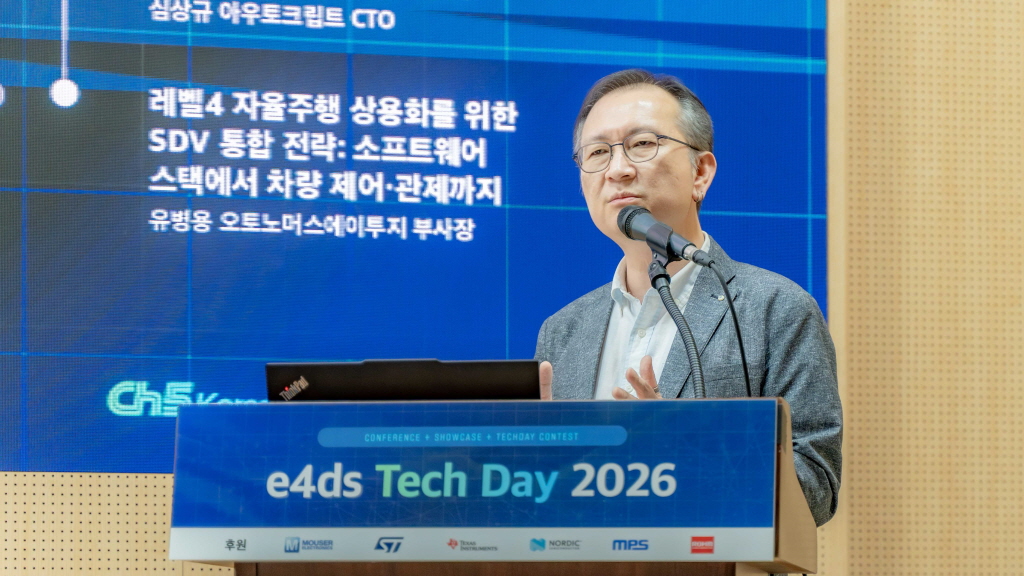
[e4ds Tech Day 2026 ⑨] Sim Sang-gyu, Autocrypt CTO: "In the Physical AI Era, Automotive Security Must Extend Beyond the Vehicle"
At e4ds Tech Day 2026, Sim Sang-gyu, CTO of Autocrypt, explained automotive cybersecurity strategies in the era of Physical AI and SDV (Software-Defined Vehicle). Automobiles are evolving as part of an ecosystem connected to AI, cloud, chargers, IoT, and robots, and he emphasized that the scope of security must expand beyond the vehicle interior to the entire connected environment. In particular, AI model tampering, adversarial attacks, OTA updates, and EV charger hacking were identified as major threats. He explained that response measures require zero trust, AI model integrity protection, intrusion detection, Security by Design and Default, and full lifecycle security management, and that proactive security system establishment beyond regulatory compliance is critical for securing future mobility competitiveness.
2026.10.12by 배종인 기자
NVIDIA to Invest $1 Billion in U.S. Science Over Next Five Years
NVIDIA has announced plans to invest $1 billion over the next five years to strengthen U.S. scientific and technological competitiveness. The company will enhance cutting-edge artificial intelligence research and development capabilities in key areas including quantum computing, healthcare, and energy security, while expanding support for higher education research institutions and cloud service providers. NVIDIA is participating as a major industry partner in the White House Office of Science and Technology Policy's Genesis Mission, and is promoting supercomputer construction in collaboration with national laboratories including Argonne and Los Alamos.
2026.10.12by 배종인 기자











