



AMD Accelerates Space Application Inference with Versal AI Edge
 Published2023.09.22 11:34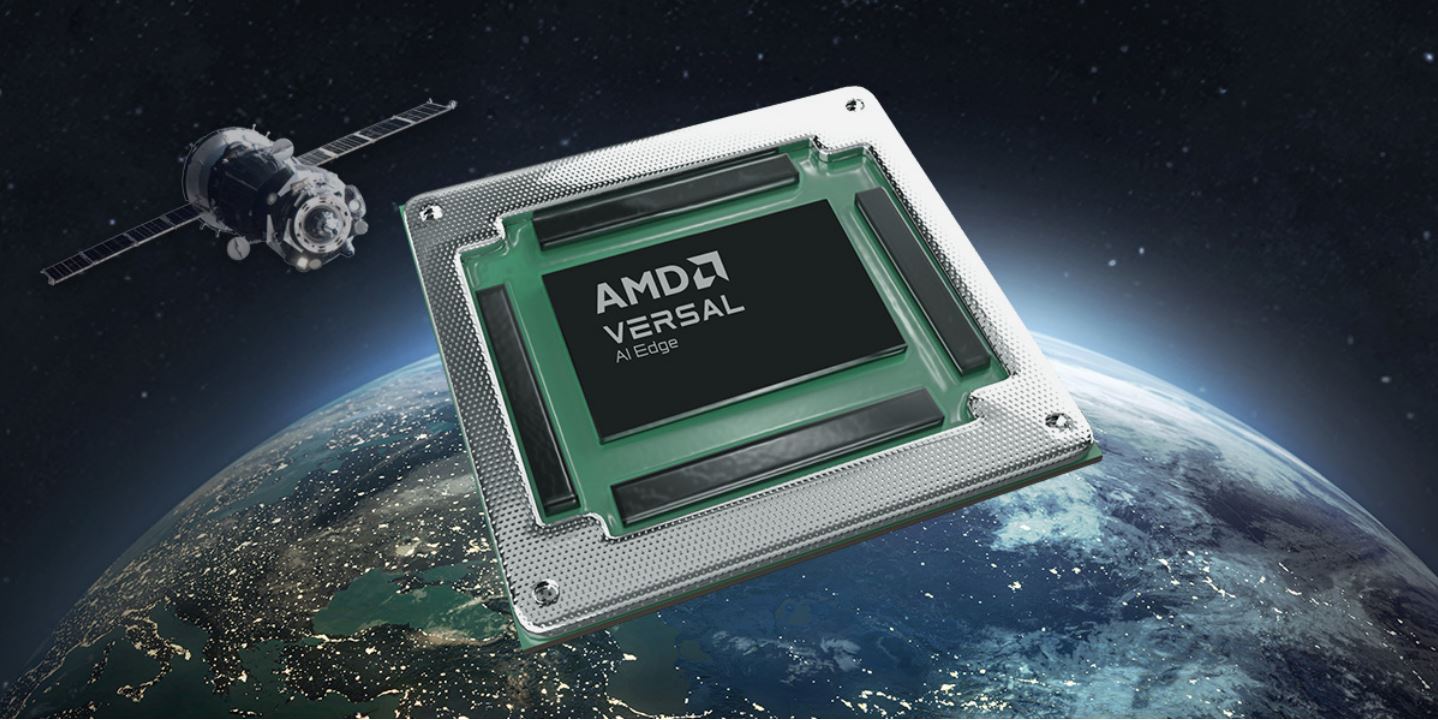
▲ AMD Versal AI Edge Adaptive SoC Accelerates AI Inference for Space Applications (Image: AMD)
AMD is strengthening its leadership in radiation-hardened space-grade adaptive computing solutions as demand for advanced semiconductors in space applications such as low-orbit satellites and space resource development is expected to surge as a next-generation cutting-edge industry.
AMD today announced the availability of the Versal AI Edge XQRVE2302, the second device in its Versal adaptive SoC portfolio that has achieved spaceflight qualification.
The XQRVE2302 is the first to offer an adaptable SoC for space applications in a very small form factor (23 mm x 23 mm) package. The device has a board area that is approximately 75% smaller than the existing Versal AI Core XQRVC1902, and can also reduce power consumption.
The XQRVE2302 is one of the first Versal devices to integrate AMD AI Engine (AIE) technology, better known as AIE-ML, which is optimized for machine learning (ML) applications by delivering higher performance than existing AIEs, as well as expanded support for data types commonly used in ML inference (INT4 and BFLOAT16).
Unlike other radiation-tolerant FPGAs, XQR Versal Adaptive SoCs support unrestricted reprogramming during development, post-deployment, and even while in flight in the harsh radiation environment of space.
Additionally, the security features of Versal Adaptive SoCs help prevent tampering and unwanted configuration changes, allowing satellite operators to safely change processing algorithms even after satellite launch, providing flexibility to support remote sensing and communications applications.
The radiation tolerance of the XQR Versal SoC device has been tested by AMD and independent parties and has been verified to support space missions from Low-Earth Orbit (LEO) to Geosynchronous Earth Orbit (GEO) and beyond, AMD said.
Commercial pre-production devices are currently available to interested customers, with spaceflight-qualified components expected to be available in late 2024.

Comments
Related news
.jpg)
Microchip Launches FPGA-Based Satellite System Development Kit
Microchip Technology (Asia General Manager and Korea Representative Han Byung-don) combines RT PolarFire® FPGA with aerospace-grade certification and development kits and interfaces that enable design concepts to be evaluated based on actual in-flight electrical and mechanical characteristics.
2023.03.09by 배종인 기자
Space power generation takes a giant leap forward: Caltech succeeds in the first space-to-Earth wireless power transfer.
Thomas F. Rosenbaum, president of Caltech, stated that "the transition to renewable energy is developing at a limited pace due to energy storage and power transmission issues today." Currently, renewable energy in Korea faces significant challenges due to the problem of uneven power generation output, as well as the cost of establishing transmission and distribution infrastructure to support it. <br/> <br/> In response, the world is making progress through technological exploration and experimentation in space-based solar power in order to achieve carbon neutrality and obtain unlimited renewable energy with high efficiency. <br/> <br/> The California Institute of Technology (Caltech) announced on the 1st local time that it successfully conducted a test of wireless power transmission technology in a space environment and performed the first demonstration of wirelessly transmitting power to Earth, successfully detecting it at a ground-based receiver. <br/> <br/> After testing wireless power transmission technology in the Earth environment, Caltech is known to have launched a satellite equipped with a microwave array into the space environment to conduct the corresponding experiment. It is expected to be recorded as the first successful case of demonstrating wireless power transmission and reception in space as well as wireless power transmission and reception between space and Earth. <br/> <br/> Domestically, the Korea Electrotechnology Research Institute (KERI) is developing technology for space-based solar power generation and wireless power transmission. In collaboration with the Korea Aerospace Research Institute (KARI), it derived the design plan for the first Korean-type space-based solar power system and jointly presented content on "wireless power transmission between low-orbit small satellites" at the International Space Conference...(more) <br/> <br/> #wireless power transmission #space solar power #space solar power generation #space development #electromagnetic waves #microwave #eco-friendly energy #space energy
2023.06.05by 명세환 기자
Korea Radio Promotion Association and Korea Aerospace University Join Hands to Activate Aerospace Radio
The convergence with the radio frequency field, which serves as a foundational technology, is essential for the development of next-generation space and aerospace industries such as urban air mobility (UAM) and low-earth orbit satellite communications. The Korea Radio Promotion Association is strengthening collaborative efforts to revitalize the aerospace radio communications industry.
2023.09.13by 명세환 기자

Intel Unveils Next-Generation 'Core Ultra Series 3' and vPro Platform for Enterprise PCs
Intel has officially unveiled the "Intel Core Ultra Series 3" for next-generation enterprise PCs and the latest vPro platform, addressing a wide range of demands from enterprise notebooks to high-performance workstations.
2026.03.26by 배종인 기자

ROHM Launches ESD Protection Diode Compatible with High-Speed Interfaces of 10Gbps or Higher
Semiconductor specialist ROHM has developed the 'RESDxVx series' of ESD (electrostatic discharge) protection diodes capable of responding to next-generation high-speed data communication environments exceeding 10Gbps, simultaneously enhancing both signal quality maintenance required in high-speed interfaces and IC protection performance.
2026.03.26by 배종인 기자











