


TI Launches Opto-Emulator, Improving the Lifespan of High-Voltage Products
 Published2023.09.26 14:44
.jpg)
▲Taeho Kim, Vice President, is giving a presentation at a press conference to launch TI's new isolation device portfolio.
Improved signal integrity and 80% power consumption reduction
New optoemulator, SiO2-based technology
Today's wave of electrification, coupled with the increasing complexity of high-voltage system design, challenges engineers to balance increased product performance and lifespan with the need for appropriate levels of insulation.
Texas Instruments (TI) announced at a press conference on the 26th that it has launched a new optoemulator portfolio comprised of signal isolation semiconductors that support signal integrity, power consumption, and extended lifespan in high-voltage industrial and automotive applications.
TI's optoemulator is an alternative to optocouplers and is pin-to-pin compatible with commonly used optocouplers in the industry, allowing for seamless integration into existing designs.
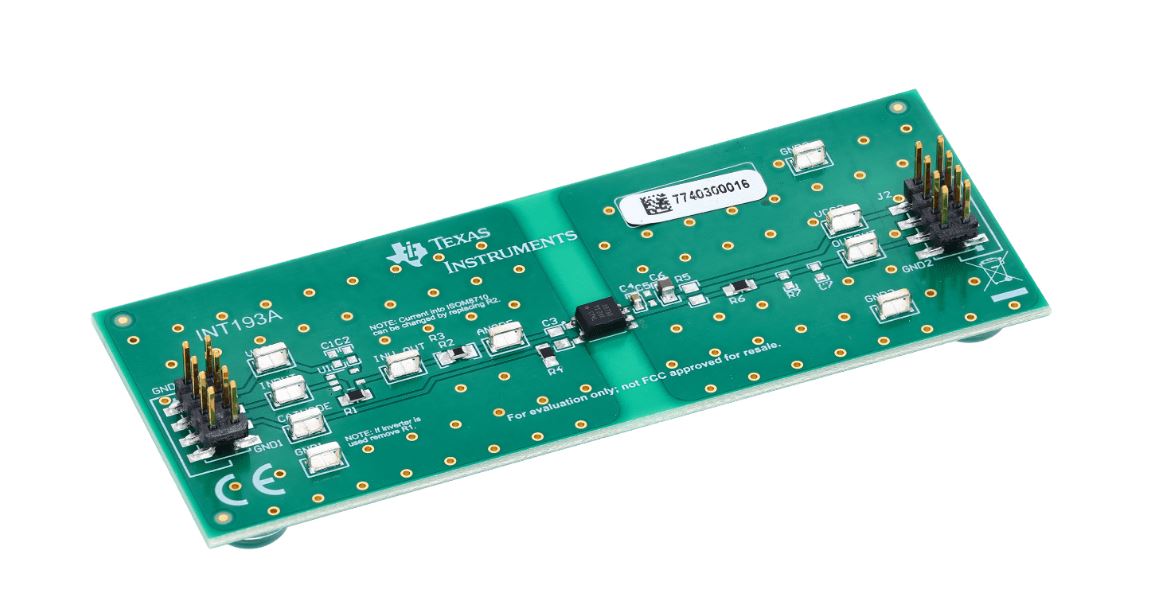
▲TI optoemulator ISOM8710DFFEVM (Photo: TI website)
Conventional optocouplers have the problem that LED signal transmission is affected by aging. While LEDs are devices that can be used semi-permanently, their brightness decreases over time, necessitating overdesign to account for aging. This leads to inefficiencies in power and system costs, such as increased standby power consumption.
Opto-emulators that utilize silicon dioxide (SiO₂)-based insulation technology use SiO₂ as an insulation barrier, eliminating the need for overdesign and eliminating concerns about LED aging.
The SiO₂ insulating barrier with a high dielectric strength of 500 VRMS/µm protects the final product design for more than 40 years and provides up to 3,750 VRMS of insulation protection while reducing power consumption by up to 80%. It emulates a diode instead of an LED, withstands a wide operating temperature range of –55°C to 125°C, and provides up to 10 times better common-mode transient immunity than an optocoupler.
Kim Tae-ho, manager of analog technology support at TI Korea's personal electronics division, said, "The optoemulator has been certified by ISO 60747-17 and has been tested for 30 years without any issues," adding that they even conducted high-voltage tests up to twice that level.
Optoemulators, which can replace optocouplers in power supply feedback loops and bring benefits, are expected to provide power and system design advantages in various power delivery areas, such as adapters for laptops, chargers, onboard chargers for automobiles, server power supplies, TV set-top boxes, battery-powered devices, and high-voltage applications such as Switching Mode Power Supplies (SMPS).
In the past, when there was a small burden on product packaging and the size of the power supply unit, such as an adapter or set-top box, was large, so-called 'brick' adapters were available, and optocouplers were sufficient. However, as product sizes and packaging sizes decrease, frequencies must increase, and as PWM controllers move to higher frequency bands, emulators that monitor the signals are also expected to move toward supporting this bandwidth.
In general, controllers used in analog signal products are increasingly being equipped with bandwidths below 500 kHz. Currently, TI optoemulators offer high bandwidths of up to 680 kHz for analog signals, and TI reportedly plans to expand its roadmap to bandwidths beyond 1 MHz, depending on future market demand.
Meanwhile, TI's optoemulator devices, tools, and resources are currently available on the market, with pre-production quantities available through TI. Evaluation modules such as the ISOM8110DFGEVM and ISOM8710DFFEVM can also be requested through the TI website.

Comments
Related news

TI Simplifies Current Sensing with Hall-Effect Sensors and Integrated Shunt Solutions
Texas Instruments (TI) announced on the 23rd a new current sensor product that helps engineers improve accuracy while simplifying design.
2023.08.23by 명세환 기자
.jpg)
TI, “Energy Innovation with Semiconductor Solutions”
As electrification emerges as an inevitable trend in industrial and product development, semiconductor technology is providing the foundation to achieve sustainable energy transition.
2023.08.30by 명세환 기자

TI’s Eco-friendly Efforts at New 300mm Fab Bear Fruit
Texas Instruments' (TI) new 300mm semiconductor wafer manufacturing facility, RFAB2, has achieved Gold certification under the Leadership in Energy and Environmental Design (LEED) Building Certification System version 4 (v4), marking the culmination of the company's long-standing commitment to environmentally responsible and sustainable manufacturing.
2023.09.04by 배종인 기자

Intel Unveils Next-Generation 'Core Ultra Series 3' and vPro Platform for Enterprise PCs
Intel has officially unveiled the "Intel Core Ultra Series 3" for next-generation enterprise PCs and the latest vPro platform, addressing a wide range of demands from enterprise notebooks to high-performance workstations.
2026.03.26by 배종인 기자
ROHM Launches ESD Protection Diode Compatible with High-Speed Interfaces of 10Gbps or Higher
Semiconductor specialist ROHM has developed the 'RESDxVx series' of ESD (electrostatic discharge) protection diodes capable of responding to next-generation high-speed data communication environments exceeding 10Gbps, simultaneously enhancing both signal quality maintenance required in high-speed interfaces and IC protection performance.
2026.03.26by 배종인 기자











