


SKT aims to become a global AI company with AI sales of KRW 25 trillion by 2028.
 Published2023.09.26 17:05
A.X. (AX) is advancing its LLM specialized in telcos.
AI personal assistant 'Adot' supports AI phone recording.
SKT aims to become a 'global AI company' based on AI infrastructure, AIX, and AI services.
SKT held a press conference at the SKT Tower Supex Hall on the 26th and introduced a two-track strategy to strengthen its own competitiveness and pursue all-round cooperation centered on AI.
At the event, SKT CEO Yoo Young-sang emphasized that “the AI gold rush has begun, and AI is a significant opportunity for telecommunications companies,” and added that “SKT will implement an ‘AI pyramid strategy’ that combines ‘self-reliance’ that integrates AI technology, services, and customers with ‘cooperation’ within the AI alliance.” SKT's 'AI Pyramid Strategy' refers to the three main axes of AI infrastructure, AIX (business), and AI services.
Through this, SKT aims to approximately triple its AI investment ratio from 12% over the previous five years to 33% by 2028, and achieve total AI sales of over 25 trillion won by 2028.
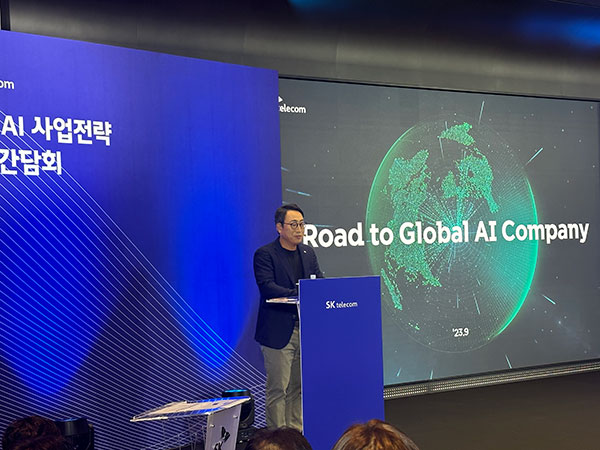
▲SKT President Yoo Young-sang
■ Emphasis on AI infrastructure innovation: data centers, AI semiconductors, and multi-LLM
SKT is innovating AI infrastructure, starting with its most fundamental areas: data centers, AI semiconductors, and multi-LLM. President Yoo stated, "In AI infrastructure, we will develop data sensors and Sapion, our AI semiconductor, into a rival to Nvidia."
SKT plans to introduce energy solutions such as liquid immersion cooling systems and hydrogen fuel cells to its data centers and expand the scale of its domestic data centers to approximately double the current level by 2030. Furthermore, it plans to expand into the AI hosting business by packaging Sapion's NPU and SK Hynix's latest HBM.
SKT will also pursue global expansion of its data centers through collaborations with global cloud service providers (CSPs). Details on this will be announced within the year. President Yoo stated, "SKT will prioritize serving as an MSP for global cloud service providers and create synergy with their data centers."
SKT's AI semiconductor specialist Sapion is set to launch the AI semiconductor 'x330' by the end of this year. The x330 is expected to have approximately twice the computing performance and 1.3 times the power efficiency of Nvidia GPUs.
In addition, it will secure software competitiveness to replace NVIDIA's CUDA. Sapion CEO Ryu Su-jeong stated, "We are researching various areas, including software that can optimize computations as well as CUDA, or tools that optimize specific industries based on pre-trained models." He added, "We will support users in easily deploying domain data from the provided foundation model."
SKT emphasizes two-track innovation: self-reliance and cooperation.
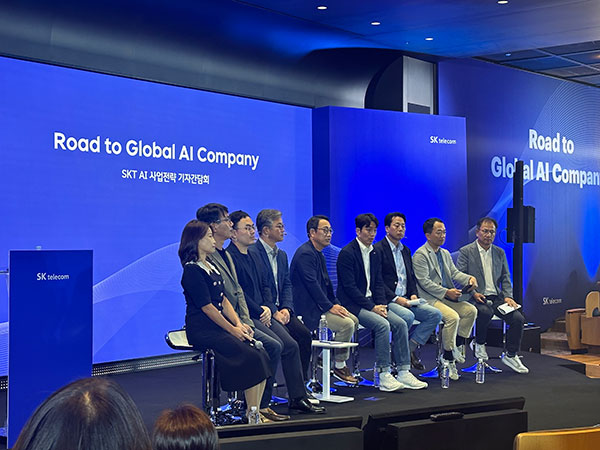
SKT emphasized a two-track strategy of enhancing its own LLM while collaborating with domestic and foreign AI companies such as Anthropic, OpenAI, and Conan Technology, through its multi-LLM strategy.
As LLM technology has recently expanded from general-purpose models to vertical AI utilized in specific domains, SKT has put forward a strategy of building a 'Telco-specific LLM' based on this rather than competing with existing large-scale AI models. SKT emphasized that “the key to LLM these days is what data to utilize,” and that “high-quality, specialized data is more important than the amount of data.”
SKT plans to continuously enhance its specialized LLM based on the unstructured telco data (Telco Data) acquired over the past 10 years as a telecommunications operator, including customer data on telecommunications services, customer response, service usage, and lifestyle.
Furthermore, in terms of "collaboration," SKT is leading the global AI ecosystem through partnerships with global telecommunications companies, such as the "Global Telco AI Alliance" and the "K-AI Alliance" with AI companies. President Yoo added, "We have completed basic preparations for collaboration with Antropic, and are currently in the process of finalizing discussions with global telcos and discussing specific structures and strategies." These details are expected to be announced at MWC next year.
AI personal assistant 'Adot' officially launched after one year.
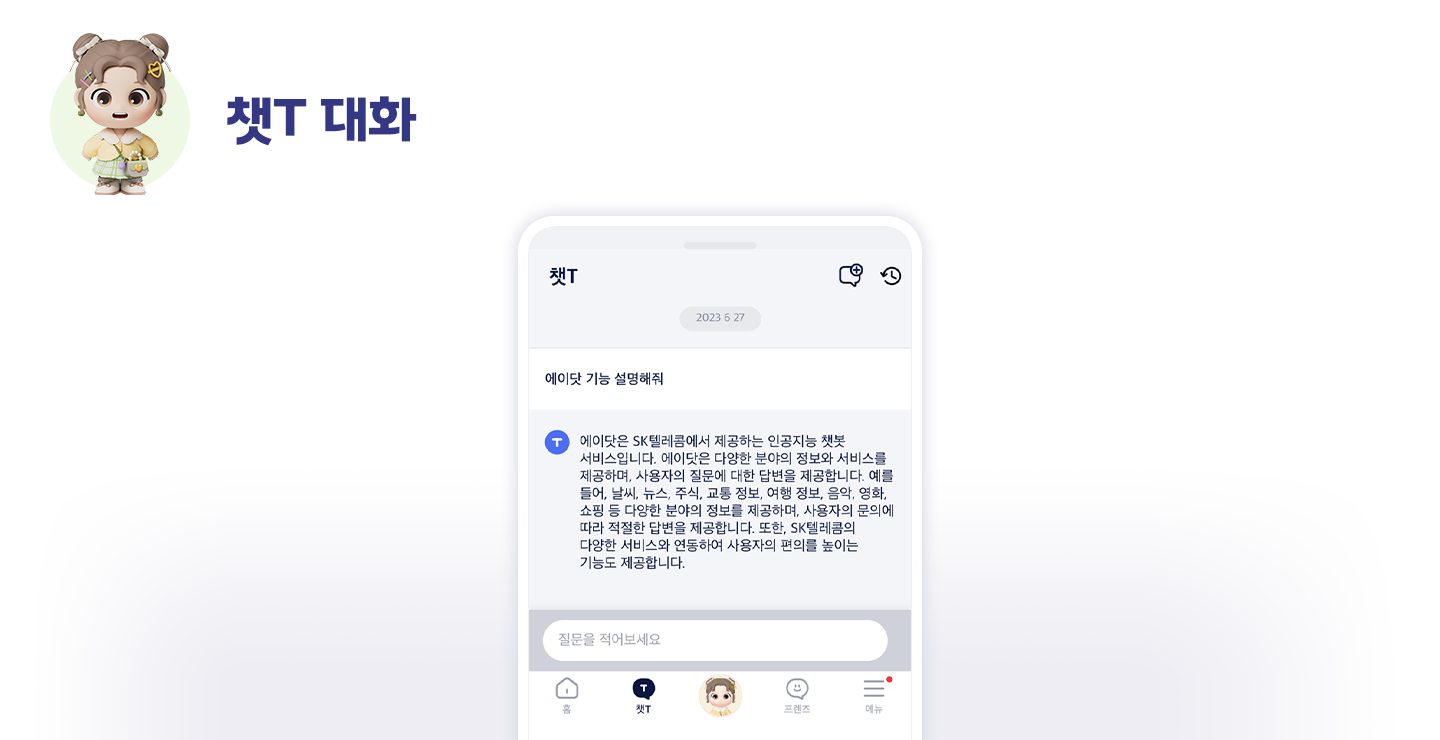
At the event, SKT officially launched its Korean-language LLM service, "Adot," after a year. It's an AI personal assistant built on its own "AdotX (AX) LLM."
Adot revolutionizes customers' communication experiences and expands the connection between daily life and AI services. “I anticipate a war in the AI personal assistant market in a few years, with companies like Adot, which was created based on SKT’s telco-specialized LLM, poised to launch,” said CEO Yoo.
At the event, SKT's Kim Yong-hoon, head of the AI Service Business Division, demonstrated the Adot AI phone feature. The AI phone provides call recording, analysis, summarization, and content sharing capabilities. Kim stated, "The feature is currently available on Android and will be rolled out to iOS." With the introduction of the AI phone, even iPhones, which previously had limited call recording capabilities, are expected to benefit.
In particular, SKT is introducing a two-way, real-time AI interpretation phone feature. Targeted for release in the second half of November this year, it will support interpretation in four languages (Korean, English, Japanese, and Chinese), with plans to expand to 11 languages in the future.
Adot also manages daily routines, including waking up, commuting, and going to bed. Additional features, such as AI sleep management in September and AI music in October, are scheduled to be added sequentially. Currently boasting 1.2 billion subscribers in 45 countries, Adot plans to expand into next-generation domains such as finance, commerce, and travel.
Meanwhile, SKT is introducing AI transformation across its existing businesses, including mobile, broadband, and enterprise. Key initiatives include: improving customer service processes, such as the AICC; evolving into AI TV through collaboration with Netflix; securing UAM leadership through collaboration with Joby; and launching AI healthcare service Excalibur.
Comments 1
1 Comments:
Related news

SKT Targets Enterprise and Public Generative AI Market Based on 'Multi-LM'
SKT announced a "multi-LLM (Large Language Model)" strategy on the 23rd to capture the enterprise and public sector generative AI market. SKT stated that it is in the process of preparing technology and business measures to provide customized solutions by combining A.Dot LLM, Anthropic's LLM, and Conan LLM tailored to the needs of corporations and public institutions.
2023.08.23by 김예지 기자
.jpg)
SKT Presents 6G Blueprint
SKT presented the direction of 6G future network evolution at the IOWN (Innovative Optical & Wireless Network) Global Forum, a global next-generation communication standards consortium.
2023.09.06by 김예지 기자

SKT-SKB-Netflix Network Usage Fee Dispute Ends... Forms Partnership
Netflix, SK Telecom, and SK Broadband, a global entertainment streaming service, announced on the 18th that they have established a strategic partnership to enhance customer benefits at Netflix Korea's office in Jongno-gu, Seoul.
2023.09.18by 김예지 기자
.jpg)
SKT Expands Quantum Ecosystem..."Nurturing Quantum Talent"
SKT has signed a memorandum of understanding with the Quantum Sapiens Talent Development Center for research and development and exchange in the quantum technology field.
2023.09.22by 김예지 기자
SKT-Jobi to Enter Phase 1 of UAM Demonstration Project Next Year
SKT and Joby signed a cooperation agreement on the 20th at SK T Tower for the "Korean Urban Air Mobility Demonstration Project (K-UAM Grand Challenge)" and commercialization.
2023.09.25by 김예지 기자












https://www.naver.com/