


Dell Launches Latest Version of PowerFlex and Apex Block Storage
 Published2023.10.17 09:59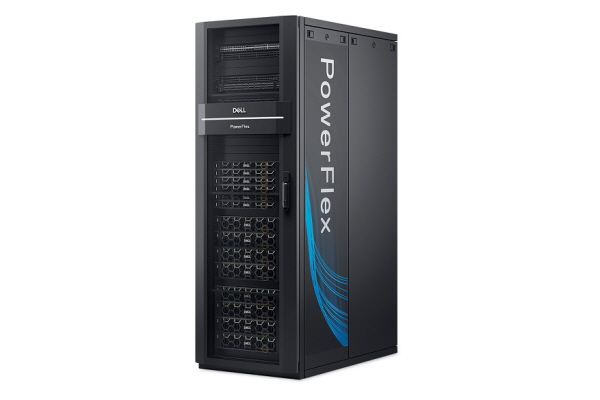
Enterprise data storage performance and software public cloud connectivity
Dell Technologies has launched the latest release of its software-defined infrastructure solution, Dell PowerFlex, and enhanced its Dell APEX Block Storage offering, improving the efficiency and functionality of multi-cloud environments.
Dell announced on the 17th that it has released the latest version of 'PowerFlex' with enhanced efficiency and performance in a multi-cloud environment and 'Apex Block Storage' for MS Azure.
As data volumes rapidly increase due to advancements in AI and the proliferation of connected devices, companies are facing greater challenges in managing their IT infrastructure.
Generative AI is projected to add approximately $10 trillion to global GDP over the next decade, making infrastructure modernization a top priority for businesses today.
Dell has launched the latest release of PowerFlex and announced the Dell Apex Block Storage for Microsoft Azure offering.
PowerPlex supports both block storage and file storage, and this 4.5 release includes significant improvements in file storage functionality and performance.>
User convenience features like a single global namespace and unified storage pool management have been added, and scalability has been quadrupled, supporting up to 2,000 NAS servers per system. File snapshots support has increased 22-fold, reaching 57,000, boasting 22x greater file scalability.
In this release, PowerPlex has strengthened its integration with CloudIQ, an AIOps software. This update enhances CloudIQ's system visibility and monitoring, as well as real-time license management for both PowerPlex and Apex Block Storage for Public Cloud. These features enhance control, improve efficiency, and facilitate data-driven decision-making. Management and operational capabilities have also been improved, with new features added for alarms and reporting, and the supported operating systems expanded.
Last year, Dell announced Project Alpine, a solution strategy that extends the enterprise-class performance, scalability, and cyber resilience of Dell storage solutions to public cloud environments.
In May of this year, the company launched its first service, ‘Dell APEX Block Storage for AWS,’ and recently launched ‘Dell APEX Block Storage for Microsoft Azure.’
Dell Apex Block Storage for Microsoft Azure enables customers to run diverse workloads in the public cloud without performance, scalability, or resiliency constraints.
It enables seamless data movement across multicloud environments and availability zones in multiple locations, ensuring interoperability. Key features such as outstanding performance, exceptional scalability, flexible deployment options, and enterprise-grade resiliency optimize a wide range of block-based workloads, from databases and analytics to development, testing, virtualization, and containers.
Dell Apex Block Storage for Microsoft Azure combines cloud agility and enterprise capabilities to help you scale capacity and performance to meet the most demanding workloads and SLAs in multicloud environments.
Dell PowerFlex recently achieved Outposts Ready certification from Amazon Web Services (AWS). This allows PowerFlex customers to build more agile data centers by leveraging the diverse features and benefits of PowerFlex across the multi-cloud ecosystem. The combination of AWS Outposts and Dell PowerFlex delivers 12x the IOPS compared to native Outpost deployments,3) and allows for linear performance scaling by adding compute configurations.
“In this rapidly evolving digital age, adaptable and robust IT infrastructure is essential,” said Kim Kyung-jin, CEO of Dell Technologies Korea. “Dell aims to help customers utilize Dell’s enterprise storage capabilities in the most efficient way, even in multi-cloud environments, and operate critical workloads.”

Comments
Related news

Dell to supply 'PowerEdge Server' to NHN Cloud Gwangju AI Data Center
Dell Technologies' 'PowerEdge Server' is being supplied to the Gwangju National AI Data Center with high-performance GPUs and stable infrastructure, contributing to enhancing South Korea's artificial intelligence competitiveness.
2023.08.31by 배종인 기자
Dell Expands Azure Experience from Data Centers to the Edge
Dell has launched the "Dell APEX Cloud Platform for Microsoft," a fully integrated turnkey system developed in collaboration with Microsoft, extending the Azure experience from the data center to edge environments.
2023.09.27by 배종인 기자
Dell, “Supporting Customer Growth as a Total AI Solution Provider”
Dell Technologies held an online press briefing and announced that as an artificial intelligence (AI) total solutions provider, it will actively support customers in enhancing their efficiency and productivity.
2023.10.12by 배종인 기자
.jpg)
SalePoint Signs Multi-Year Partnership Agreement with AWS… Promoting Identity Security that Integrates Even AI Agents
Sailpoint has entered into a multi-year strategic partnership agreement with AWS and is moving forward with establishing an integrated governance system that manages both human and non-human identities together. The plan is to consistently manage access permissions in an environment where AI agents are increasing as work execution entities, while applying the principle of least privilege and automated policy enforcement. The two companies plan to jointly expand capabilities to manage the identities of various entities, including AI agents, within a single layer in the AWS environment. This collaboration is interpreted as a move to design security and governance together in corporate environments where AI adoption is expanding.
2026.03.26by 배종인 기자
.png)
Databricks Unveils Open AI Security Monitoring 'Lakewatch'
Databricks entered the security market on March 24 by unveiling LakeWatch, an open-source agentic SIEM. The core functionality of this product is to integrate and analyze security, IT, and business data in a single environment to support AI-based threat detection and investigation. The company explained that it reduces the limitations of existing security operations centers, which have had to forgo some data due to high cost structures, and enables large-scale data analysis and automation based on open formats and ecosystems. LakeWatch is currently offered as a private preview, with Adobe and Dropbox mentioned as early customers. Databricks also announced an expanded partnership with Anthropic as well as the acquisition of Antimatter and SiftD.ai.
2026.03.26by 배종인 기자











