


ETRI Accelerates Demand for Hyper-connectivity with 25Gbps Optical Access Technology
 Published2023.10.19 09:44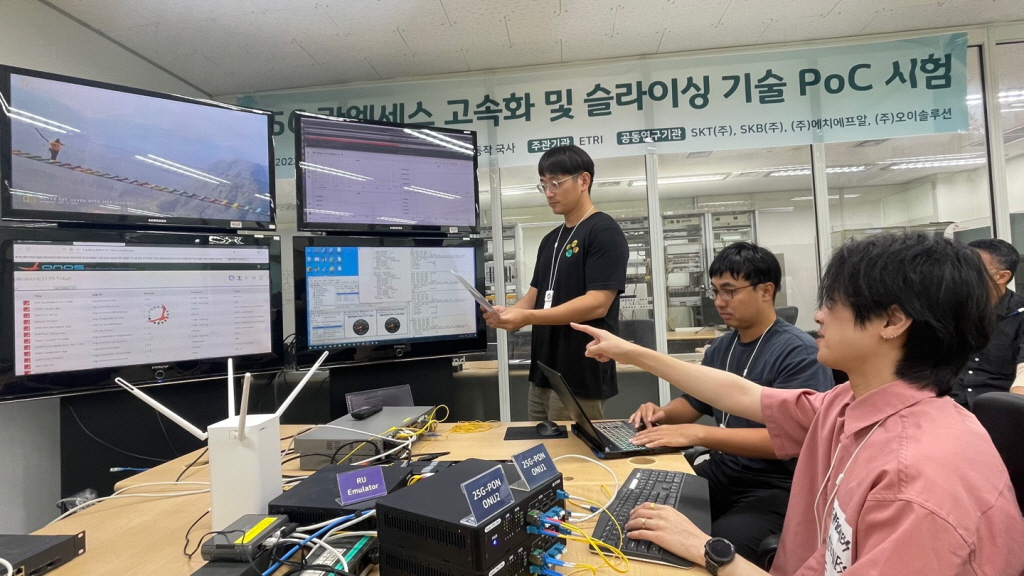
ETRI researchers testing 25-gigabit AnyConnect optical access technology.
Meeting the demand for customized speed and dense optical connectivity in the digital society
Domestic researchers have succeeded in developing fast and flexible next-generation networking technology needed for communication networks, which are called the capillaries of the digital age. This opens the way to simultaneously address the demand for customized speeds and dense optical connections, as it allows for high-speed internet, mobile, and business services to be handled with a single device.
The Electronics and Telecommunications Research Institute (ETRI) announced on the 19th that it completed the functional verification of 'AnyConnect' optical access networking technology last month at the SK Broadband Seoul Dongjak Information Center together with SK Telecom, SK Broadband, HFR, and OISolution.
The research team stated that this demonstration confirmed that it can address various demands requiring customized speed and optical connectivity.
Optical access networks are fiber-optic-based networks widely used in various locations, ranging from front-haul systems connecting high-speed internet and mobile communication equipment in homes to factories, offices, and buildings.
Just as capillaries in our bodies supply air and nutrients, it plays the role of providing the information and data we need in the digital society.
The newly developed AnyConnect optical access networking technology combines the advantages of 'high speed' and 'large-scale connectivity' provided by existing optical communication.
Furthermore, it is suitable as an optical access network technology for a digital society where services and devices must always be connected with high speed and low latency.
Existing optical access networks were centered on high-speed internet providing speeds of 10 gigabits (Gbps) per subscriber.
Furthermore, the coexistence of purpose-oriented equipment from various manufacturers resulted in a closed and rigid structure that limited the ability to add or modify new functions.
The technology developed by ETRI researchers upgrades 10-gigabit (Gbps) internet technology to the next level, providing speeds of 25 gigabits (Gbps) while also being able to accommodate mobile devices.
Also, open and It has a flexible structure.
The research team stated that the core of this technology is 'virtualization-based slicing' technology and 'disaggregation' technology.
'Virtualization-based slicing' technology manages and controls optical access equipment from different manufacturers and with different functions as if they were a single device using software, and provides customized network resources for each application.
In addition, cooperative response bandwidth allocation technology was developed through the exchange of packet transmission information between optical access network equipment and mobile equipment, making it possible to utilize this developed technology up to mobile fronthaul.
'Disaggregation' technology separates the Optical Line Terminal (OLT), an existing optical access network device, into hardware and software components, configures each as a separate device, and connects them via a standard interface.
The developed technology can be applied to existing optical access networks simply by upgrading the equipment.
It can be used without the burden of time and cost associated with redesigning optical access networks, so it is expected to be widely used in B5G and 6G communications.
“The technology developed this time represents a groundbreaking evolution of Passive Optical Network (PON) technology from a traditionally hardware-centric approach to a software-centric one. "It is highly significant that we have established a technological foundation capable of efficiently meeting the requirements of optical access networks, which have become more complex and diverse alongside the development of mobile services," he explained.
This research has been conducted as a joint study with SK Telecom, SK Broadband, HFR, and OISolution since 2019 with support from the Ministry of Science and ICT's 'Development of B5G Optical Access Acceleration and Slicing Technology' project.
During the research period, the research team is also leading global research in the relevant field, including 7 invited presentations in SCI and prominent international academic conferences and 38 domestic and international patent applications.
The research team plans to conduct research on next-generation optical access core technology that applies artificial intelligence to intelligently provide optimal network resources for each use and purpose, while also providing speeds of 50 gigabits per second (Gbps).
The plan is to secure core technologies applicable to optical access networks, which are the capillaries of the digital society, and future intellectual property rights through continuous research, and to drive the development of the domestic industry.

Comments
Related news
A Hyperconnected Society: A Global Energy Industry Future
BIXPO 2019, where one can glimpse the future of the energy industry, opened on November 6th at the Kim Dae-jung Convention Center in Gwangju. The theme of this event is Digital Platform (Hyper-Connectivity & Mega Shift), focusing on the massive transformations in the global energy industry occurring in a hyper-connected society where everything is densely interconnected based on digital technologies such as IoT, AI, and big data.
2019.11.11by 최인영 기자
ETRI develops AI and network convergence platform
Domestic researchers have developed a next-generation networking platform that integrates artificial intelligence (AI) and network technology. The platform-based application service demonstration has also been successful, suggesting that the realization of a human-centered hyper-connected society, which has become the new normal following COVID-19, is within reach.
2021.11.03by 강정규 기자
.jpg)
[Interview] 6G Forum Executive Director Jang Kyung-hee - “6G to expand the entire industry by 2030… Leading global leadership”
6G, expected to be commercialized between 2028 and 2030, is anticipated to serve as a core technology in the hyper-connected era and accelerate the creation of new business markets in autonomous driving, UAM, smart cities, healthcare, VR, and other sectors. Building on its track record of supporting mobile communications industry revitalization, the 6G Forum is targeting the convergence of 5G with heterogeneous industries and securing global competitiveness in B5G/6G going forward. This publication arranged a meeting with Jang Kyung-hee, Executive Chairman of the 6G Forum, to discuss Korea's telecommunications policy and R&D strategy as well as the vision and objectives of the 6G Forum.
2023.07.03by 김예지 기자
ETRI Recognizes Research Results for "Visual Intelligence Deep View"
ETRI received the Minister of the Interior and Safety Award at the 2023 Republic of Korea Disaster and Safety Research and Development Awards ceremony for "Visual Intelligence DeepView," a technology for public safety demonstration and commercialization using public CCTV through core video understanding artificial intelligence technology.
2023.09.15by 배종인 기자
ETRI presents guidelines for smart manufacturing ‘digital twin’
ETRI is releasing "Manufacturing Digital Twin Standard Model and Interoperability Guidelines 1.0" as part of the "Smart Manufacturing Innovation Technology Development Project" led by the Ministry of Science and ICT and the Information and Communications Technology Planning and Evaluation Institute.
2023.09.19by 배종인 기자











