


Korea Electrotechnology Research Institute (KERI) leads the international standardization of eco-friendly ship charging systems.
 Published2023.10.23 11:43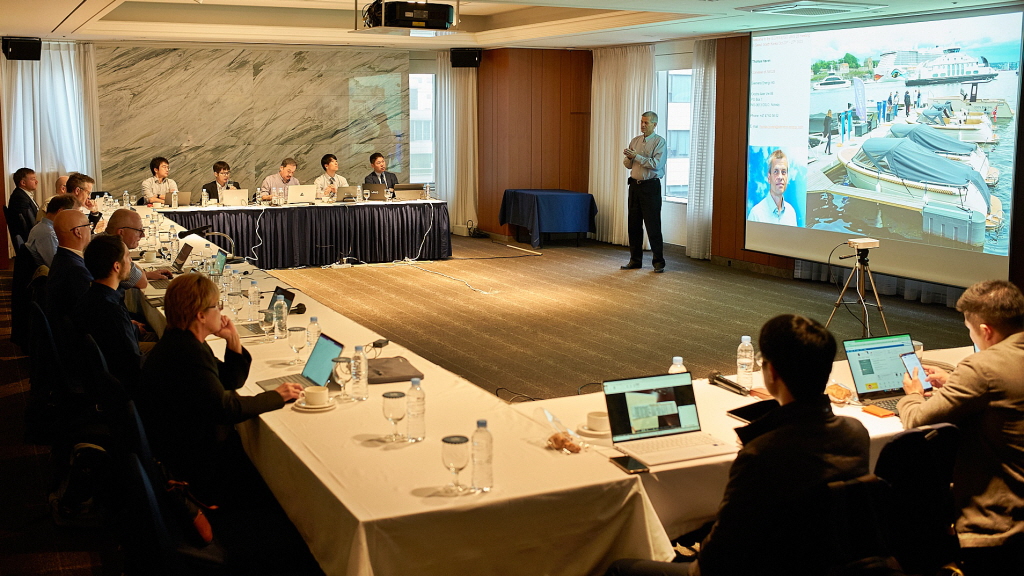
Promoting standardization of electric ship and port power grid connection technology
The Korea Electrotechnology Research Institute (KERI), an internationally recognized power equipment testing and certification body, is leading the international standardization of eco-friendly ship charging systems, advancing the eco-friendliness of coastal vessels and contributing to the domestic shipbuilding industry's dominance in the global market.
The Korea Electric Power Research Institute held the 'International Conference for Standardization of Port Power System Connection Technology' (IEC TC18 JWG28) for five days from October 23rd to 27th at the Oakwood Premier COEX Center in Seoul.
Recently, greenhouse gas regulations for ships are being strengthened worldwide, with the International Maritime Organization (IMO) announcing a carbon neutrality target for the shipping sector by 2050. This event aims to share the various system technologies required for the operation and battery charging of eco-friendly electric ships and to promote international standardization. Approximately 30 experts from 10 countries, including the United States, Canada, Norway, Japan, and Canada, leading shipbuilding and marine industries, will attend.
For ships using electric motors and batteries, connection to the power grid at the port is very important. Especially in the case of ships traveling between multiple countries, interoperability is even more crucial as interpretations of complex power grids and systems may differ between countries.
In the case of electric vehicles, many domestic and international major automakers and various small and medium-sized charger companies are already participating in infrastructure construction, and compatibility errors frequently occur in the field during rapid charging due to differences in standard interpretations by manufacturer.
Ships are much larger than electric vehicles, including batteries, and utilize more internal electrical and power equipment, making the establishment of international standards for related technologies even more essential. Furthermore, the countries and companies that lead these standards will likely dominate the high-value-added, eco-friendly electric ship market, leading to fierce competition. In this sense, hosting this international conference in Korea is particularly significant.
KERI's ability to host this event stems from its world-class capabilities in testing and evaluating the performance of electric vehicle charging systems. Designated as the "First Global Electric Vehicle Interoperability Conformity Assessment Body" by CharIN, the international electric vehicle charging technology association, KERI has been instrumental in identifying compatibility issues between electric vehicles and chargers through its "International Test+Festival" program, and has spearheaded the development of international standards for charging systems.
At this meeting, KERI's proposal to apply the rapid charging system for electric vehicles, which is technologically and industrially active, to the field of electric ships and establish an international standard was adopted, and active discussions took place. On the third day of the conference, Wednesday the 25th, experts from 10 countries will visit the Ansan branch of the research institute and inspect the electric vehicle charging test infrastructure.
KERI's Seo Woo-hyun, head of the Intelligent Energy Testing Lab, said, "Currently, the supply voltage at ports is alternating current (AC), and core equipment such as batteries operate on direct current (DC) voltage, so heavy and expensive transformers or converters must be installed inside the ship." He added, "At this stage, when the rapid charging capacity of electric vehicles is being increased from kilowatts (kW) to megawatts (MW), it is appropriate to quickly pursue technology standardization for power grid connection between electric ships and ports without delay."
Building on support from the Korea Institute for Advancement of Technology (KIAT)'s "Eco-Friendly Ship Transition Response Project," KERI plans to continue developing standards for electric ship charging system technology. KERI also plans to actively support the Korean Agency for Technology and Standards' work on establishing and revising domestic standards in related fields and establishing a testing and certification system. Through these efforts, the goal is to accelerate the eco-friendliness of coastal vessels and contribute to the Korean shipbuilding industry's global market dominance.
Meanwhile, KERI is a government-funded research institute under the National Research Council of Science and Technology (NRST) of the Ministry of Science and ICT. The institute carries out comprehensive work, from core technology development to testing and certification and corporate support, to accelerate the era of fast and convenient future electric mobility.

Comments
Related news
Korea Electric Power Corporation (KEPC) is leading the way in establishing international standards for rapid charging of electric vehicles.
The Korea Electrotechnology Research Institute (hereinafter KERI) and Charini collaborate to inspect technical problems occurring during fast charging of electric vehicles, sharing the common objective of investigating charging errors and contributing to problem resolution.
2022.10.25by 성유창 기자
Korea Electrotechnology Research Institute (KERI) is a leader in electric powertrains for aviation mobility.
The Korea Electrotechnology Research Institute (KERI) is receiving significant attention as it takes the lead in localizing components and equipment for the next-generation Advanced Air Mobility (AAM) sector.
2023.05.02by 배종인 기자
Kim Hyung-woo, KERI Center Director, “Leading the Electric Vehicle Main Inverter SiC Market”
Kim Hyung-woo, Center Director at the Korea Electrotechnology Research Institute, delivered a keynote presentation at the "Mouser Power Seminar 2023," hosted by Mouser and organized by e4ds on the 18th, with the topic "Trends in SiC Power Semiconductor Technology Development and Market Status Domestically and Internationally."
2023.05.30by 성유창 기자
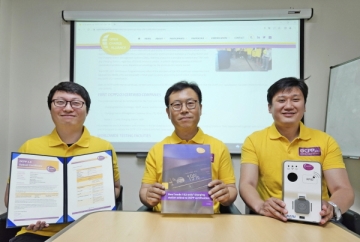
Electric Power Research Institute, “Easy Electric Vehicle Charging and Payment with 220V Charging Outlets”
The Korea Electrical Research Institute (KERI) has developed a 220V metering-type outlet that can handle everything from electric vehicle charging to payment in a single process, and expectations are gathering that it will contribute to future electric vehicle distribution and enhance convenience for electric vehicle users.
2023.07.03by 배종인 기자
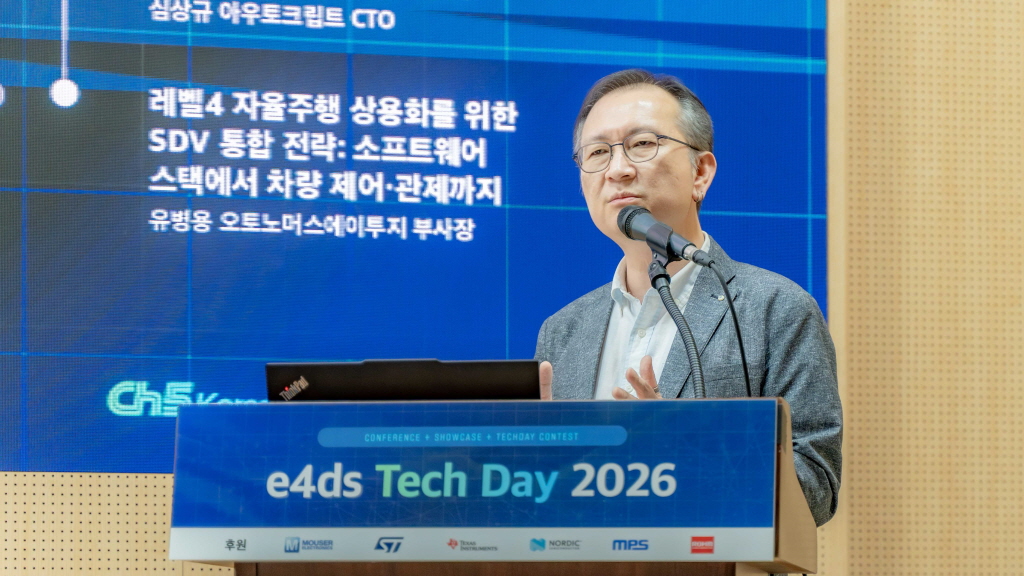
[e4ds Tech Day 2026 ⑨] Sim Sang-gyu, Autocrypt CTO: "In the Physical AI Era, Automotive Security Must Extend Beyond the Vehicle"
At e4ds Tech Day 2026, Sim Sang-gyu, CTO of Autocrypt, explained automotive cybersecurity strategies in the era of Physical AI and SDV (Software-Defined Vehicle). Automobiles are evolving as part of an ecosystem connected to AI, cloud, chargers, IoT, and robots, and he emphasized that the scope of security must expand beyond the vehicle interior to the entire connected environment. In particular, AI model tampering, adversarial attacks, OTA updates, and EV charger hacking were identified as major threats. He explained that response measures require zero trust, AI model integrity protection, intrusion detection, Security by Design and Default, and full lifecycle security management, and that proactive security system establishment beyond regulatory compliance is critical for securing future mobility competitiveness.
2026.10.12by 배종인 기자











