


Siemens Energy and Air Liquide to Establish Gigawatt-Scale Water Electrolyzer Plant in Germany
 Published2023.11.27 11:47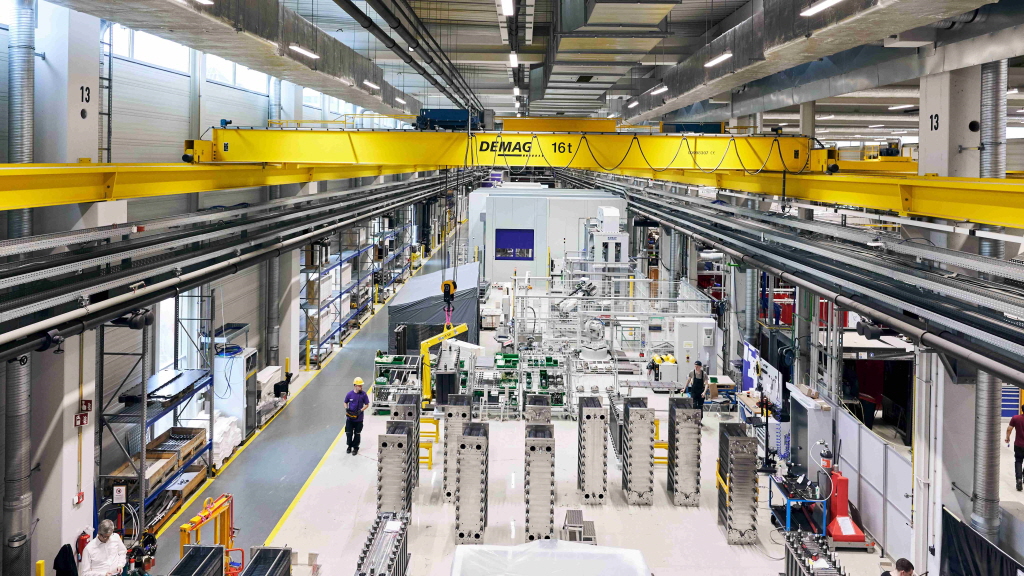
▲Inside the Siemens Energy plant in Berlin, Germany.
Siemens Energy, a global energy technology company, has established a water electrolysis plant in Germany and laid the foundation for revitalizing the hydrogen economy through mass production of hydrogen.
Siemens Energy announced on the 27th that it has established a gigawatt-scale electrolyzer plant (equipment that splits water into hydrogen and oxygen using electricity) in Berlin, Germany, in cooperation with French industrial gases company Air Liquide.
Through this, Siemens Energy has entered into a mass production system for electrolysis equipment, laying the foundation for activating the hydrogen economy.
Siemens Energy and Air Liquide expect that with the establishment of this plant, they will be able to start producing 1 GW of electrolyzers per year and expand to at least 3 GW by 2025.
If a 3GW electrolysis facility is put into operation, an average of 300,000 tons of green hydrogen can be produced per year. Replacing fossil fuels with this green hydrogen could reduce carbon dioxide emissions equivalent to those of the 260,000 inhabitants of the German metropolis of Aachen.
Siemens Energy has invested approximately 30 million euros (42 billion won) in its Berlin plant to build a new 2,000-square-meter electrolysis production line, leveraging the existing production facility's well-equipped infrastructure and skilled workforce.
The Berlin plant will supply stacks, a key component of electrolysis, to a variety of customers to meet the rapidly growing market. These stacks are based on proton exchange membrane (PEM) technology, making them particularly well-suited for intermittent renewable energy supplies. PEM electrolysis is ideal for hydrogen production at gigawatt-scale, requiring less raw materials, labor, and space than other hydrogen technologies, enabling rapid market delivery.
Once production of the stacks for the electrolysis project is complete, assembly will take place near the project site, further enhancing cost efficiency. The strategic partnership between Siemens Energy and Air Liquide aims to create synergies by leveraging the expertise and portfolio pipelines of both companies.
A number of large-scale low-carbon and renewable hydrogen projects are already underway in Europe. A 200-megawatt (MW) water electrolysis plant is under construction for Air Liquide Normand'Hy near Port-Jérôme, Normandy, France, which will reduce carbon dioxide emissions by 250,000 tonnes per year and will be one of the first suppliers of PEM electrolyzers to be manufactured at Siemens Energy's Berlin production facility.
Siemens Energy is also working on several other large-scale water electrolysis projects, including Kassø (50 MW) in Denmark and FlagshipONE (70 MW) in Sweden, which will supply hydrogen for marine fuel synthesis.
Hong Sung-ho, CEO of Siemens Energy Korea, said, “By starting operation of this plant and expanding the production scale to 3 GW by 2025, we expect to be able to supply electrolysis facilities to the Korean market in an economical and stable manner.” He added, “We will work closely together to ensure that hydrogen energy can be considered a competitive alternative for Korean companies to successfully achieve energy transition.”
Comments
Related news
POSCO to actively develop carbon-neutral clean hydrogen by 2050
POSCO Group's six subsidiaries unveiled a comprehensive business blueprint and major achievements across the entire hydrogen business value chain, spanning hydrogen production, transportation, storage, and utilization, aimed at achieving carbon neutrality by 2050.
2023.09.15by 성유창 기자
Rockwell and Hanwha Power Systems Join Hands for Hydrogen Blending Gas Turbine System Automation
Rockwell Automation announced on the 24th that it has established a strategic partnership with Hanwha Power Systems and agreed to mutually cooperate on the supply of automation solutions and equipment required for hydrogen co-firing power generation systems.
2023.10.24by 김예지 기자
Hanjayeon supports participation of Korean SMEs in Saudi hydrogen mobility project
The Korea Automotive Research Institute, together with Hyundai Motor Group, Air Products Korea (hereinafter AP Qudra), and SAPTCO, takes the lead in establishing a hydrogen mobility ecosystem in Saudi Arabia.
2023.10.24by 성유창 기자
From green hydrogen to nitrogen and oxygen, we make whatever you want.
A research team led by Professors Ryu Jeong-gi and Lee Dong-wook from the Department of Energy Chemical Engineering at UNIST (President Lee Yong-hoon) has developed a large-area hydrogel thin film technology that can be universally applied to gas-producing electrodes. It is anticipated that this technology will enable easy production of clean gas feedstocks such as green hydrogen.
2023.10.24by 배종인 기자
2nd Hydrogen Day, Forming a Hydrogen Economy Consensus and Encouraging Hydrogen Industry People
The Hydrogen Convergence Alliance held a meaningful second "Hydrogen Day" event, presenting government commendations to individuals and companies/organizations that have contributed to activating the hydrogen economy.
2023.11.02by 성유창 기자











