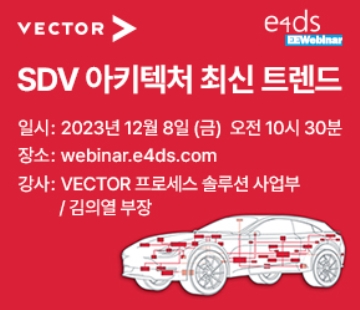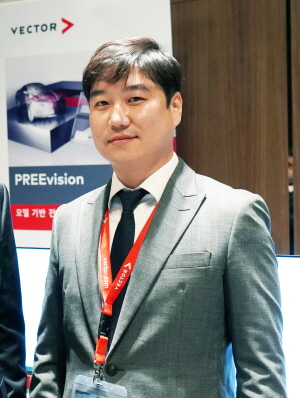
[Editor's Note] SDV (Software Defined Vehicle) is a key keyword in the paradigm shift in the automotive industry. The benefits of SDV include continuous software upgrades, and by securing connectivity with both the traditional automotive industry and other industries, profits are expected to be generated in various areas. In line with this trend, our magazine will host a webinar on December 8th with Vector, which is developing a vehicle operating system (OS) in collaboration with more than half of global automakers. We will explore the definition and characteristics of SDV architecture, as well as how it is currently being developed in the industry. Before that, we heard from Kim Eui-yeol, the webinar speaker and head of the Vector Korea business division.
■ Please introduce Vector Korea.
Vector is a software company that develops comprehensive solutions for vehicle development, supporting customers in various areas such as vehicle architecture, systems, software, communications, diagnostics, calibration, and consulting services.
Vector Korea, one of 14 global branches, has a significant influence on the Korean automotive market, and its CANoe product, which simulates and tests CAN communication used in vehicles, has become an essential tool for almost all vehicle developers.
Vector Korea provides visionary solutions for vehicle manufacturers and their partners, leveraging cutting-edge technologies. Vector's software enables customers to stay abreast of the latest technological trends and build processes and toolchains to achieve their goals.
Vector is not simply a tool provider; we aim to build strategic partnerships, always striving to support our customers' goals in sync with theirs.
■ There is a lot of interest in SDV. Why is SDV attracting attention, and what is its outlook?
SDV refers to the transformation of the automobile industry, which used to create value through existing hardware, into a type of IT industry that creates value through software.
The automotive industry needs a major change to achieve this.
It must address technically complex challenges, including a centralized architecture based on high-performance computers, an Ethernet communications backbone for fast data transmission, and enhanced connectivity with the cloud to receive external information and enhance interfaces.
Additionally, the automotive industry, which prioritizes safety, needs to shorten long lead times and transition to a development environment that allows for continuous updates.
This technological paradigm shift requires a shift in architecture, which means changes in development organizations, processes, and development toolchains.
Companies that plan accordingly to the shift to an SDV system will survive and take the lead, while those that fail to recognize or embrace the change will be eliminated.
■ Please introduce Vector's SDV-related technology.
Vector is 60% owned by a non-profit organization, which owns 6% of the total shares and participates in management.
;
These management principles prevent the acquisition of management rights through profit, ensuring that the company cannot be acquired or merged with any other company, and that it maintains independence from a neutral position and focuses solely on technological development.
Based on the above organizational structure, approximately 9,000 customer companies collaborate with Vector to develop technologies, share design data, and carry out numerous projects leading to mass production.
The experience and know-how developed with our clients are well incorporated into our products.
This has the advantage of minimizing trial and error and enabling efficient development simply by using Vector's tools.
Additionally, we created concepts such as Base Layer and Software Factory for SDV and laid the foundation for jointly developing Vehicle OS based on these.
As a result of these efforts, more than half of the world's automobile manufacturers are working with Vector to develop their Vehicle OS.
Not only Vector, but also overseas automakers (OEMs) and suppliers are responding to these technologies more quickly than their domestic counterparts, conducting in-depth analysis of detailed technologies and embarking on development.
Through various experiences like the above, Vector is also growing by sharing successes and failures.
■ Among the SDV related keywords, Zonal ArThere is a chitecture. What are the advantages compared to existing architectures?
Zonal Architecture is considered an advanced form of centralized architecture that utilizes High-Performance Computing (HPC).
Zonal Controller allows for effective integration of hardware components, simplifying parts and reducing costs.
At the same time, it has the advantage of simplifying communication and wiring and minimizing installation space, thereby securing additional interior space in the vehicle.
Additionally, the Zonal Controller and modules, which simplify the connection of communication wiring and wiring harnesses, have the advantage of being able to be installed efficiently regardless of the type or size of the vehicle.
■ At the last Vector Tech Day 2023, it was announced that the core of SDV is value creation through continuous software updates. Please tell me about this
The benefit that customers who purchase a vehicle can get through SDV is the continuous upgrade of the software.
If a feature that wasn't available at the time of purchase becomes available through an update after purchase, or if the vehicle's performance (such as the EV's range or autonomous driving technology) improves, customers will be willing to invest in this value.
Additionally, SDV can secure connectivity with the existing traditional automobile industry and other industries.
Collaboration with various industries, such as delivery, logistics, e-commerce, and fashion, that have not been attempted before will enable us to provide convenient, customized services to customers and enable customization.
Not only vehicle manufacturers but also the IT industry are expected to focus on this new market, and the value these technologies provide to customers could generate significant profits, similar to the success stories of the mobile industry.
■ I'm curious about Vector Korea's 2023 performance, 2024 goals, and market strategy.
In 2023, Vector Korea promoted the new features of various tools and the completeness of its adaptive platform in response to the changing SDV trends.
At the same time, SDV has successfully completed various customer projects with its excellent technical skills. We were able to demonstrate our unrivaled technological prowess in the field.
By 2024, we aim to support the Korean automotive industry in effectively responding to rapidly changing trends through the experience and expertise of leading domestic and international companies.
To achieve this, we aim to provide customers with insights by hosting various marketing events and SDV symposiums and support them in successfully establishing new technologies in the market.
■ Please give a brief introduction to the content you will be announcing on December 8th and say a few words to our readers.
Rather than focusing on technical depth, I want to convey a broad and diverse knowledge of SDV's architectural trends.
With many technologies, industries, and engineers currently struggling to develop strategies to address evolving trends, we hope this will provide practical information to help formulate business strategies and technology development plans for the next few years, enabling individuals to establish effective direction within their respective work environments and circumstances.




 Published2023.12.04 08:42