This page was machine-translated and may differ from the original. View original
Kia to launch its first mid-size PBV, the PV5, in 2025, signaling the start of its PBV business.

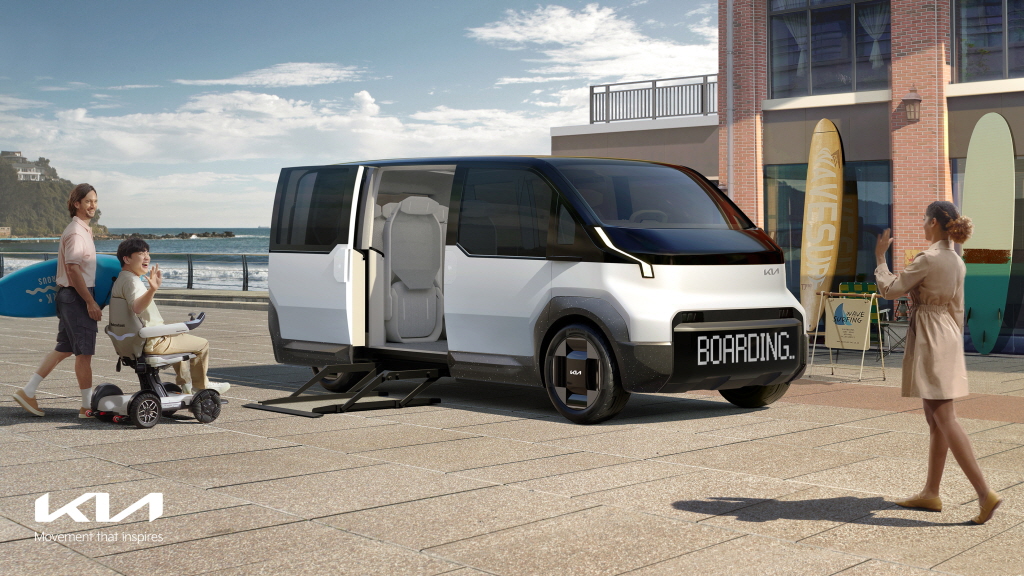
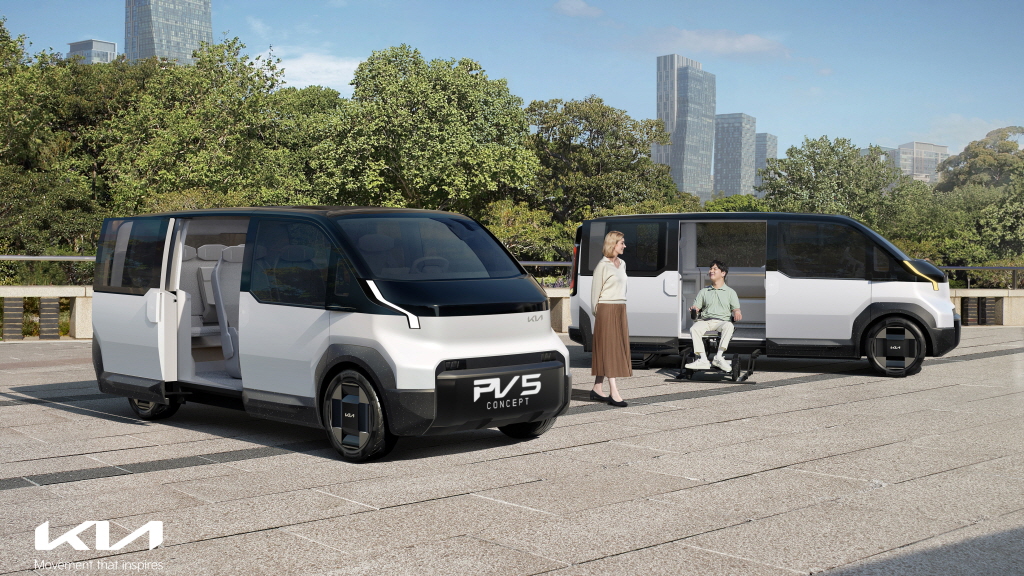
▲Kia PV5 (Image source: Hyundai Motor Group)Kia Unveils Detailed Innovation Strategy, Including PBV Phased Roadmap, at CES 2024
Kia Motors President Song Ho-sung: "We will enter an era where PBVs become the standard for mobility."
Kia Motors has announced its future core business that will lead innovation in transportation, including a lineup of five PBV concept models and technologies such as 'Easy Swap' and 'Dynamic Hybrid'.
At CES 2024, which Kia participated in for the first time in five years, it held a media day with the theme of 'All Set for Every Inspiration' and unveiled various exhibits to show Kia's sustainable PBV strategy under the theme of 'Place of Inspiration'.
At the Kia booth, a total of five PBV concept model lineups were unveiled for the first time at CES 2024, including three PV5 concept models, including the PV5 Basic, PV5 Delivery High Roof, and PV5 Chassis Cab, as well as one PV1 concept model and one PV7 concept model. They also introduced future core businesses that will lead innovation in transportation, such as 'Easy Swap' and 'Dynamic Hybrid'.
Kia's PBV strategy, unveiled on this day, includes: △ launching an innovative PBV lineup that breaks away from the concept of traditional automobiles; △ launching cutting-edge software-based Technology application △ Creating a new mobility ecosystem through partnership diversification, and Kia has expressed its intention to become a leading brand in the PBV market through this.
At CES 2024, which Kia participated in for the first time in five years, it held a media day with the theme of 'All Set for Every Inspiration' and unveiled various exhibits to show Kia's sustainable PBV strategy under the theme of 'Place of Inspiration'.
At the Kia booth, a total of five PBV concept model lineups were unveiled for the first time at CES 2024, including three PV5 concept models, including the PV5 Basic, PV5 Delivery High Roof, and PV5 Chassis Cab, as well as one PV1 concept model and one PV7 concept model. They also introduced future core businesses that will lead innovation in transportation, such as 'Easy Swap' and 'Dynamic Hybrid'.
Kia's PBV strategy, unveiled on this day, includes: △ launching an innovative PBV lineup that breaks away from the concept of traditional automobiles; △ launching cutting-edge software-based Technology application △ Creating a new mobility ecosystem through partnership diversification, and Kia has expressed its intention to become a leading brand in the PBV market through this.
Kia has unveiled its "Future Strategy for Sustainable PBV Mobility Solutions," which focuses on the value customers will receive, demonstrating its confidence and preparedness for the PBV business.

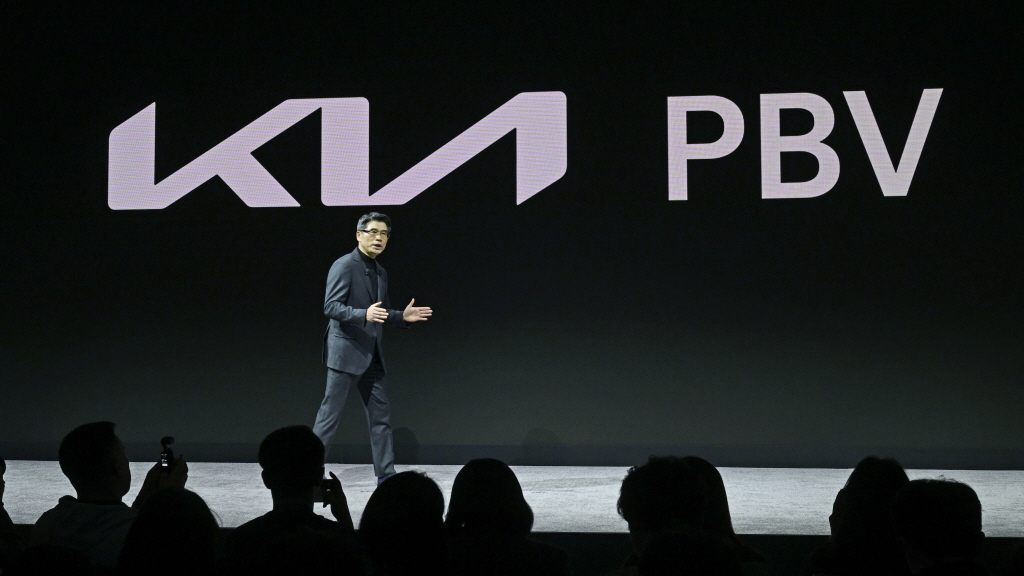
▲Kia Motors President Song Ho-sung giving a presentation at the CES 2024 Media Day (Photo credit: Hyundai Motor Group)
Kia President and CEO Song Ho-sung said, “Since the ‘Brand Relaunch’ in 2021, Kia has been on a diverse journey, including building a groundbreaking electric vehicle lineup, presenting a customer-centered future of mobility, and developing global sustainability initiatives such as our partnership with the global non-profit organization ‘The Ocean Cleanup.’ Now, we have set PBV as a core strategy for a new leap forward and are preparing for a full-scale transition to a sustainable mobility platform.”
Kia Redefines PBV… 'Platform Beyond Vehicle'
The PBV pursued by Kia is Kia's future vision of 'Sustainable Mobility Solutions Provider'.We provide an experience that goes beyond customer satisfaction based on our ability to provide mobility solutions that are capable of meeting customer needs.
Through PBV, Kia aims to present a new future direction in a rapidly digital transformation driven by smart mobility, the sharing economy, and e-commerce.
To this end, Kia redefined the concept of PBV as 'Platform Beyond Vehicle' at CES 2024.
The key is to provide new business and lifestyle opportunities through customized designs with freedom and flexibility, as well as an efficient in-vehicle experience through innovative space utilization.
Kia announced plans to go beyond the traditional concept of automobiles by meeting the needs of diverse customers and communities with vehicles and services optimized for global markets and business environments through its newly defined PBV business.
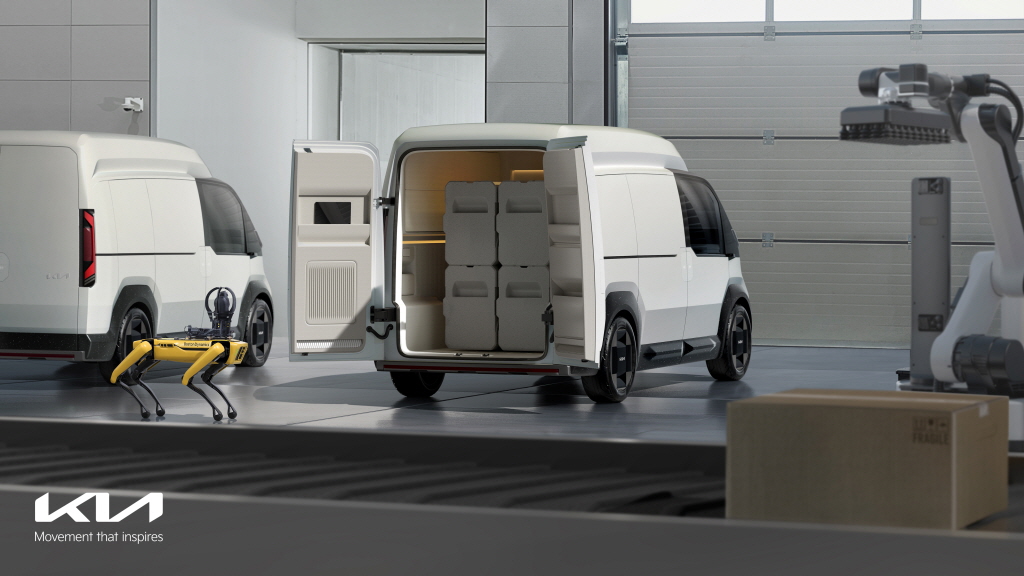
▲Kia PBV lineup (Image source: Hyundai Motor Group)Based on this vision, Kia has unveiled a step-by-step PBV roadmap that includes: △ building a PBV lineup that progresses from midsize → large → small; and △ fully customized (bespoke) production.
Kia will launch its first mid-size PBV, the PV5, in 2025 and launch its PBV business in earnest.
You can replace various life modules depending on the purpose of use, such as vehicle calling, delivery, and utility. It is planned to be equipped with conversion functions and strengthen the connectivity between SDV and external data such as routes and information, enabling the simultaneous operation of multiple vehicles.
Next, we will expand our reach to large logistics companies, mobility companies, and individual users by adding a lineup of large and small PBVs.
At this stage, digital control and autonomous driving technologies will be fully applied to Kia PBVs, and the scope of data connection will be expanded with AI-based vehicle control and management support.
We are also pursuing new forms of business linked to future technologies such as robotics.
Afterwards, the PBV will be developed into a 'bespoke mobility solution' that is completely customized according to an individual's taste and purpose.

▲Kia PV5 (Image source: Hyundai Motor Group)
Through this step-by-step roadmap, Kia PBV aims to achieve Kia's vision of 'Platform Beyond Vehicle' by creating a PBV ecosystem that links future technologies such as autonomous driving, advanced air mobility (AAM), robotics, and energy grids with Hyundai Motor Group's SDV strategy.
“PBV will soon revolutionize the world of mobility, and many people will enter an era where PBV becomes the standard for mobility,” said CEO Song Ho-sung. “Kia is committed to providing a safe and comfortable environment for people who work and travel.” “I am ready to embrace and implement all the inspiration that exists to change the way I live, and even the way I do things,” he said.
■ Kia diversifies its lineup, including the PV5, which is based on the PBV lineup.
The Kia PBV lineup embodies a solid and robust character based on a simple yet intuitive design.
In addition, the form of attaching modules (upper bodies) that reflect various demands on top of the skateboard-based PBV-dedicated EV platform was adopted to maximize usability, and all functions were made to be easy and intuitive to use.
The PV5, Kia's first dedicated PBV model and the foundation of the PBV lineup, features a spacious and flat interior created by a dedicated EV platform and extended wheelbase.
▲Kia PV5 (Image source: Hyundai Motor Group) The driver's cockpit, which provides a desk-like flat surface, and the steering wheel, which can be folded upwards to be used as a desk lamp, provide the driver with an office-like experience.
PV5 will be released in various versions, including Basic, Delivery (Van), Delivery High Roof, and Chassis Cab.
In the future, we will also introduce a robotaxi model developed in collaboration with Motional.
Robo-taxi is a self-driving technology Kia expects this to bring about innovation in ride-hailing services.
In addition to the PV5 concept model, Kia also unveiled the PV7 and PV1 concept cars at CES 2024.
The PV7, a large PBV, offers the most spacious interior in the lineup and has a long driving range, making it suitable for a variety of applications.
The compact PBV, PV1, is a model optimized for short-distance logistics transport, and uses a driving module to minimize the turning radius in narrow spaces.
It is capable of free movement, such as right-angle driving, diagonal driving, turning in place, and pivot turning (freely turning the vehicle to the desired position), allowing for quick movement even in narrow spaces where driving is not possible.
Kia expects to provide an optimal transportation solution encompassing logistics from the beginning to last mile delivery through the synergy between the PV7, which is specialized for long-distance logistics, and the PV1, which is capable of agile movement.
“The PBV experience that Kia will deliver will extend beyond the physical boundaries of the vehicle to suit customers’ lives and needs,” said Karim Habib, Vice President of Kia Motors. “Kia PBV will become the best business and lifestyle partner that makes customers’ daily lives more efficient and enjoyable.”
Kia introduces innovative technologies such as EasySwap and Dynamic Hybrid, which are applied to PBVs.
Kia has introduced a new 'customer-participatory vehicle development process' that reflects customer opinions from the PBV product planning and development stage, thereby creating a customer-centered product.Joe is embarking on a revolution.
We plan to establish a 'PBV-specific business system' that can provide customized solutions for each customer and introduce vehicles that meet various customer needs.
To this end, Kia is building the 'EVO Plant', a dedicated PBV electric vehicle plant with an annual production capacity of 150,000 units in Autoland Hwaseong.
The Evo Plant, named after the word 'Evolution', will serve as a smart factory for full-scale mass production of PBVs, equipped with an innovative production system that applies digital technology and robots and combines conveyor systems and cell production methods.
Kia PBV's innovation is expected to be maximized thanks to 'Easy Swap' technology.
EasySwap is a technology that allows consumers to swap out life modules to suit their style.
Instead of traditional bolt-on fastening methods, the hybrid unit combines magnetic and mechanical fastening, allowing you to customize the body to suit your desired business needs without having to purchase a new vehicle.
The 'Dynamic Hybrid' technology, which will lead the multi-variety, small-quantity production system of Kia PBV, also attracts attention.
Dynamic Hybrid is a technology that allows customers to adjust the size and height of the vehicle body to their liking to meet their various needs.
It is considered an assembly method that can be expanded horizontally and vertically to cope with the multi-variety, small-batch production that will become widespread in the future.
Kia is providing PBV customers with a PBV solution that is optimized for their business.The software is being prepared.
Software is broadly divided into three areas: IVI (In-Vehicle Infotainment), FMS (Fleet Management System), and Charging.
First, IVI can develop the services customers need directly and reflect them directly in the PBV application market or receive them through third-party developers.
Additionally, you can enjoy the latest information and entertainment content while moving, and use personalized services combined with data, such as charging, parking, and payment.
FMS is software that supports the stable operation of PBV.
Real-time operation control is possible using vehicle data without the need for separate devices for data collection or management, and predictive maintenance information is provided to drivers by analyzing operation patterns and failure types based on AI technology.
In the case of charging, we provide customers with an optimized charging schedule and charging station based on charging consulting that takes into account charging schedules, driving routes, schedules, etc.
Additionally, high-density energy batteries based on optimal charging infrastructure such as V2X can be used to supply power to mobile devices and emergency equipment.
Pierre-Martin Baux, Managing Director of Kia’s PBV Business Unit, said, “Kia PBV’s software not only increases mobility convenience but also helps differentiate customers’ businesses. By accumulating software and diverse business experiences, Kia PBV will strengthen connectivity between vehicles and become a platform that will further integrate social infrastructure.”
■ PBCollaborating with various global partners to create the V ecosystem
Kia aims to meet the needs of customers in each segment through its PBV business. To this end, it is introducing a PBV-specific "Kia PBV Partners Day," a first-of-its-kind process that reflects diverse customer needs.
Kia also decided to collaborate with various partners to create a new mobility ecosystem through PBV.
Kia plans to further strengthen its PBV-specific business system by forming partnerships with companies such as Uber, Coupang, CJ Logistics, and Kakao Mobility, and will develop PBV robotaxis capable of Level 4 autonomous driving with Motional.
PV5 will be released in various versions, including Basic, Delivery (Van), Delivery High Roof, and Chassis Cab.
In the future, we will also introduce a robotaxi model developed in collaboration with Motional.
Robo-taxi is a self-driving technology Kia expects this to bring about innovation in ride-hailing services.
In addition to the PV5 concept model, Kia also unveiled the PV7 and PV1 concept cars at CES 2024.
The PV7, a large PBV, offers the most spacious interior in the lineup and has a long driving range, making it suitable for a variety of applications.
The compact PBV, PV1, is a model optimized for short-distance logistics transport, and uses a driving module to minimize the turning radius in narrow spaces.
It is capable of free movement, such as right-angle driving, diagonal driving, turning in place, and pivot turning (freely turning the vehicle to the desired position), allowing for quick movement even in narrow spaces where driving is not possible.
Kia expects to provide an optimal transportation solution encompassing logistics from the beginning to last mile delivery through the synergy between the PV7, which is specialized for long-distance logistics, and the PV1, which is capable of agile movement.
“The PBV experience that Kia will deliver will extend beyond the physical boundaries of the vehicle to suit customers’ lives and needs,” said Karim Habib, Vice President of Kia Motors. “Kia PBV will become the best business and lifestyle partner that makes customers’ daily lives more efficient and enjoyable.”
Kia introduces innovative technologies such as EasySwap and Dynamic Hybrid, which are applied to PBVs.
Kia has introduced a new 'customer-participatory vehicle development process' that reflects customer opinions from the PBV product planning and development stage, thereby creating a customer-centered product.Joe is embarking on a revolution.
We plan to establish a 'PBV-specific business system' that can provide customized solutions for each customer and introduce vehicles that meet various customer needs.
To this end, Kia is building the 'EVO Plant', a dedicated PBV electric vehicle plant with an annual production capacity of 150,000 units in Autoland Hwaseong.
The Evo Plant, named after the word 'Evolution', will serve as a smart factory for full-scale mass production of PBVs, equipped with an innovative production system that applies digital technology and robots and combines conveyor systems and cell production methods.
Kia PBV's innovation is expected to be maximized thanks to 'Easy Swap' technology.
EasySwap is a technology that allows consumers to swap out life modules to suit their style.
Instead of traditional bolt-on fastening methods, the hybrid unit combines magnetic and mechanical fastening, allowing you to customize the body to suit your desired business needs without having to purchase a new vehicle.
The 'Dynamic Hybrid' technology, which will lead the multi-variety, small-quantity production system of Kia PBV, also attracts attention.
Dynamic Hybrid is a technology that allows customers to adjust the size and height of the vehicle body to their liking to meet their various needs.
It is considered an assembly method that can be expanded horizontally and vertically to cope with the multi-variety, small-batch production that will become widespread in the future.
Kia is providing PBV customers with a PBV solution that is optimized for their business.The software is being prepared.
Software is broadly divided into three areas: IVI (In-Vehicle Infotainment), FMS (Fleet Management System), and Charging.
First, IVI can develop the services customers need directly and reflect them directly in the PBV application market or receive them through third-party developers.
Additionally, you can enjoy the latest information and entertainment content while moving, and use personalized services combined with data, such as charging, parking, and payment.
FMS is software that supports the stable operation of PBV.
Real-time operation control is possible using vehicle data without the need for separate devices for data collection or management, and predictive maintenance information is provided to drivers by analyzing operation patterns and failure types based on AI technology.
In the case of charging, we provide customers with an optimized charging schedule and charging station based on charging consulting that takes into account charging schedules, driving routes, schedules, etc.
Additionally, high-density energy batteries based on optimal charging infrastructure such as V2X can be used to supply power to mobile devices and emergency equipment.
Pierre-Martin Baux, Managing Director of Kia’s PBV Business Unit, said, “Kia PBV’s software not only increases mobility convenience but also helps differentiate customers’ businesses. By accumulating software and diverse business experiences, Kia PBV will strengthen connectivity between vehicles and become a platform that will further integrate social infrastructure.”
■ PBCollaborating with various global partners to create the V ecosystem
Kia aims to meet the needs of customers in each segment through its PBV business. To this end, it is introducing a PBV-specific "Kia PBV Partners Day," a first-of-its-kind process that reflects diverse customer needs.
Kia also decided to collaborate with various partners to create a new mobility ecosystem through PBV.
Kia plans to further strengthen its PBV-specific business system by forming partnerships with companies such as Uber, Coupang, CJ Logistics, and Kakao Mobility, and will develop PBV robotaxis capable of Level 4 autonomous driving with Motional.
본 기사에 대한 정정·반론·추후보도 청구는 보도 청구 안내를, 그간 게재된 보도문은 정정·반론보도 모아보기를 참고해 주세요.

.png)