


Kia to Partner with Uber to Produce and Supply PBV Models
 Published2024.01.12 14:05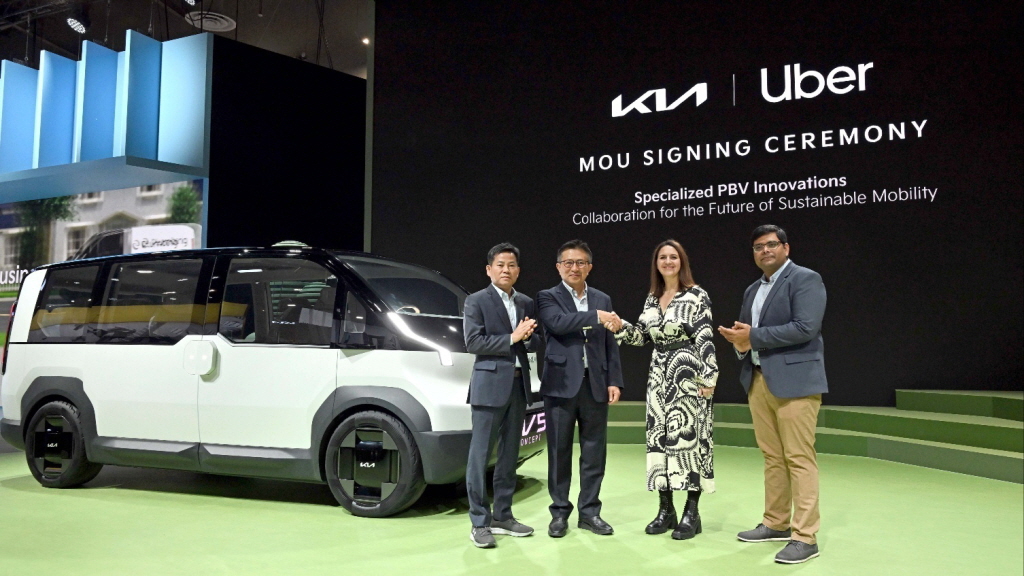
Uber-provided PBVs are based on Kia's first dedicated PBV model, the PV5.
Cooperation to expand Kia Flex operations in North America through Uber platform integration
Kia announced on the 10th that it has signed a partnership with Uber at CES 2024 and will collaborate to develop and supply PBVs optimized for Uber mobility.
The signing ceremony held at the Kia exhibition hall on this day was attended by key officials from both companies, including Seung-kyu Yoon, Vice President and Head of Kia North America; Sang-dae Kim, Head of Kia PBV Business Division; Susan Anderson, Head of Uber Global Business Division; Ajay Dalvi, Head of Uber Global Business Development; and Nishith Kumar, Director of Uber Global Business Development.
This agreement was reached through a joint effort between Kia, which aims to realize its vision of a “Platform Beyond Vehicle” by providing diverse experiential value, and Uber, which aims to achieve its “2040 carbon neutrality” goal by expanding PBV operations.
Through this agreement, the two companies will collaborate to identify optimal specifications for ride-hailing drivers and passengers using the Uber platform, and to produce and supply specialized PBV models based on these specifications.
In this process, the diverse needs of drivers and customers are actively reflected in the PBV development process.
The PBV to be provided to Uber in the future will be based on Kia's first dedicated PBV model, the 'PV5', which is scheduled for mass production in 2025.
The PV5, the first vehicle to feature a dedicated EV platform for PBVs, boasts greater space and greater livability than existing passenger taxi models. It also features driver-specific applications with an open infotainment system, and provides a personalized transportation environment for the convenience of passengers.
The two companies also plan to continue their collaboration to develop and provide user-centric solutions based on software, data, and AI.
In addition, PBV diagnosis and prevention services are also provided through the application of ‘Kia Connect.’
This allows drivers to detect potential failure signs in advance and reduce the total cost of ownership (TCO) by minimizing maintenance costs and service time.
Kia and Uber will also actively cooperate to expand public and home charging infrastructure utilizing the global charging network to address the inconvenience faced by Uber drivers switching to PBVs.
We are also developing software that suggests optimal driving patterns and charging routes based on analysis of charging station and vehicle data.
The two companies will also collaborate to expand the operation of the 'Kia Flex' service in North America through integration with the Uber platform.
The plan is to encourage more Uber drivers to subscribe to vehicles through Kia Flex by offering exclusive package benefits such as rental, insurance, and maintenance.
This partnership with UberKia expects that by developing customized vehicles that reflect diverse requirements, it will be able to increase the value and role of PBVs, while also contributing to achieving its goal of providing individual customers with a total mobility solution optimized for their business environment.
“Through our partnership with Uber, Kia aims to enhance the mobility experience with industry-leading hardware technology and high-quality software and services,” said Seung-Gyu Yoon, President and CEO of Kia North America. “Kia’s PBV will serve as a bridgehead for the future mobility industry and contribute to achieving the electrification and sustainability goals pursued by both companies.”
Susan Anderson, Uber’s head of global business, said, “By sharing mobility insights and collaborating with Kia, we hope to provide more Uber platform users with improved work productivity and optimized total cost of ownership, thereby accelerating the transition to EVs.”
Comments
Related news
.jpg)
Kia to launch its first mid-size PBV, the PV5, in 2025, signaling the start of its PBV business.
At CES 2024, which Kia is participating in for the first time in five years, the company held a media day under the theme "All Set for Every Inspiration," showcasing Kia's sustainable PBV strategy through various exhibits under the theme of "Place of Inspiration."
2024.01.10by 성유창 기자

Intel Announces 'AI Everywhere' Strategy for SDV SoCs
Intel announced on the 10th (local time) at CES that it plans to lead an AI Everywhere strategy for the automotive market, including the acquisition of Silicon Mobility, a fabless silicon and software company specializing in SoCs for intelligent EV power management. Along with this, Intel announced a new product line of AI-based software-defined vehicle SoCs (System-on-Chip), and stated that Zeekr will be the first OEM to adopt the new products to provide next-generation vehicles with generative AI-based in-cabin experiences.
2024.01.10by 권신혁 기자

Personal AI computing is in full swing, and chipmakers are waging a war over AI semiconductors.
At CES 2024, a large number of chip solutions that substantialize personal AI computing are emerging. This ranges from GPUs that enhance generative AI capabilities, to desktop processors enabling AI PCs, and the advent of processors opening the mobile AI computing era. This signifies that personal AI hardware is penetrating into a very broad range of edge and local domains. AI processors that address latency issues and privacy concerns that can arise from server-side AI computing, while delivering performance improvements to AI functions on PCs and edge devices, are expected to define the coming year.
2024.01.11by 권신혁 기자
Ministry of SMEs and Startups to Encourage Korean Companies at CES 2024 and Discuss Collaboration Plans with Apple
The Ministry of SMEs and Startups announced that it will attend CES 2024 to encourage Korean companies and subsequently discuss collaboration methods with global companies such as Apple and Google.
2024.01.11by 성유창 기자
UAM Innovations Seen at CES… To Be Commercialized by 2025
At CES 2024, advanced mobility UAM (Urban Air Mobility) garnered significant attention. While domestic companies from various sectors are collaborating under the objective of resolving traffic congestion and environmental issues, there remains further ground to cover before commercialization in 2025.
2024.01.11by 김예지 기자











