



Repeal the Single-Targeting Act and Activate On-Device AI
 Published2024.02.14 11:56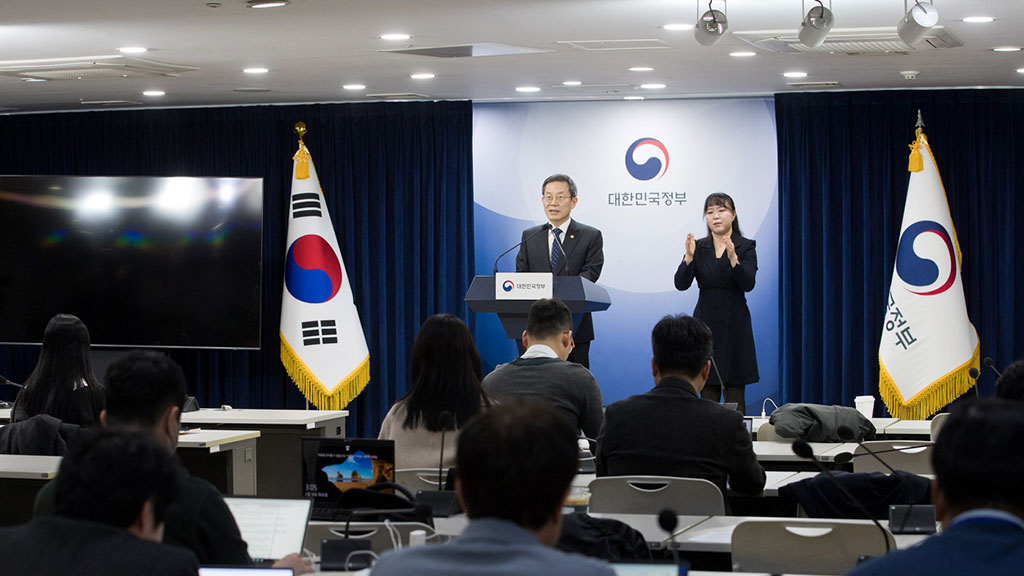
Global R&D Expansion, AI, and Digital Transformation in 2024
Plan to abolish the Single Rate Law and maintain the 25% discount on optional contracts
Support for new mobile carriers and encourage the launch of low- to mid-priced devices
The Ministry of Science and ICT (MSIT) is expanding into global R&D hubs and pursuing a strategy to activate on-device AI based on domestically produced AI semiconductors. Amid the push to repeal the Terminal Distribution Act (DSM), the MSIT announced that it is devising a plan to abolish the subsidy disclosure system while maintaining the 25% optional contract discount system.
The Ministry of Science and ICT announced its key policy implementation plan for 2024 on the 13th, aiming to transform Korea into a global science and technology powerhouse and a digital model nation. The ministry announced that it will abolish the Single Telecommunications Act and expand the release of low- to mid-priced devices as part of its digital-based livelihood stabilization policy.
The Ministry of Science and ICT, in collaboration with the Korea Communications Commission, will abolish the Single Mobile Network Act to promote competition in mobile device subsidies. The plan is to transfer the optional contract system, a user protection provision, to the Telecommunications Business Act, guaranteeing the right to choose a discount while ensuring it does not hinder competition in subsidy provision.
The core goal of the abolition of the Single Telecommunications Act is to eliminate the subsidy disclosure system, allowing mobile carriers to freely provide subsidies, thereby stimulating competition in the telecommunications market and reducing the burden on consumers purchasing mobile devices. The existing disclosure system required mobile carriers to sell devices only at the subsidy amounts disclosed for each device. The Korea Communications Commission will also abolish the cap on additional subsidies. Due to the existing restrictions on additional subsidies, mobile carriers could only provide additional subsidies within 15% of the publicly announced subsidy amount.
A key point to note is that the selective contract system will remain in place alongside the abolition of the Single Rate Act. In the briefing, an official stated, "Even if the subsidy disclosure is abolished, we will ensure that users can still receive the 25% discount they currently receive."
The related content is expected to be concretized as Rep. Park Seong-jung of the People Power Party re-introduces an additional amendment bill following Rep. Kim Young-sik of the People Power Party, who proposed the bill to abolish the Single Channel Act.
Consumers are expressing their opinions, saying, “It will be useless if the cost of communication remains high by forcing people to use expensive plans instead of increasing subsidies,” and “I wish they would increase the discount rate for optional contracts.”
Furthermore, the Ministry of Science and ICT will pursue policies to resolve difficulties, such as supporting the utilization of communication facilities and distribution of terminals, to ensure the market stabilization of StageX, which was successfully bid for as a new mobile carrier based on the 28GHz frequency. This will include specific measures to expand the opening of essential facilities such as optical cables and support joint use (roaming), which were mentioned alongside StageX's confirmation as the fourth mobile carrier in an auction in early February for 430.1 billion won. Notably, the Ministry of Science and ICT visited Samsung Electronics in February and requested cooperation in the procurement and distribution of 28GHz terminals.
The Ministry of Science and ICT also presented policies to lead AI and digital transformation as key initiatives for 2024. It will pursue strategies to promote domestically produced AI semiconductors and on-device AI. A KRW 40 billion AI-digital convergence pilot project will create new markets. Furthermore, it will promote the widespread use of AI in everyday life and establish a digital order to ensure AI reliability. The second AI Stability Summit is scheduled for May.
To establish South Korea as a global R&D hub, we will expand the recruitment of overseas talent and joint research. We will support young researchers and apply bold special privileges to innovative and challenging R&D projects. For example, we will drastically shorten the introduction period for the latest high-performance equipment from 120 days to 50 days. Building on this, we will accelerate the creation of game-changing results in three key areas: quantum, AI, and advanced bio. We will prioritize challenging R&D and aim to establish AI research hubs in Korea and the United States.
Furthermore, the government plans to prioritize fostering three global leading technologies: next-generation semiconductors, next-generation networks, and space. Specifically, R&D for 6G commercialization and demonstration of domestically produced OpenLAN equipment will be promoted in the first half of the year, and a 479.7 billion won low-orbit satellite communications feasibility study will be pursued.
Minister of Science and ICT Lee Jong-ho said, “This year marks the third year of the Yoon Seok-yeol administration, and we will become a government that takes action for the future of the Republic of Korea,” adding, “We will create an R&D hub where the world’s best researchers can work together to tackle innovative research, and thoroughly prepare for the great transition to AI and digitalization so that the Republic of Korea can leap forward as a science and technology powerhouse and a digital model nation.”
Comments
Related news
Ministry of Science and ICT introduces zero trust, boosting security levels.
The Ministry of Science and Technology Information and Communications established a 'Zero Trust Forum' composed of domestic experts from academia, industry, and research institutions in October last year, and through global trend analysis, data review, and discussion sessions, compiled opinions to develop a 'Zero Trust Guideline 1.0' tailored to the domestic environment. The zero trust security model treats servers, computing services, and data as resources that must be protected and separately protects each of them.
2023.07.10by 김예지 기자
Ministry of Science and ICT launches Korea OpenLAN Alliance
The Ministry of Science and ICT held a launch declaration ceremony on the 16th at the Pangyo Second Techno Valley Business Support Hub, announcing the government's Open-RAN policy direction and presenting the operational direction for the 'Open-RAN Industry Alliance (ORIA),' which was launched in April.
2023.08.16by 김예지 기자
Ministry of Science and ICT begins efforts to secure 6G frequencies
The Ministry of Science and Technology participated in the 6th Asia-Pacific Regional Preparatory Group meeting (APG23) held in Brisbane, Australia from the 14th to the 19th to prepare for the World Radiocommunication Conference (WRC23, with 193 countries expected to participate) scheduled to be held in the UAE in November of this year.
2023.08.21by 김예지 기자
.jpg)
Korea successfully adopts three 6G candidate frequency bands
The WRC-23, the highest decision-making conference hosted by the International Telecommunication Union (ITU) that determines important matters in global frequency allocation and radio communication fields, was attended by 3,800 experts from 162 countries over a four-week period from November 20 to December 15. At the event held in Dubai, United Arab Emirates, our country also participated with a total of 49 public and private sector experts including the Ministry of Science and ICT, Ministry of Defense, National Radio Research Agency, and Samsung Electronics.
2023.12.19by 김예지 기자
The Ministry of Science and ICT stated, "The number of 5G locations nationwide doubled to 54 last year."
The Ministry of Science and Technology Information and Communication announced on the 3rd that usage of the 5G Network has increased more than twofold compared to the previous year, expanding to 54 locations across 30 companies and organizations nationwide as of the end of 2023.
2024.01.03by 김예지 기자











