



AMD Spartan UltraScale+ Unveiled
 Published2024.03.05 23:00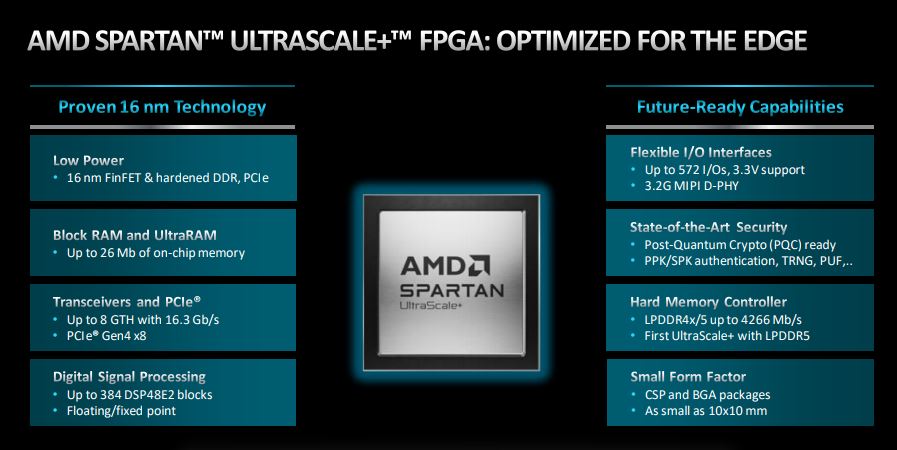
▲AMD Spartan UltraScale+ FPGA specifications (Source: AMD)
Long product life cycle, high I/O ratio
The number of IoT devices is expected to increase 2.3 times by 2028, and the demand for FPGAs is growing at the same time as the number of connected devices. On the other hand, the shortage of developers is also expected to worsen, with a shortage of design engineers reaching 30%.
Since current industrial and healthcare products require years of development, extending the product life cycle is essential for companies to secure a return on investment (ROI).
AMD unveiled the AMD 6th generation Spartan UltraScale+ FPGA on the 5th local time.
In a pre-briefing before the public announcement, AMD explained the background of the product's development as mentioned above: △increase in IoT devices, △efficiency of SW tools, and △increase in product life cycle.
AMD Spartan FPGAs are being used in a variety of applications, including medical, aerospace, and particle colliders.
The newly released AMD Spartan UltraScale+ based on the 16nm FinFET process is an edge-optimized product that features over 26Mb of on-chip memory and PCIe Gen4, supporting high I/O at low power and featuring advanced security.
AMD Spartan UltraScale+ consists of nine product lines, with logic cell counts ranging from 11,000 to 218,000. The smaller logic cell counts feature I/O expansion and board management, offering a higher I/O ratio per logic cell.
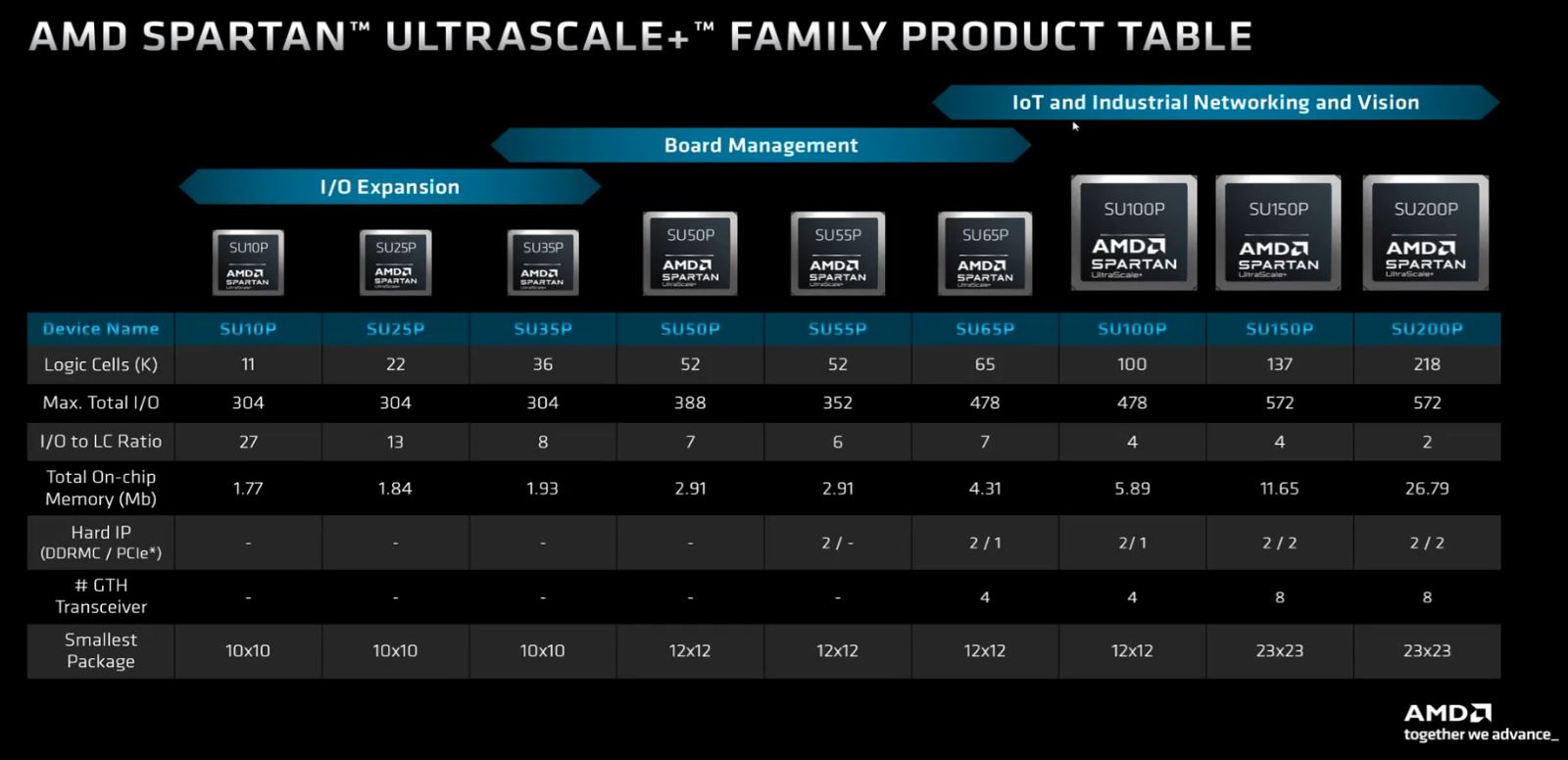
▲AMD Spartan UltraScale+ product table (Source: AMD)
Early access documentation is currently available, and developer tools are expected to be available later this year. The product's first market launch is said to be in the first quarter of 2024, with samples available, and evaluation kits also expected to be available around the same time.
Design tools designed to improve developer efficiency are expected to help address challenges such as learning curves, developer efficiency, and reliable results.
AMD is addressing the learning curve by offering a single development tool across its entire portfolio, said Rob Bauer, senior manager of silicon marketing for AMD's Adaptive and Embedded Computing Group. "That way, developers don't have to learn new tools when they move on to different projects, and we provide example designs and training."
“Long product life cycles are important to us, and we’ve maintained supply for over 15 years with each new FPGA product we release,” said Rob Bauer, manager. “We’ve also extended product life cycles when customers request them.”

Comments
Related news
AMD Expands Ryzen Embedded Processor Lineup for Machine Vision and Edge
AMD unveiled the AMD Ryzen Embedded 7000 series processor product line at the SPS 2023 (Smart Production Solutions 2023) exhibition on the 15th, optimized to meet the high-performance requirements demanded by industry.
2023.11.15by 명세환 기자
Dell Launches Servers Equipped with AMD Instinct Accelerators
Dell Technologies is stepping up efforts to expand an open ecosystem for generative AI through the PowerEdge server XE9680, which is equipped with eight AMD Instinct MI300X accelerators.
2023.12.07by 배종인 기자
AMD Seeks Growth Momentum in AI Solutions
As demand for AI accelerator solutions is rapidly increasing, AMD, which is challenging Nvidia's dominance in the AI market, held a meeting with key partner companies to explore future growth in AI solutions.
2023.12.07by 명세환 기자
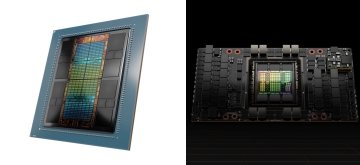
AMD vs Nvidia, Clash in AI GPU...MI300X vs H100
The server and ultra-high-performance GPU market that accelerates generative AI and ultra-large language models is burning hot. Since AMD launched its new MI300X GPU product on the 7th in response to Nvidia, which has monopolized the market, a battle of wits has unfolded between AMD and Nvidia.
2024.01.18by 명세환 기자
Mouser now stocks AMD Xilinx CREA KD240 drive starter kits.
Mouser Electronics announced on the 28th that it will supply the Kria KD240 Drive Starter Kit from AMD Xilinx.
2023.12.28by 명세환 기자











