


Celebrating 40 years of mobile communications: "A 'highly cost-effective' telecommunications policy is essential in the AI era."
 Published2024.03.06 08:48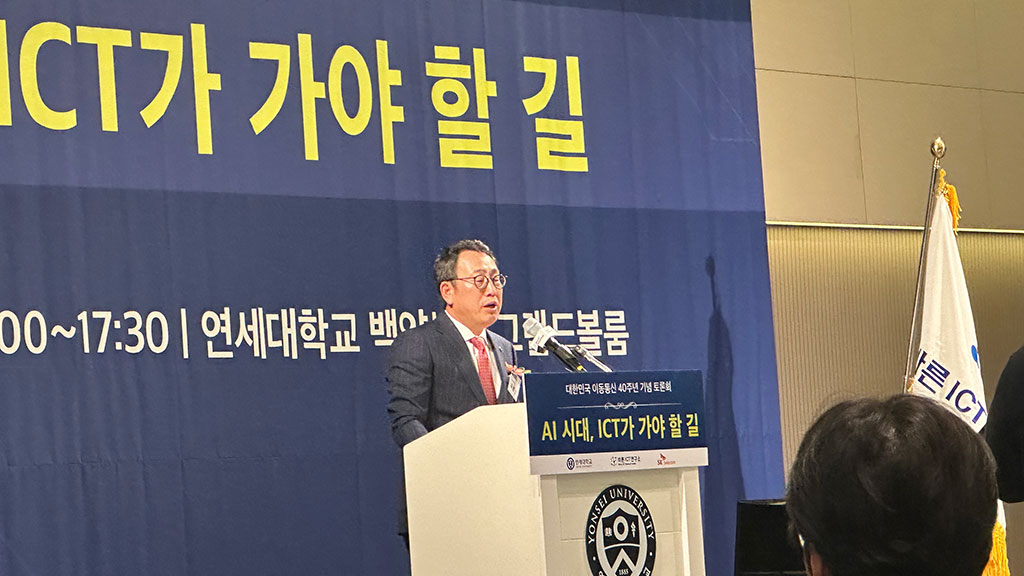
A forum commemorating the 40th anniversary of mobile communications will be held on the 5th.
SKT CEO Yoo Young-sang: "We will leap forward as a global AI company."
We need to create a new domestic market based on killer apps such as AI assistants.
As the 40-year-old mobile communications industry faces a new phase in the AI era, the need for future-oriented communications policies is being emphasized. Experts have suggested that, rather than simply reducing telecommunications costs across the board, we should provide more high-quality services at the lowest possible cost.
Yonsei University's Barun ICT Research Institute announced on the 5th that it held a symposium commemorating the 40th anniversary of mobile communications in Korea on the topic, "The Path ICT Should Take in the AI Era." The event, held at the Baekyangnuri Grand Ballroom at Yonsei University, reviewed Korea's achievements in the ICT sector and discussed the role of ICT in achieving economic and social value in the AI era.
Mobile communications have permeated our daily lives for 40 years.
In his congratulatory address, Yonsei University President Dong-Seop Yoon stated, “AI is triggering a paradigm shift across all areas of industry and society, and amid fierce competition to secure global AI leadership, Yonsei University will also join this important journey.”
SK Telecom President Yoo Young-sang said, “Mobile communications, which has been changing people’s lives and contributing to the development of the ICT industry in Korea for the past 40 years, is now facing a new challenge: AI,” and predicted, “Just as electricity transformed the 20th century, AI will revolutionize the 21st century.”
He continued, "SKT, which celebrates its 40th anniversary this year, has rapidly commercialized world-class WCDMA, LTE, and 5G technologies since its world-first commercialization of CDMA in 1996. Furthermore, it played a significant role in the semiconductor industry with its acquisition of SK Hynix in 2012. Going forward, we will continue to grow into a global AI company."
Kim Beom-su, director of Yonsei University's Barun ICT Research Institute, said, "As AI becomes more widespread, it is expected to bring positive changes to all aspects of our lives. However, concerns are also being raised about unpredictable risks. Therefore, it is time to predict the changes AI will bring and calmly prepare for them."
He also said, “I will reveal the dark side of SKT and ICT.” He said, “We will explore blueprints and specific policy measures for the industrial ecosystem that Korea will create in the AI era.”
■ AI, a new driving force for telecommunications companies
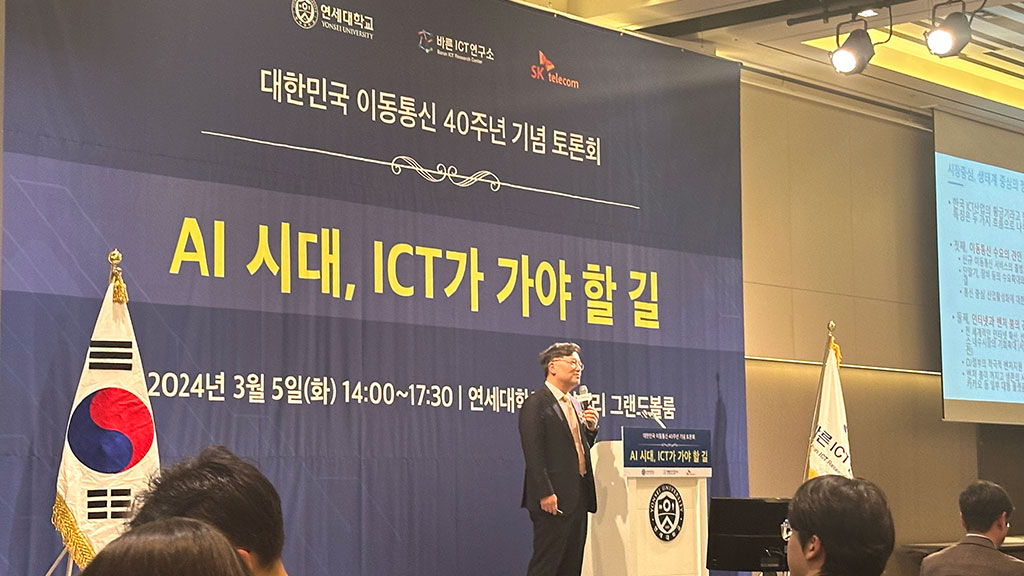
▲ Professor Kwon Nam-hoon, Department of Economics, Konkuk University
The telecommunications industry has experienced remarkable growth over the past 40 years, but since the 2010s, its growth rate and influence have stagnated. Amidst this, AI is expected to be a key factor in reviving the telecommunications industry's glory.
Five years after commercialization in 2018, the number of 5G subscribers continues to grow slightly. However, feeling the limitations of focusing solely on telecommunications, telecommunications companies are gradually increasing their presence in non-telecommunication and non-telecommunication businesses. SKT, the first to enter the AI business, announced plans to increase its AI portion to 36% in the future.
Professor Kwon Nam-hoon of the Department of Economics at Konkuk University argued that "AI is the new driving force behind the telecommunications industry," and that "when we evolve to 5G and even 6G, we need killer applications that go beyond the services we experienced in 1G and 4G." He cited services that "make people's daily lives more useful, making their absence inconvenient," such as AI assistants and the metaverse.
Also, “communication requires an active approach that goes beyond communication. “Telecommunications companies should become enablers of the AI transition in the B2B and B2C sectors by going beyond telecommunications and incorporating AI,” he suggested.
Professor Kwon then looked back on the history of past ICT policies and emphasized the need for forward-looking communications policies in the coming era, where AI will become a new driving force.
The ultimate goal of communications policy is to promote consumer interests. Professor Kwon argued that the current administration's ICT policy "is intended to strengthen competition in the communications market, but its focus on industrial development needs to be strengthened."
To this end, regarding the household telecommunications cost policy at key locations, he stated, “It is against economic principles for rates to be high compared to the amount of telecommunications consumed by the people,” and “In cases where total telecommunications consumption increases, it is more important to provide more high-quality services at the lowest cost globally rather than reducing telecommunications costs across the board.”
Finally, Professor Kwon argued, "In the era of AI convergence, ICT policy must move beyond the confrontational structure of services, devices, platforms, and content and restore a virtuous cycle of a mobile communications-centered ecosystem." He explained that because demand is expanding beyond devices to content and internet services, a collaborative and developmental framework linking communications, devices, platforms, and content must be pursued.
He also argued that for ICT policy to succeed, “we must create new domestic markets based on discovered killer applications, and we also need an active defensive strategy against global big tech companies.”
Comments
Related news
SKT achieved 1.7 trillion won in operating profit last year... "AI will produce tangible results this year."
SK Telecom announced on the 5th that its consolidated operating profit for fiscal year 2023 increased 8.8% year-over-year to 1.7532 trillion won, with sales up 1.8% to 17.6085 trillion won, and net income rising 20.9% to 1.1459 trillion won. On a separate basis, operating profit reached 1.4559 trillion won, sales increased 1.4% year-over-year to 12.5892 trillion won, and net income came to 1.0597 trillion won.
2024.02.06by 김예지 기자
SKT-MediaTek-Nota, Develop Technology to Reduce Terminal Power Consumption
SK Telecom announced that it has successfully developed initial-stage technology in collaboration with MediaTek, a global mobile AP manufacturer, and Nota, an AI optimization startup, aimed at reducing terminal power consumption based on on-device AI.
2024.02.15by 김예지 기자
.jpg)
SKT and KT to showcase AI innovation technology at MWC2024
SKT and KT will showcase future technologies based on AI innovation at 'MWC 2024 (Mobile World Congress 2024)' opening on the 26th in Barcelona, Spain. LG Uplus will participate by organizing an observer group to explore AI trends.
2024.02.19by 김예지 기자
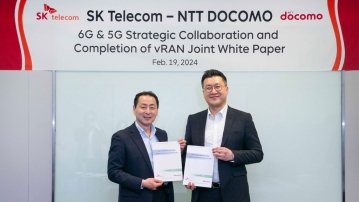
SKT and NTT Docomo Jointly Publish OpenRAN Virtualization Technology White Paper
SKT and Japanese telecommunications company NTT DOCOMO jointly announced on the 20th that they have co-published a technical white paper containing key requirements that telecommunications operators need in the process of implementing and advancing virtualized base stations.
2024.02.20by 김예지 기자
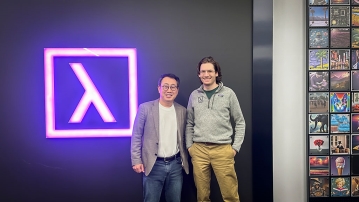
SKT, Full-scale Entry into AI Data Center Market
SKT announced on the 21st that it has invested in Lambda, a global GPU cloud company, as its first global move to secure a stable supply of graphics processing units (GPUs) in earnest pursuit of its AI DC (Data Center) business.
2024.02.21by 김예지 기자











