


AMD MI300 Series AI Accelerators to Begin Full Delivery in May
 Published2024.03.20 16:03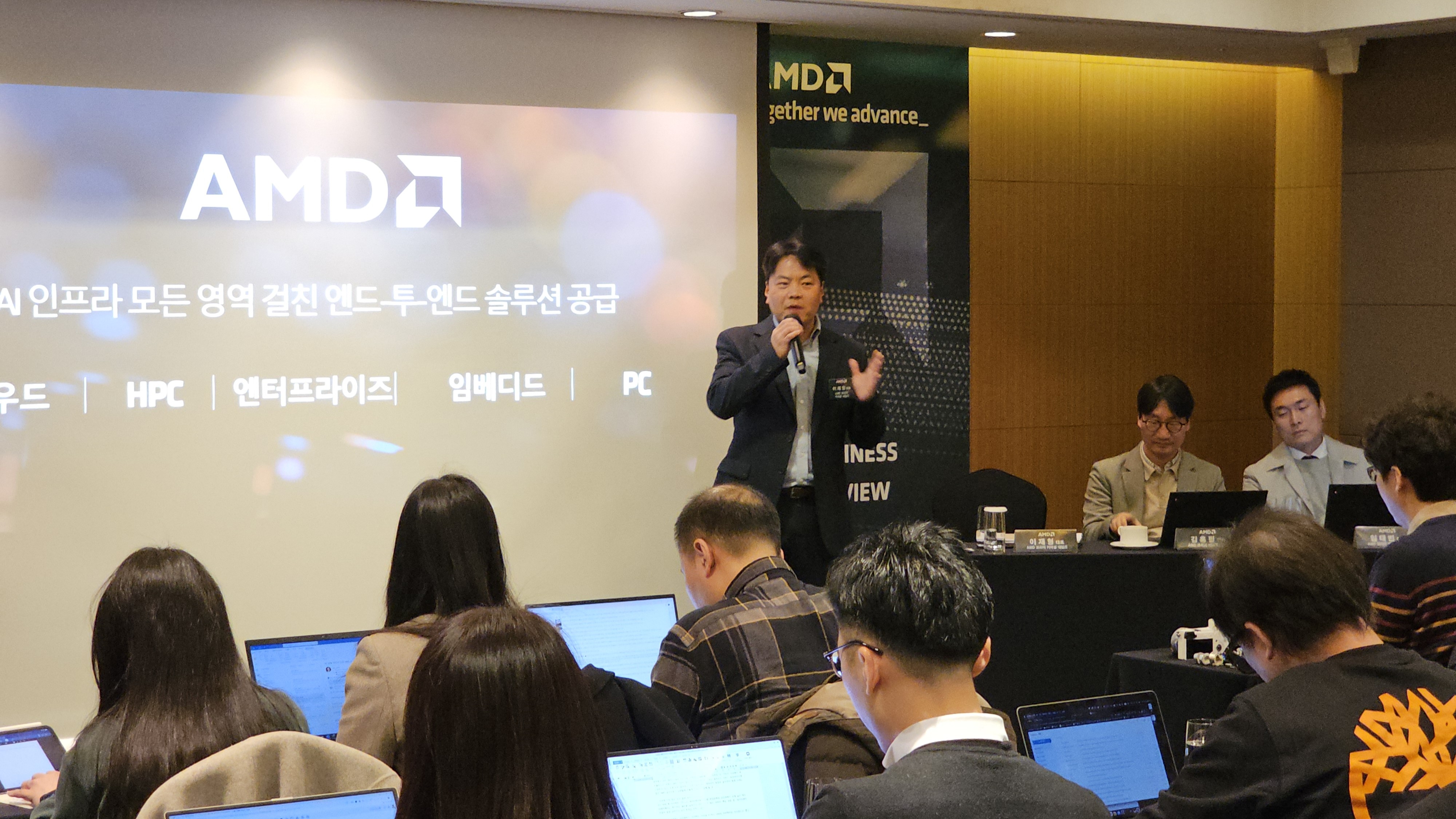
▲Jaehyung Lee, CEO of AMD Korea, speaking at the 'AMD AI Business Overview' press conference.
Emphasizes low-power, energy-efficient green AI accelerators, launching the MI300 in May.
Artificial intelligence (AI) has emerged as a hot topic in the industry, driving innovation with powerful ripple effects not only across IT but across industries. Amidst this, AMD, at the center of this AI momentum, has organized a forum to share its AI business strategy.
AMD held a press conference titled 'AMD AI Business Overview' at the InterContinental Seoul COEX on the 20th.
This was an opportunity to overview AMD's current status and future plans for its AI business, and the following products were introduced: the AMD Instinct MI300X accelerator, the AMD Instinct MI300A APU, the Instinct software ecosystem, the AMD EPYC server processor, and the AMD Ryzen AI and Ryzen 8040 series processors.
In early 2023, AMD predicted that the data center AI accelerator market would grow at a 50% annual rate, from $30 billion in 2023 to $150 billion in 2027. However, this growth forecast was significantly off the mark. AMD revised its growth forecast for this year, forecasting $45 billion in growth in the same segment in 2023 and a 70% annual growth rate to $400 billion by 2027.
“Until last year, the focus was on AI learning with large language models like Chat GPT in vogue, but in fact, the AI inference market is much larger,” said Lee Jae-hyung, CEO of AMD Korea, diagnosing the current situation and revealing his vision, saying, “AMD will provide solutions across all areas of life through pervasive AI that encompasses AI learning and inference.”
AMD plans to integrate AI engines across its entire portfolio within the next five years. AMD has already launched products with AI engines in many areas, including servers, HPC, embedded edge, enterprise, and PCs.
Furthermore, the core of AI solutions lies in how to configure the software stack, including development tools for developers. AMD plans to embrace an open ecosystem and expand collaboration with diverse partners. It supports software across the entire spectrum, from data center GPUs and CPUs to embedded edge and endpoints, with offerings such as ROCm, ZenDNN, and Vitis AI.
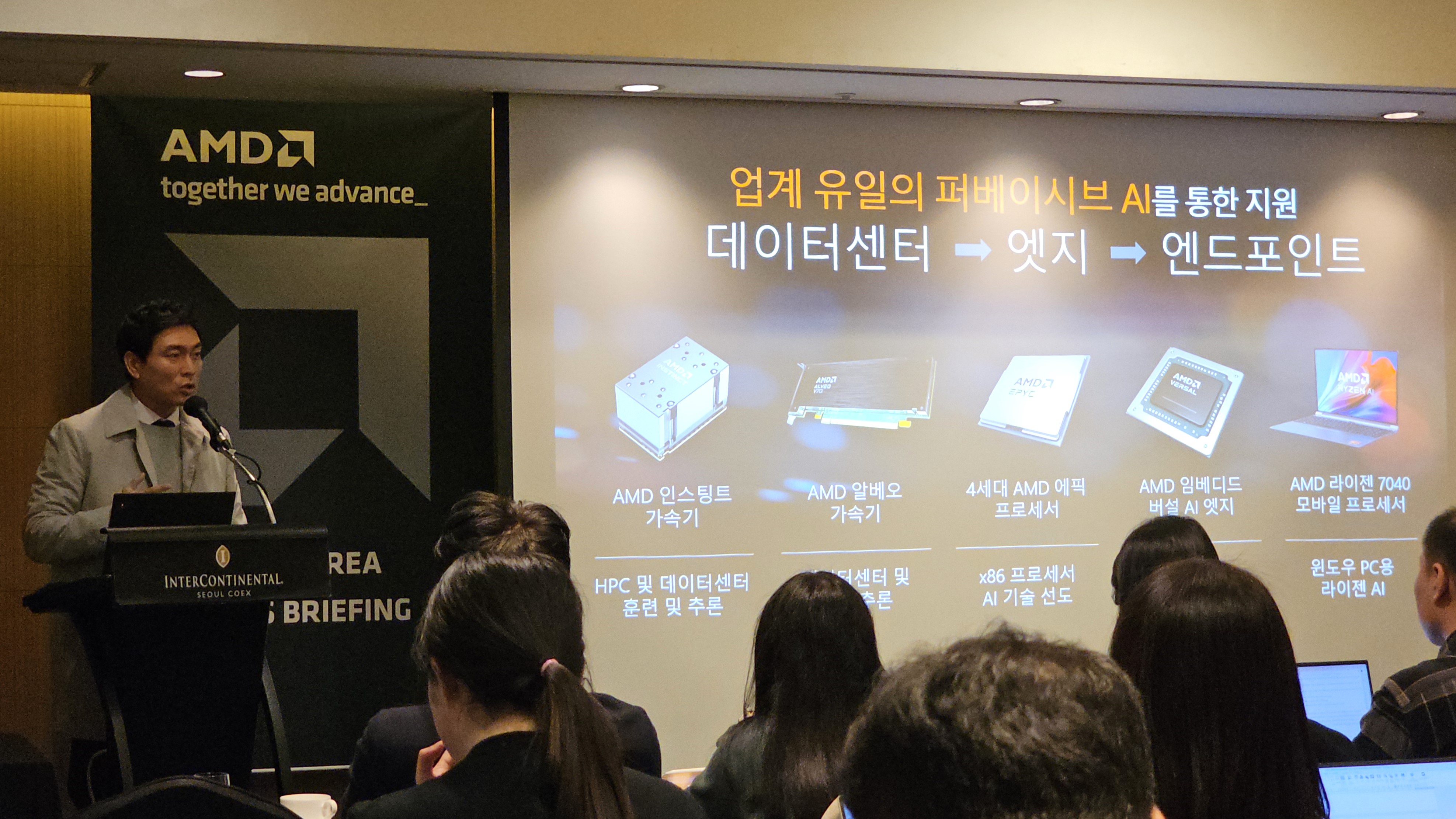
▲ AMD Korea Director Lim Tae-bin mentioned that AMD Pervasive AI supports end-to-end AI solutions across all industries. Director Lim introduced the Ryzen AI processor in the B2C sector.
AI services in edge devices, including data centers, can consume excessive CPU and GPU resources due to parallel operations during AI computations. Therefore, competitiveness will likely depend on how much resource burden can be reduced and power-efficient operation and management can be achieved through AI accelerators.
Data centers can employ hundreds or even tens of thousands of AI accelerators to achieve power efficiency and cost savings. For edge devices, power efficiency is a crucial factor in ensuring battery life and operational efficiency.
This is why AMD, with the launch of the MI300 series, emphasized its high energy efficiency as a green AI accelerator. AMD's Instinct product line has been installed in six of the world's top ten green supercomputers, highlighting its energy-efficient solutions compared to competitors.
AMD announced that its server-focused MI300 series will be delivered to customers and shipped as a product around May. It is expected to see widespread adoption in data centers, cloud AI services, and other areas, increasing consumer engagement.
AMD is also focusing on personal AI processing in line with the AI PC era. In addition to its server-oriented product line targeting advanced B2B, the company is expanding its user touchpoints in the B2C sector by introducing Ryzen AI last year.
The delay in the launch of the AMD Ryzen 7040 series (Phoenix) to the second half of 2023 significantly narrows the gap between its launch and that of the Ryzen 8040 series (Hawkpoint), which is scheduled for the first quarter of 2024.
Accordingly, some have pointed out that the launch interval is too short, as it is added to the launch of the next-generation AMD Ryzen AI processor, Strix Point, which was announced to be released within the year.
In response, AMD Korea Director Lim Tae-bin said, “We expect to be able to receive Strix Point, which is scheduled to be released within the year, in the first half of next year, so we will be able to maintain the one-year cycle of AMD Ryzen AI processor releases to some extent.”
Comments
Related news
AMD Unveils New Ryzen and Radeon Product Lines... The Era of Personal AI Arrives
AMD announced a spectacular comeback at CES 2024 with its new desktop solution product lineup. The company particularly introduced new features and products, highlighting AI on personal computers tailored to the AI era as the main characteristic of this product family.
2024.01.09by 권신혁 기자
AMD Embedded+ Launch, “Background for Rapid Increase in Edge AI Chips and Sensor Data Analysis”
Growing supply of AI inference chipsets is expected at the edge. Machine vision and sensor data analytics are projected to drive edge AI-related shipments, while AI semiconductors for edge AI devices are emerging in SoC form factors.
2024.02.06by 명세환 기자

AMD Radeon RX 7900 GRE Graphics Card Worldwide Launch
AMD has unveiled a new graphics card equipped with an AI accelerator, designed for 4K resolution gaming and streaming.
2024.02.27by 명세환 기자

AMD Spartan UltraScale+ Unveiled
By 2028, IoT devices are expected to increase 2.3-fold, and FPGA demand is rising concurrently with the growth in connected devices. Meanwhile, the developer shortage is intensifying, with design engineer shortages expected to reach 30%. Currently, industrial and healthcare sector products require years of development, so companies need to extend the lifecycle of developed products to secure return on investment (ROI) relative to their capital expenditure.
2024.03.05by 명세환 기자

AMD CEO Lisa Su: "AI PCs will lead innovation in gaming and entertainment."
With AI PCs beginning to see widespread adoption, concrete examples are being presented demonstrating how to leverage them to enhance productivity.
2024.03.14by 권신혁 기자











