


SK Hynix Saves 40 Billion Won in Purchase Costs by Recycling Neon
 Published2024.04.01 12:10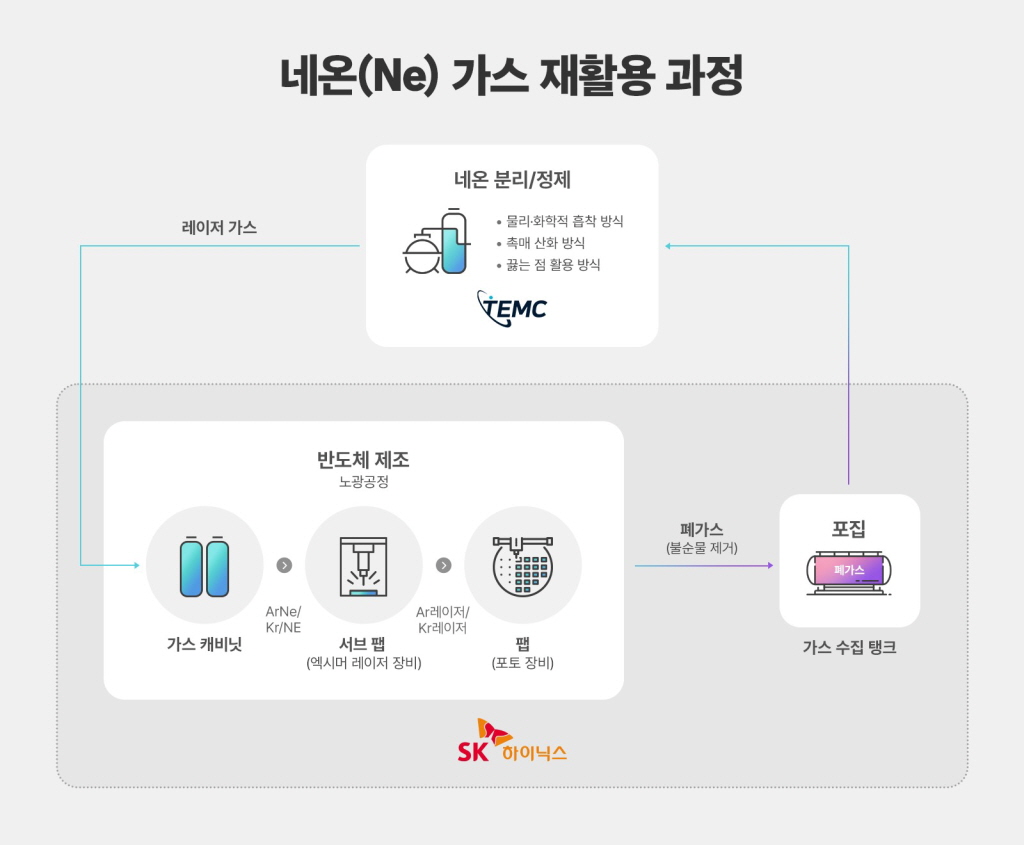
▲Neon gas recycling process (Data: SK Hynix)
Reduce greenhouse gas emissions by 12,000 tCO2e/yr
SK Hynix's success in neon recycling technology is expected to reduce the cost of purchasing neon and greenhouse gas emissions, and stabilize the supply and demand of neon.
SK Hynix announced on the 1st that it has developed neon (Ne) gas recycling technology in collaboration with TEMC.
This is an achievement made in just over a year of developing recycling technology.
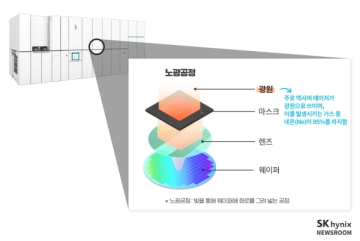
Neon is a major component of excimer laser gas, which is essential for semiconductor exposure processes.
Neon has the characteristic of not being chemically decomposed or deformed when used as a laser light source, so neon that has been used once can be recycled simply by separation and purification, such as removing impurities.
SK Hynix took note of this and collected the neon gas emitted into the air through a scrubber after the exposure process into a collection tank, and selectively separated and purified only the neon through TEMC's gas treatment process.
Neon purified in this way is then supplied to SK Hynix and used in the semiconductor manufacturing process.
The current neon recovery rate stands at 72.7%. SK Hynix plans to continuously improve the purification yield in the future to increase the neon recovery rate to 77%.
If neon recycling technology is applied to semiconductor fabs, it is expected that annual neon purchase costs will be reduced by KRW 40 billion.
In addition, this technology is expected to have the effect of reducing greenhouse gas emissions (Scope 3) during the neon production process by approximately 12,000 tCO2e/yr.
The Material Recycling Division of the SK Hynix Carbon Management Committee, which led the development of neon recycling technology, aims to ultimately recycle all materials that are not chemically decomposed or transformed in the semiconductor process.
The division plans to develop recycling technologies for a total of 10 raw materials, including four gaseous materials, including neon, deuterium (D2), hydrogen (H2), and helium (He), and chemical materials, including sulfuric acid (H2SO4), by 2025.
The company's goal is to complete a technology review of all materials without chemical modification by 2030.

Comments
Related news
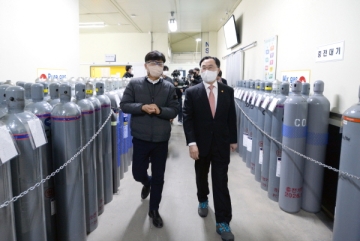
“Semiconductor rare gas supply instability, semiconductors will stop without it”
As Russia and Ukraine entered into war, an emergency alert was sounded for the semiconductor industry, which is a cornerstone of our nation's economy. The reason is that xenon (Xe), neon (Ne), and krypton (Kr) are essential core materials in semiconductor processes, and supply disruptions could cause delays in semiconductor manufacturing. Accordingly, the semiconductor industry is reportedly mobilizing all efforts to secure these rare gases, regardless of price.
2022.03.02by 배종인 기자
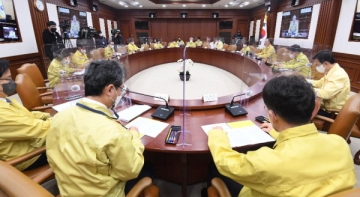
Xenon, Neon, and Krypton 0% Tariff in April
The government is implementing tariff quotas on neon (Ne), xenon (Xe), and krypton (Kr)—key materials in semiconductor processes with high import dependency from Russia and Ukraine—to stabilize supply and demand.
2022.03.18by 배종인 기자
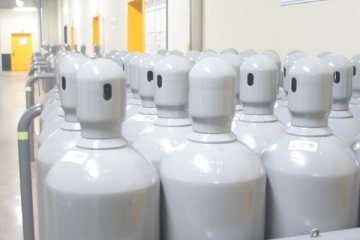
Semiconductor neon production facility destroyed in Mariupol, Ukraine, leading to long-term supply disruption.
The neon production facility in Mariupol, Ukraine, which is the world's largest production facility for neon, has been destroyed, and a global long-term supply shortage of neon and a sharp price surge are anticipated.
2022.05.09by 배종인 기자
SK Hynix to produce 100% domestically produced neon by 2024
SK Hynix will achieve 100% localization of 'neon (Ne) gas,' used in semiconductor photolithography processes, in 2024, and will make full-scale efforts to strengthen the semiconductor raw material supply chain.
2022.10.05by 배종인 기자

Semiconductor Rare Gas Domestic Production Pitfalls: Is It Economically Sustainable?
Linde, a global industrial gas manufacturer, has announced domestic production of semiconductor rare gases. With Posco, it is expected to lead domestic supply of semiconductor rare gases going forward, while attention is being paid to whether rare gas production requiring hundreds of billions of won in investment will maintain economic viability and whether sustainable production will be possible. <br><br> #rare gases #xenon #krypton #neon #nitrogen #oxygen #Linde #Posco #Samsung Electronics #SK Hynix #Kioxia #Micron #TMSC #Wonkwang Materials #SK Materials #etch gas #NAND #Russia #Ukraine #ASU
2023.01.05by 배종인 기자











