



Exploring Major Domestic EMC Laboratories... Distinct Characteristics of 4 Labs
 Published2024.07.18 12:19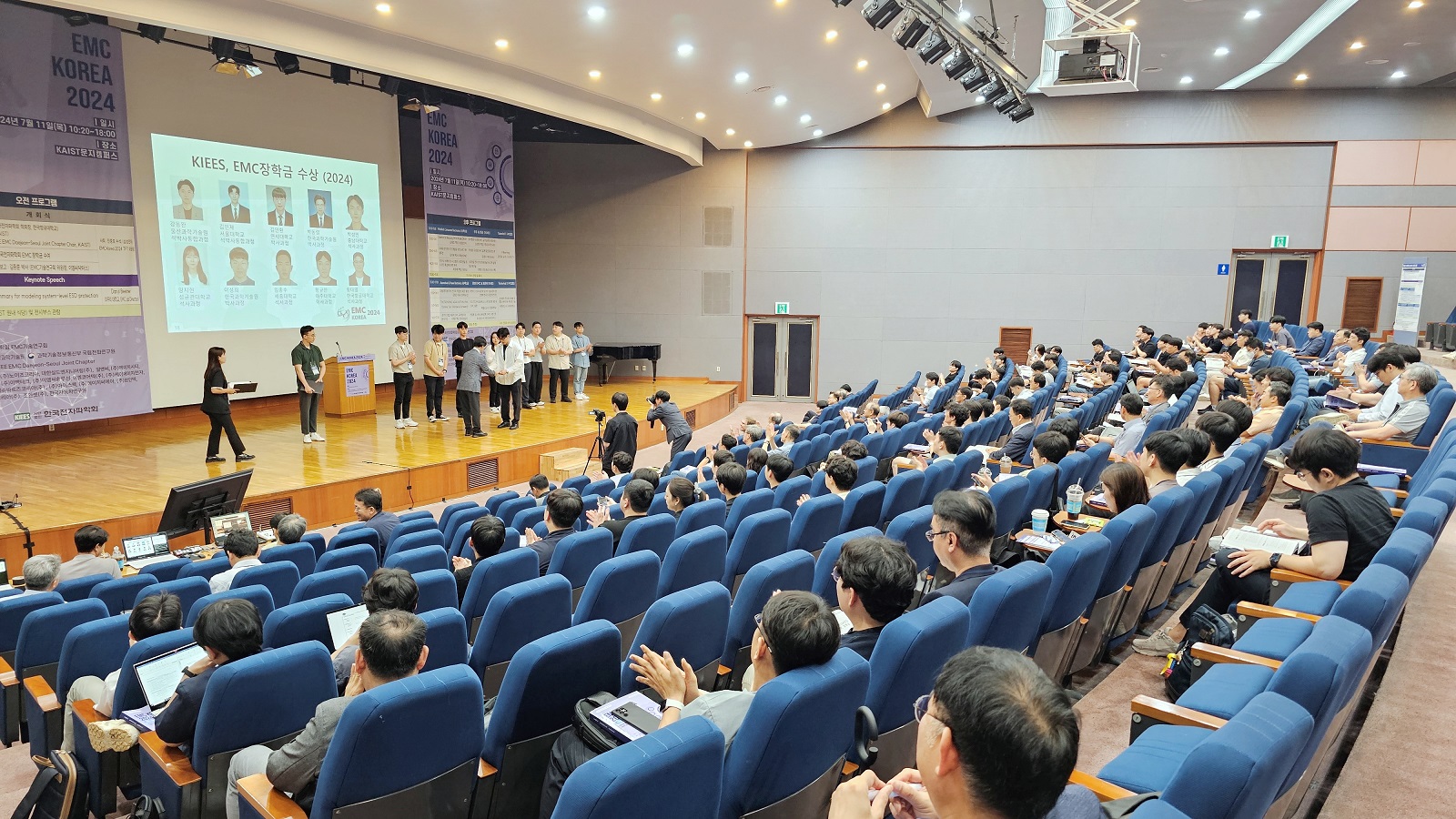
▲ Unrelated to the article content. Scholarship awards being presented to distinguished scholars researching the domestic EMC field at EMC KOREA 2024.
UNIST, EMIC's Strength in Physical Hardware
Yonsei University Specializes in National Defense with Strengths in Numerical Analysis
Sungkyunkwan University, Next-Generation Mobility Cooperation UP
EMI/EMC is essential as a key foundational technology for all electronic products, and the necessity of EMI/EMC is becoming increasingly prominent as noise in the electromagnetic environment increases due to the recent electrification of automobiles, the miniaturization of various IT devices, and the paradigm shift to 5G and 6G communication.
With the growing importance of cultivating talent to advance high-tech industries, we examined EMC laboratories at major domestic universities.
■ KAIST EMC Laboratory
The EMC laboratory at the Korea Advanced Institute of Science and Technology (KAIST) is led by Professor Seung-Young Ahn, who also serves as an adjunct professor at the Cho Chun-Sik Mobility Graduate School and the School of Electrical and Electronic Engineering at KAIST. Professor Ahn is an expert in electric vehicle wireless power transmission technology and high-speed digital system signal integrity design, and serves as the Seoul-Daejeon Chapter President of the IEEE EMC Society.
The KAIST EMC Laboratory targets the fields of EMC, SI/PI, and wireless power transfer, and conducts research in the EMC area including analysis of human exposure to EMC, EMC noise analysis, measurement and modeling of EMC components, and AI-based EMC design and analysis.
Recently, with the high integration and miniaturization of semiconductors, as well as the acceleration of chip-to-chip and chip-to-communication data transmission, semiconductor SI/PI optimization is receiving significant attention.
Accordingly, the KAIST EMC Laboratory is also conducting numerous semiconductor-related SI/PI studies, including recent research on: △calculation of Signal Integrity values based on Interposer dielectric and electrode structure characteristics (Samsung Electronics) △Signal and Power Integrity with Machine Learning (Samsung Electronics) △research on 5I (SI, PI, TI, EMI, AI) for improving the performance and reliability of semiconductors, packages, and modules (SK Hynix) △Advanced PSI Technology for Chiplet Implementation (Samsung Electronics).
■ UNIST IC&EMC Convergence Laboratory
The IC & EMC Convergence Laboratory at Ulsan National University of Science and Technology (UNIST), led by Professor Jin-Kook Kim, primarily conducts convergence research in the two fields of semiconductor circuits and electromagnetic waves, and has strengths in the research areas of semiconductor circuit, package, and system design for EMI/EMC.
The EMI/EMC ICs developed by the IC & EMC Convergence Laboratory include wafer-level packaged EMI analysis ICs, EMICs (Electromagnetic Interference Management ICs), and oscilloscopes. There are ICs, active EMI filter ICs, two types of ICs for ESD noise effect analysis and measurement, and three types of ICs for SI/PI analysis.
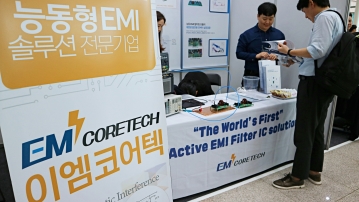
The distinguishing feature of this place is its hardware strength, such as manufacturing actual chips, and in 2018, it established EM Core Tech, a research institute-based company where Professor Jin-Gook Kim serves as co-CEO, and is introducing products such as EMIC, custom modules, EMI solutions, and EMI sensing to the market.
Major projects include semiconductor design for EMC, SI/PI, EMI/EMC, semiconductor package design, and AI-based EMC design. Recent ongoing research includes: △ research on system-level ESD noise analysis and immunity improvement (SK Hynix) △ development of active choke circuits for reducing electromagnetic noise in high-voltage motor systems (Hyundai Motor Company) △ research on 5I (SI, PI, TI, EMI, AI) to improve the performance and reliability of semiconductors, packages, and modules (SK Hynix).
■ Yonsei University ACEM Lab
Yonsei University’s ACEM laboratory, led by Professor Yuk Jong-kwan, is a research center for the field of 'Advanced Computational Electromagnetics' and combines four synergistic research fields.
It encompasses the fields of RF systems, numerical analysis, communications, and EMI/EMC, and conducts research such as RCS analysis of fighter aircraft using numerical analysis techniques, RCS reduction research using plasma, analysis of coupling phenomena induced in drones by EMP, and TEMPEST for security and signal restoration.
The characteristics of the ACEM laboratory include government research projects with the National Security Technology Research Institute, the Agency for Defense Development, and the Agency for Defense Development, as well as research achievements in the defense and defense industry sectors, such as research on the development direction of anti-drone technology and application methods for naval vessels (Hanwha Ocean) and research on performance improvement methods using high-gain radome structures (LIG Nex1).
Professor Yuk Jong-kwan, the supervising professor, is a leading domestic expert in the field of numerical electromagnetic wave analysis and is making a name for himself in the defense and security sectors. In addition, it has specialized laboratories under its umbrella, including the Aviation Detectability Reduction Technology Laboratory and the Large Stealth Platform Radio Wave Analysis Laboratory.
■ Sungkyunkwan University EMC Laboratory
The Sungkyunkwan University EMC Laboratory is led by Professor Na Wan-soo and aims to provide efficient solutions for SI/PI and EMI/EMC issues at the chip-package-PCB-hybrid vehicle system level.
Professor Na Wan-soo has been conducting research in areas such as chip-package-PCB SI/PI/EMC, integrated circuits and automotive EMI/EMS, high-frequency characteristics for electronic packaging, and high-speed digital system design. Since 1995, he has established the Sungkyunkwan University EMC Laboratory and has been training domestic and international EMC experts.
In recent research achievements, the company has produced results in carrying out research projects with major domestic companies, including the development of a noise generator with a ground isolation structure for evaluating RF immunity of Flex PCB components, research on the development of an electromagnetic immunity analysis model for electronic devices using broadband radiation interference electromagnetic waves, and the development of FET high-frequency analysis modeling techniques.
In particular, over the past five years, as next-generation mobility such as electric vehicles and smart cars has garnered attention, Professor Na has collaborated with Mando, Samwon Act, LS Automotive Technologies, and Hyundai NGV on the development of next-generation mobility electronic component technology.
Comments
Related news
.jpg)
[New Year Interview] Yook Jong-kwan, the new president of the Korean Electromagnetic Society, “Electromagnetic waves, the infrastructure of the human nervous system and blood vessels”
[Editor's Note] The new year of 2023 has dawned amid a global economic crisis. As industrial and technological competition for hegemony intensifies day by day, it is no exaggeration to say that the nation's survival depends on the development of next-generation technologies. At this critical juncture that could serve as a breakthrough for overcoming the crisis, we met with Yuk Jong-kwan, the newly appointed 25th president of the Korean Institute of Electromagnetic Engineering and Science, a cradle of technological science in Korea's electromagnetic field, to discuss the current situation.
2023.01.05by 명세환 기자
[EMI/EMC Expert Dialogue ①] Professor Kim Ji-seong: "In the evolving electromagnetic environment, it's crucial to consider EMI/EMC early in the design process."
[Editor's Note] Electromagnetic noise occurring during IT product design causes critical defects such as performance degradation and malfunctions. Recently, with the electrification of automobiles, miniaturization of various IT devices, and paradigm shifts toward 5G and 6G communications, noise in the electromagnetic environment is increasing and leading to malfunctions in various devices and systems. In response, through this planned series 'EMI/EMC Expert Dialogue,' we aim to highlight the importance of EMI and EMC countermeasures for the development of safe and highly reliable advanced IT products, and have arranged meetings with EMI/EMC specialists active across various sectors to hear the latest perspectives on these issues.
2024.05.10by 권신혁 기자
[EMI/EMC Expert Talk②] Professor Jin-Guk Kim, “Passive EMI Filters Face Limits, Active EMI Filter Semiconductor Mass Production Preparations in Progress”
[Editor's Note] Electromagnetic noise generated during IT product design causes critical defects such as product performance degradation and malfunction. Recently, electromagnetic noise in the environment has been increasing due to vehicle electrification, miniaturization of various IT devices, and paradigm shifts toward 5G and 6G communications, leading to malfunctions in various devices and systems. In response, through the planned series 'EMI/EMC Expert Dialogue,' we aim to shed light on the importance of EMI and EMC design for the development of safe and highly reliable advanced IT products, and have arranged opportunities to meet with EMI/EMC specialists active across various sectors and hear their latest insights.
2024.05.24by 권신혁 기자
[EMI/EMC Expert Talk ③] Dr. Jong-Hoon Kim, “AI-based EMC engineering, improving work efficiency... EMC KOREA 2024 opening just around the corner”
[Editor's Note] Within the continuously evolving landscape of technology trends and standardization environments, domestic EMC (Electromagnetic Compatibility) and SI/PI (Signal Integrity/Power Integrity) experts are establishing technological leadership through ongoing research and exchange. In particular, centered on the EMC Technical Research Group of the Korean Institute of Electromagnetic Engineering and Science, comprised of the nation's leading experts, there is significant contribution to the development of professional capabilities by exchanging countermeasure design and technologies that address radio wave environments such as SI/PI/EMI/EMC. Recently, we met with Dr. Kim Jong-hun of the EMC Technical Research Group, who has been busy preparing for the upcoming EMC Korea 2024, and discussed current activities and trends in EMC technology.
2024.07.09by 권신혁 기자
EMC Solutions in Mass Gathering...Visiting the EMC Korea Booth
At the recently held EMC KOREA 2024, domestic and international EMC solution companies gathered to showcase their flagship EMI/EMC products.
2024.07.15by 권신혁 기자











